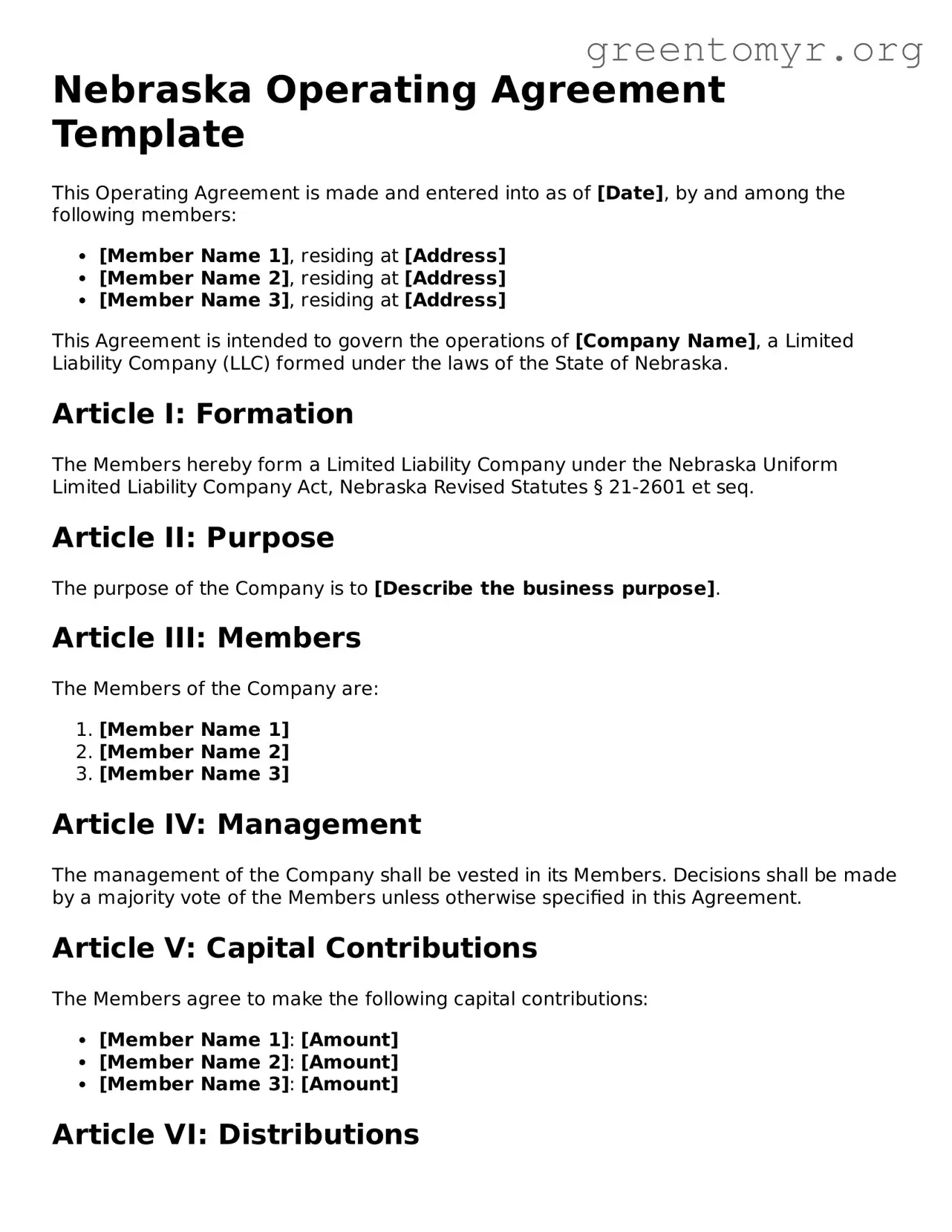
The Nebraska Operating Agreement form plays a crucial role in the management and structure of Limited Liability Companies (LLCs) within the state. This document outlines the internal workings of an LLC, detailing the rights and responsibilities of its members. It addresses key aspects such as ownership percentages, profit distribution, and decision-making processes. Members can specify how the company will be managed, whether by members themselves or designated managers. Additionally, the agreement can include provisions for adding new members, transferring ownership interests, and resolving disputes. By clearly defining these elements, the Nebraska Operating Agreement helps to prevent misunderstandings and conflicts among members, ensuring smoother operations and compliance with state laws.
Nebraska Operating Agreement Template
This Operating Agreement is made and entered into as of [Date], by and among the following members:
This Agreement is intended to govern the operations of [Company Name], a Limited Liability Company (LLC) formed under the laws of the State of Nebraska.
Article I: Formation
The Members hereby form a Limited Liability Company under the Nebraska Uniform Limited Liability Company Act, Nebraska Revised Statutes § 21-2601 et seq.
Article II: Purpose
The purpose of the Company is to [Describe the business purpose].
Article III: Members
The Members of the Company are:
Article IV: Management
The management of the Company shall be vested in its Members. Decisions shall be made by a majority vote of the Members unless otherwise specified in this Agreement.
Article V: Capital Contributions
The Members agree to make the following capital contributions:
Article VI: Distributions
Distributions of profits and losses shall be allocated to the Members in proportion to their respective capital contributions.
Article VII: Amendments
This Agreement may be amended only by a written agreement signed by all Members.
Article VIII: Governing Law
This Agreement shall be governed by and construed in accordance with the laws of the State of Nebraska.
Signatures
By signing below, the Members agree to the terms of this Operating Agreement:
_________________________ [Member Name 1] Date: ___________
_________________________ [Member Name 2] Date: ___________
_________________________ [Member Name 3] Date: ___________
| Fact Name | Description |
|---|---|
| Purpose | The Nebraska Operating Agreement form outlines the management structure and operational procedures for a limited liability company (LLC) in Nebraska. |
| Governing Law | This form is governed by the Nebraska Revised Statutes, specifically Chapter 21, which pertains to limited liability companies. |
| Members' Rights | The agreement defines the rights and responsibilities of members, including voting rights and profit distribution. |
| Flexibility | Members have the flexibility to customize the agreement to suit their specific business needs, as long as it complies with state law. |
| Filing Requirement | While the Operating Agreement itself does not need to be filed with the state, it is essential for internal governance and may be requested by banks or investors. |
| Amendments | The Operating Agreement can be amended as needed, provided that the amendment process is clearly outlined within the document. |
Once you have the Nebraska Operating Agreement form, it is essential to ensure that all sections are completed accurately. This document is crucial for outlining the management structure and operational procedures of your business. Follow these steps carefully to fill out the form correctly.
A Nebraska Operating Agreement is a legal document that outlines the management structure and operational procedures of a limited liability company (LLC) in Nebraska. This agreement serves as a foundational blueprint for how the business will be run, detailing the roles and responsibilities of members, decision-making processes, and distribution of profits.
Having an Operating Agreement is essential for several reasons:
While Nebraska law does not mandate that LLCs have an Operating Agreement, it is highly recommended. Without one, the LLC will default to the state’s rules, which may not align with the members’ intentions or preferences. Having a tailored agreement can better reflect the unique needs of the business.
A comprehensive Operating Agreement typically includes the following elements:
Yes, an Operating Agreement can be modified at any time, provided that all members agree to the changes. It’s advisable to document any amendments in writing and have all members sign the updated agreement to ensure clarity and legal validity.
Creating an Operating Agreement can be straightforward. Here are some steps to consider:
While it’s not legally required to hire a lawyer to draft your Operating Agreement, consulting with one can be beneficial. An attorney can help ensure that the agreement complies with state laws and addresses specific concerns unique to your business. If you choose to draft it yourself, consider using templates or guides to ensure you cover all essential aspects.
An Operating Agreement itself does not directly affect how your LLC is taxed. However, it can influence how profits and losses are allocated among members, which can impact each member's individual tax obligations. By clearly outlining these details, members can better understand their tax responsibilities.
Templates for Nebraska Operating Agreements can be found online through various legal websites, business formation services, or state resources. While using a template can be a helpful starting point, it’s important to customize it to fit the specific needs of your LLC and ensure compliance with Nebraska laws.
Filling out the Nebraska Operating Agreement form is a crucial step for anyone looking to establish a limited liability company (LLC) in the state. However, many individuals make common mistakes that can lead to complications down the road. One frequent error is not including all members in the agreement. Every member of the LLC should be listed to ensure that their rights and responsibilities are clearly defined.
Another mistake is failing to specify the management structure. Some people assume that the default management structure will suffice, but it’s important to clarify whether the LLC will be member-managed or manager-managed. This distinction can affect how decisions are made and who has authority within the company.
Additionally, neglecting to outline the financial arrangements can create confusion later. It’s essential to detail how profits and losses will be distributed among members. Without this information, members may have different expectations, leading to disputes.
Many individuals also overlook the importance of including a buy-sell agreement. This provision can protect the interests of remaining members in the event that one member decides to leave the company or pass away. A well-drafted buy-sell agreement can help prevent future conflicts and ensure a smooth transition.
Another common oversight is not updating the agreement as circumstances change. Life events, such as the addition of new members or changes in ownership, should prompt a review and possible revision of the Operating Agreement. Keeping the document current is vital for maintaining clarity and legal compliance.
Some people may also forget to address how disputes will be resolved. Including a section on dispute resolution methods, such as mediation or arbitration, can save time and money in the event of a disagreement among members.
Furthermore, not specifying the duration of the LLC can lead to misunderstandings. While many LLCs are intended to exist indefinitely, stating a specific duration can provide clarity and help manage expectations among members.
Another mistake is failing to include the necessary signatures. An Operating Agreement is not just a formality; it requires the signatures of all members to be legally binding. Without these signatures, the agreement may not hold up in a legal context.
Lastly, people often neglect to consult with a legal professional. While it may seem straightforward, having a legal expert review the Operating Agreement can help identify potential issues and ensure that it meets all state requirements. Taking this step can save time and prevent costly mistakes in the future.
The Nebraska Operating Agreement is a crucial document for LLCs in Nebraska, outlining the management structure and operational procedures. However, several other forms and documents are often used in conjunction with the Operating Agreement to ensure compliance and facilitate smooth business operations. Below is a list of these documents, along with brief descriptions of each.
Utilizing these documents alongside the Nebraska Operating Agreement can enhance the clarity and effectiveness of an LLC's operations. Each form plays a specific role in ensuring that the business runs smoothly and remains compliant with state laws.
When filling out the Nebraska Operating Agreement form, it is important to follow certain guidelines to ensure accuracy and compliance. Here are four things to do and four things to avoid:
Things You Should Do:
Things You Shouldn't Do:
Many people have misunderstandings about the Nebraska Operating Agreement form. Here are four common misconceptions:
When filling out and using the Nebraska Operating Agreement form, it is essential to keep several key points in mind. Understanding these can help ensure that the document serves its intended purpose effectively.