In Nebraska, the Power of Attorney for a Child form serves as a vital tool for parents and guardians seeking to delegate specific responsibilities for the care and welfare of their children. This legal document allows a parent to appoint another individual, often a relative or trusted friend, to make decisions on behalf of their child in their absence. It covers various aspects, including medical care, education, and general well-being, ensuring that the child’s needs are met even when the parent cannot be present. By establishing clear authority, this form helps to maintain continuity in a child's life during times of transition, such as travel or emergencies. Understanding the nuances of this form is essential for any parent looking to safeguard their child's interests while providing peace of mind that their loved one will be cared for appropriately. It is important to complete the form accurately and consider the implications of the authority granted, as this will shape the child's experience during the designated period.
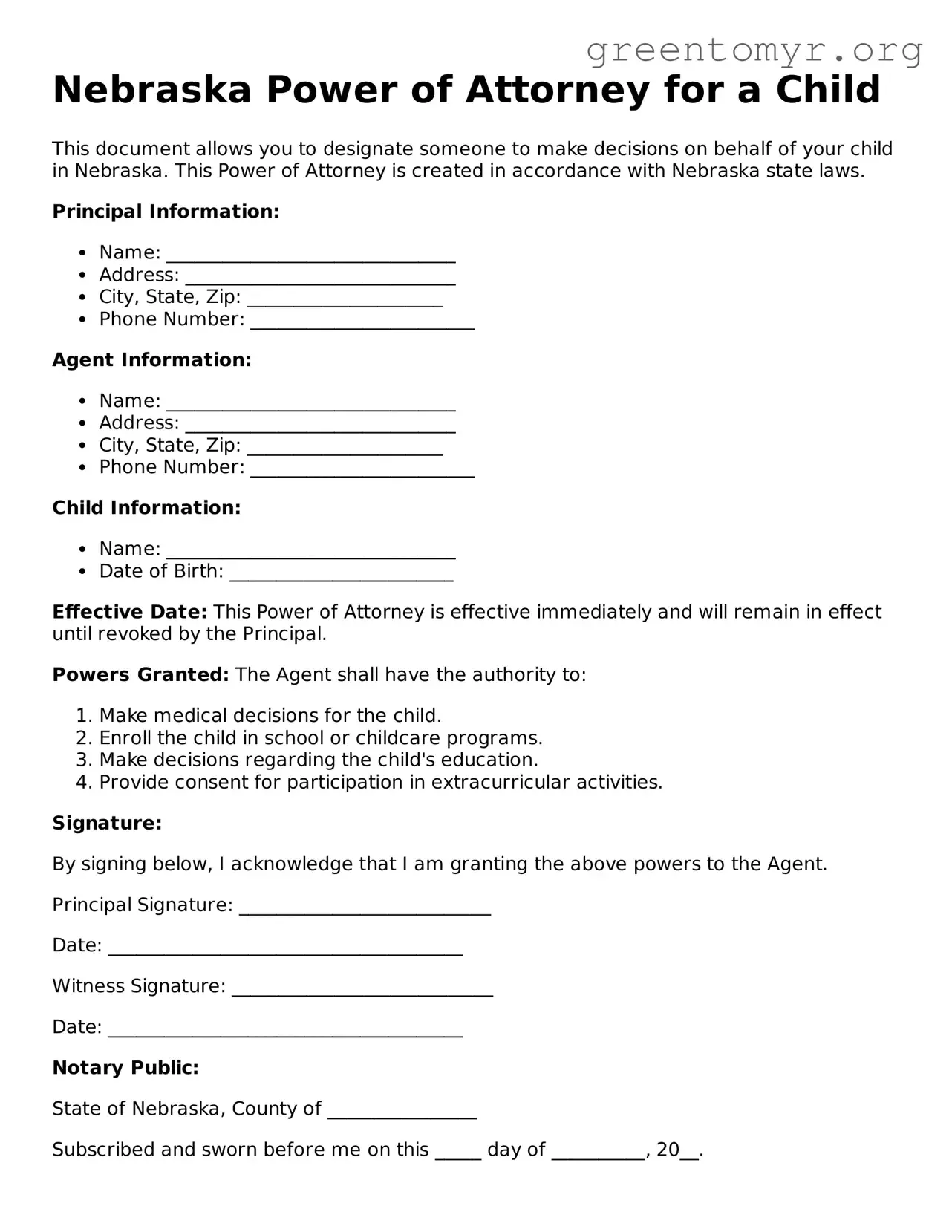
Nebraska Power of Attorney for a Child
This document allows you to designate someone to make decisions on behalf of your child in Nebraska. This Power of Attorney is created in accordance with Nebraska state laws.
Principal Information:
Agent Information:
Child Information:
Effective Date: This Power of Attorney is effective immediately and will remain in effect until revoked by the Principal.
Powers Granted: The Agent shall have the authority to:
Signature:
By signing below, I acknowledge that I am granting the above powers to the Agent.
Principal Signature: ___________________________
Date: ______________________________________
Witness Signature: ____________________________
Date: ______________________________________
Notary Public:
State of Nebraska, County of ________________
Subscribed and sworn before me on this _____ day of __________, 20__.
Notary Public Signature: ______________________
My Commission Expires: ______________________
| Fact Name | Details |
|---|---|
| Purpose | The Nebraska Power of Attorney for a Child form allows a parent or guardian to designate another adult to make decisions for their child in their absence. |
| Duration | This power of attorney can be effective for a specified period, typically up to 60 days, unless revoked earlier. |
| Governing Law | This form is governed by Nebraska Revised Statutes, specifically Section 43-247. |
| Who Can Be an Agent | The designated agent must be an adult, capable of making decisions in the best interest of the child. |
| Revocation | A parent or guardian can revoke the power of attorney at any time, provided they notify the agent in writing. |
Filling out the Nebraska Power of Attorney for a Child form is an important step for parents or guardians who wish to grant temporary authority to another adult. This process ensures that a designated individual can make decisions regarding the child’s care and welfare when the parent or guardian is unavailable. Follow the steps below to complete the form accurately.
After filling out the form, ensure that the designated individual understands their responsibilities and the extent of their authority. This preparation can help facilitate smooth decision-making regarding the child's needs.
A Power of Attorney for a Child in Nebraska allows a parent or legal guardian to appoint another adult to make decisions on behalf of their child. This can include decisions related to education, healthcare, and general welfare.
Any responsible adult can be appointed as an agent. This could be a relative, friend, or trusted neighbor. It is important to choose someone who understands the child's needs and can act in their best interest.
The agent can make various decisions, including:
However, the agent cannot make decisions that require parental consent unless specified in the document.
The Power of Attorney for a Child is generally effective until the specified expiration date in the document or until the parent or guardian revokes it. If no expiration date is provided, it typically lasts until the child turns 19 years old.
Yes, the Power of Attorney for a Child must be signed in the presence of a notary public. This ensures that the document is legally valid and can be recognized by schools, healthcare providers, and other institutions.
Yes, you can revoke the Power of Attorney at any time. To do so, you should provide written notice to the agent and any relevant parties, such as schools or healthcare providers.
No, a Power of Attorney is not the same as guardianship. Guardianship is a legal process that grants someone permanent authority over a child’s care, while a Power of Attorney is typically temporary and can be revoked at any time.
If the child has special needs, it is crucial to choose an agent who understands their unique requirements. The Power of Attorney can be tailored to specify any special considerations or medical needs that the agent should be aware of.
The form can be obtained from various sources, including legal aid organizations, family law attorneys, or online legal resources. Ensure that you are using the most current version to meet Nebraska's legal requirements.
After completing the form, make sure to sign it in front of a notary public. Provide copies to the appointed agent, relevant family members, and any institutions that may need it, such as schools or healthcare providers.
When filling out the Nebraska Power of Attorney for a Child form, individuals often make several common mistakes that can lead to complications. One frequent error is failing to provide complete information. Each section of the form must be filled out accurately. Incomplete forms may be rejected or cause delays in the legal process.
Another mistake is neglecting to sign the document. Both the parent or guardian granting the power and the designated agent must provide their signatures. Without these signatures, the form lacks legal validity, rendering it ineffective.
Individuals sometimes overlook the importance of specifying the duration of the power of attorney. It is essential to indicate how long the authority is granted. If no time frame is specified, it may lead to confusion regarding when the power of attorney is active and when it expires.
Additionally, people may forget to include the necessary witnesses. Nebraska law requires that the form be signed in the presence of two witnesses or a notary public. Failing to meet this requirement can invalidate the document.
Some individuals also mistakenly assume that the Power of Attorney for a Child form can be used for all types of decisions. It is crucial to understand that this form typically grants authority for specific areas, such as medical or educational decisions. Misusing the form can lead to misunderstandings and potential legal issues.
Another common error is not keeping a copy of the completed form. After filling out the document, it is advisable to retain a copy for personal records. This ensures that all parties involved have access to the same information and can refer to it as needed.
People often fail to communicate with the child about the arrangement. It is important to discuss the situation with the child, ensuring they understand who will be responsible for their care and what that entails. This can help ease any anxiety the child may have regarding the change in guardianship.
Lastly, individuals sometimes do not review the form for accuracy after completion. Double-checking all entries can help catch any mistakes before submission. Taking the time to review the document can prevent unnecessary complications in the future.
When considering the Nebraska Power of Attorney for a Child form, it's essential to understand that several other documents may complement it. These documents can help clarify roles and responsibilities, ensuring that the best interests of the child are prioritized. Below is a list of commonly used forms and documents that often accompany the Power of Attorney for a Child.
Utilizing these documents alongside the Nebraska Power of Attorney for a Child can help create a comprehensive plan for the child's care. Ensuring that all necessary forms are in place is crucial for smooth transitions and the child's well-being.
The Power of Attorney for a Child form allows a parent or guardian to grant someone else the authority to make decisions on behalf of their child. This document is similar to several other legal documents that also grant decision-making powers or responsibilities. Here are seven documents that share similarities with the Power of Attorney for a Child:
When filling out the Nebraska Power of Attorney for a Child form, it is crucial to approach the task with care. The decisions made in this process can significantly impact the well-being of a child. Here are some essential guidelines to follow:
Additionally, consider these points as you prepare the form:
By adhering to these guidelines, you can help ensure that the Power of Attorney for a Child form serves its intended purpose effectively and responsibly.
Many individuals have misunderstandings regarding the Nebraska Power of Attorney for a Child form. Below are seven common misconceptions that need clarification.
This is incorrect. The Power of Attorney for a Child can authorize a designated individual to make various decisions, including educational and legal matters, not just medical ones.
Contrary to popular belief, this form does not need to be filed with the court. It is a private document that should be kept in a safe place, accessible when needed.
This misconception is false. The Power of Attorney can be revoked at any time by the parent or guardian, provided they do so in writing.
While parents typically initiate this process, legal guardians and other authorized individuals may also create a Power of Attorney for a child.
This is misleading. While the Nebraska Power of Attorney for a Child is valid in Nebraska, it may also be recognized in other states, depending on local laws.
This is not entirely accurate. Although notarization is not always required, having the document notarized can add an extra layer of authenticity and may be necessary for certain situations.
This is a common misunderstanding. The Power of Attorney for a Child is intended for specific children named in the document, typically those for whom the parent or guardian has legal authority.
Understanding these misconceptions is crucial for ensuring that the Power of Attorney for a Child is used effectively and appropriately.
When filling out and using the Nebraska Power of Attorney for a Child form, consider the following key takeaways: