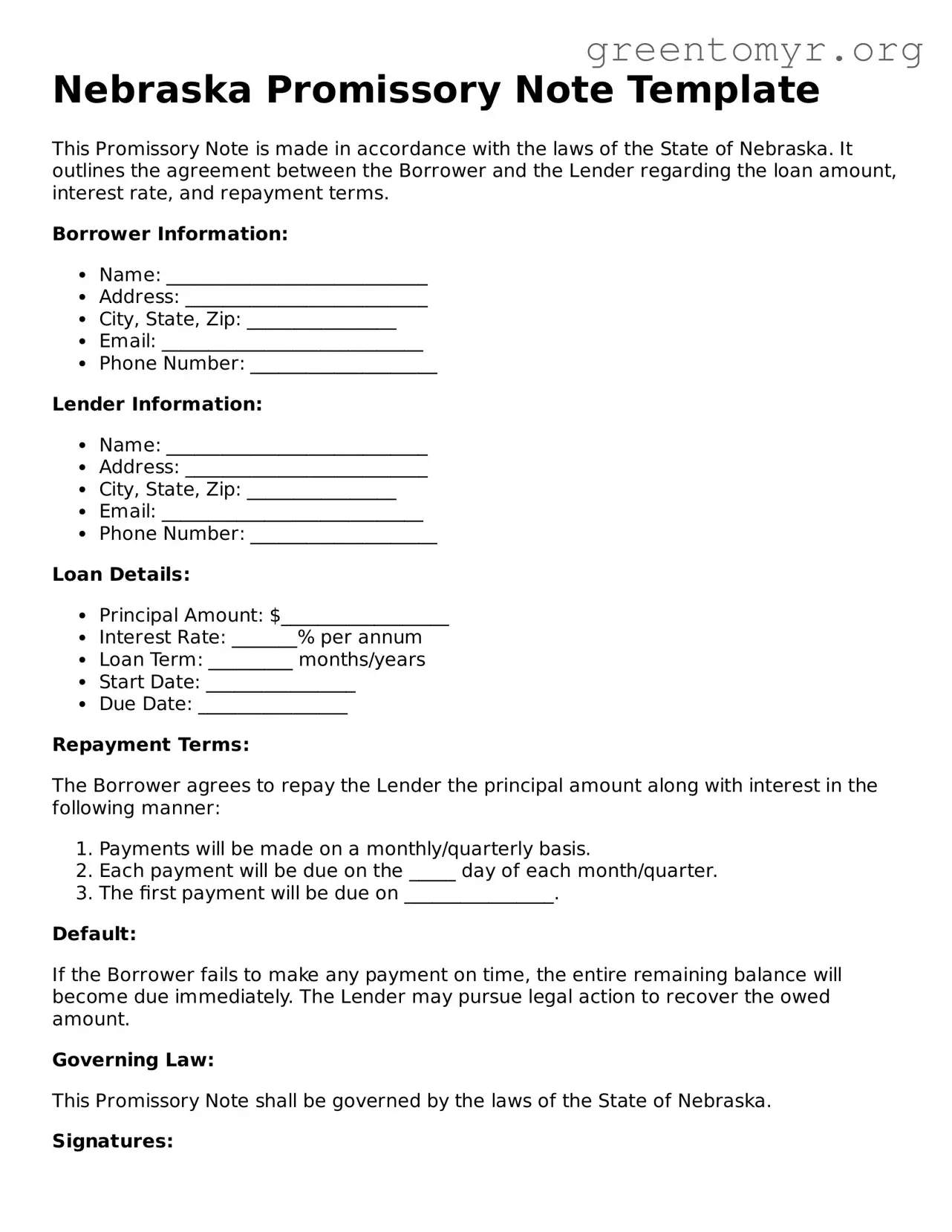
The Nebraska Promissory Note form serves as a crucial legal instrument in the realm of personal and commercial lending. It outlines the borrower's commitment to repay a specified sum of money to the lender, including details such as the interest rate, repayment schedule, and any applicable fees. This document not only provides clarity on the terms of the loan but also establishes the rights and responsibilities of both parties involved. In Nebraska, the form must comply with state regulations to ensure enforceability, making it essential for individuals and businesses to understand its components. Key elements include the principal amount, the maturity date, and the signatures of both the borrower and the lender. Properly executed, this form can prevent disputes and facilitate a smooth lending process.
Nebraska Promissory Note Template
This Promissory Note is made in accordance with the laws of the State of Nebraska. It outlines the agreement between the Borrower and the Lender regarding the loan amount, interest rate, and repayment terms.
Borrower Information:
Lender Information:
Loan Details:
Repayment Terms:
The Borrower agrees to repay the Lender the principal amount along with interest in the following manner:
Default:
If the Borrower fails to make any payment on time, the entire remaining balance will become due immediately. The Lender may pursue legal action to recover the owed amount.
Governing Law:
This Promissory Note shall be governed by the laws of the State of Nebraska.
Signatures:
By signing below, both parties agree to the terms outlined in this Promissory Note.
_____________________________
Borrower Signature
Date: ________________
_____________________________
Lender Signature
Date: ________________
| Fact Name | Description |
|---|---|
| Definition | A Nebraska Promissory Note is a written promise to pay a specified amount of money to a designated person or entity at a specified time. |
| Governing Law | The Nebraska Promissory Note is governed by the Nebraska Uniform Commercial Code (UCC), specifically Article 3, which deals with negotiable instruments. |
| Parties Involved | The document involves two primary parties: the maker (the person promising to pay) and the payee (the person receiving the payment). |
| Interest Rate | The note can specify an interest rate. If not stated, Nebraska law allows for a default rate of interest, which is typically set by statute. |
| Payment Terms | Payment terms can be flexible. The note can outline whether payments are due in installments or as a lump sum at maturity. |
| Signature Requirement | For the note to be legally binding, it must be signed by the maker. This signature indicates the maker's agreement to the terms outlined in the note. |
| Enforceability | A properly executed Nebraska Promissory Note is enforceable in court, meaning the payee can seek legal remedies if the maker defaults on payment. |
After obtaining the Nebraska Promissory Note form, it's essential to fill it out accurately. This document will require specific information about the loan agreement between the borrower and the lender. Once completed, ensure to keep a copy for your records and provide the original to the other party involved.
A Nebraska Promissory Note is a legal document in which one party (the borrower) agrees to pay a specific amount of money to another party (the lender) at a designated time or on demand. This note outlines the terms of the loan, including the principal amount, interest rate, repayment schedule, and any other relevant conditions. It serves as a written promise to repay the borrowed funds, providing legal protection for both parties involved.
A Nebraska Promissory Note generally includes the following key information:
Yes, a Nebraska Promissory Note is legally binding once it is signed by both parties. This means that if the borrower fails to repay the loan according to the agreed terms, the lender has the right to take legal action to recover the owed amount. It is important for both parties to understand the terms outlined in the note before signing, as it creates enforceable obligations.
Yes, a Nebraska Promissory Note can be modified after it is signed, but both parties must agree to the changes. It is advisable to document any modifications in writing, and both parties should sign the amended note to ensure clarity and legal validity. This helps prevent misunderstandings and provides a clear record of the new terms.
If you lose your Nebraska Promissory Note, it is important to take action promptly. Here are steps to consider:
Filling out a Nebraska Promissory Note form requires attention to detail. One common mistake is failing to include the correct names of the parties involved. This form serves as a legal contract, and any inaccuracies in names can lead to complications in enforcement. Always double-check that the names of both the lender and borrower are spelled correctly and match their legal documents.
Another frequent error is neglecting to specify the loan amount. The total amount borrowed should be clearly stated in both numerical and written form. Omitting this crucial detail can create confusion and disputes down the line. Make sure to write the amount clearly to avoid misunderstandings.
People often overlook the interest rate. If applicable, the interest rate must be explicitly mentioned. Failing to include this information can lead to legal issues, especially if the loan is subject to state regulations regarding interest rates. Ensure that the rate is clearly defined and complies with Nebraska laws.
Additionally, individuals sometimes forget to outline the repayment schedule. This schedule should detail how and when payments will be made. Without a clear repayment plan, borrowers may struggle to meet their obligations, and lenders may face challenges in collecting payments. Clearly stating the payment intervals can prevent future conflicts.
Another mistake is not signing the document. Both the lender and borrower must sign the Promissory Note for it to be legally binding. Failing to include signatures can render the note unenforceable. Always ensure that both parties have signed and dated the document.
Some individuals fail to have the document witnessed or notarized when required. While Nebraska does not mandate notarization for all Promissory Notes, having a witness can provide additional legal protection. Consider whether notarization or witnessing is appropriate for your situation.
Lastly, people often neglect to keep copies of the signed Promissory Note. After filling out the form, it is essential to retain a copy for personal records. This serves as proof of the agreement and can be vital if disputes arise in the future. Always make copies before distributing the original document.
When entering into a financial agreement, such as a loan, it is essential to have a variety of supporting documents to ensure clarity and protection for all parties involved. In the context of a Nebraska Promissory Note, several other forms and documents are often utilized. Each serves a specific purpose in the transaction, enhancing the overall understanding and enforceability of the agreement.
Incorporating these documents alongside the Nebraska Promissory Note can provide a more comprehensive framework for the lending relationship. Each form plays a critical role in protecting the interests of both the borrower and the lender, ensuring that all parties are aware of their rights and responsibilities throughout the loan process.
Loan Agreement: A loan agreement outlines the terms of a loan, similar to a promissory note. Both documents specify the amount borrowed, interest rates, and repayment terms.
Mortgage: A mortgage is a specific type of loan secured by real property. Like a promissory note, it details the borrower's obligation to repay the borrowed amount.
Lease Agreement: In a lease agreement, one party agrees to pay for the use of property owned by another. This document often includes payment terms, much like a promissory note does for loans.
Personal Guarantee: A personal guarantee involves an individual agreeing to repay a debt if the primary borrower defaults. It shares similarities with a promissory note in that it creates a personal obligation to pay.
Credit Agreement: A credit agreement outlines the terms under which credit is extended. Similar to a promissory note, it specifies repayment terms and conditions for borrowing.
Installment Agreement: An installment agreement allows for payments to be made over time. This document functions like a promissory note by detailing the repayment schedule.
Subordination Agreement: A subordination agreement establishes the priority of claims in the event of default. It relates to a promissory note by clarifying the order of repayment.
Debt Settlement Agreement: This agreement outlines terms for settling a debt for less than the full amount owed. It shares common elements with a promissory note, as both involve the resolution of a financial obligation.
Security Agreement: A security agreement provides collateral for a loan. It is similar to a promissory note in that it details the borrower's obligations and the lender's rights.
Forbearance Agreement: A forbearance agreement allows a borrower to temporarily reduce or pause payments. Like a promissory note, it formalizes the terms and conditions of the repayment arrangement.
When filling out the Nebraska Promissory Note form, it's essential to approach the task with care. Here are six important do's and don'ts to keep in mind:
By following these guidelines, you can ensure that your Nebraska Promissory Note form is completed correctly and efficiently.
Here are some common misconceptions about the Nebraska Promissory Note form:
When dealing with a Nebraska Promissory Note, understanding its components and implications is crucial. Here are some key takeaways to consider:
By paying attention to these aspects, individuals can effectively navigate the process of creating and utilizing a Nebraska Promissory Note.