The Nebraska Quitclaim Deed form serves as a vital tool in real estate transactions, particularly when it comes to transferring property ownership without the complexities of a warranty deed. This straightforward document allows one party, known as the grantor, to convey their interest in a property to another party, called the grantee. Unlike other deed types, a quitclaim deed does not guarantee that the grantor holds clear title to the property, which means it’s essential for both parties to understand the implications of this transfer. Typically used in situations such as divorce settlements, estate settlements, or transferring property between family members, the quitclaim deed is often favored for its simplicity and speed. In Nebraska, specific requirements must be met for the deed to be legally binding, including the need for proper signatures and notarization. By understanding the key components and uses of the Nebraska Quitclaim Deed, individuals can navigate property transfers with greater confidence and clarity.
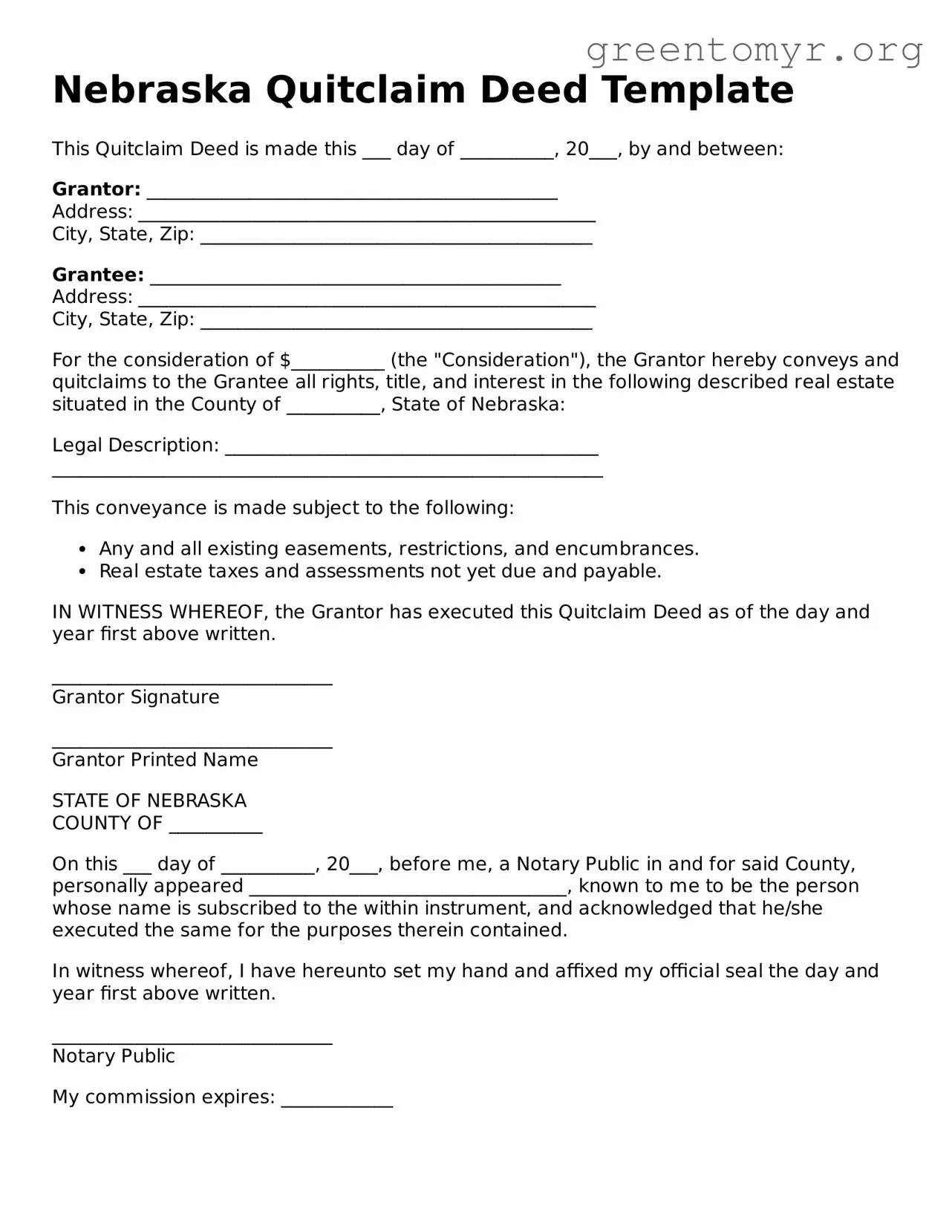
Nebraska Quitclaim Deed Template
This Quitclaim Deed is made this ___ day of __________, 20___, by and between:
Grantor: ____________________________________________
Address: _________________________________________________
City, State, Zip: __________________________________________
Grantee: ____________________________________________
Address: _________________________________________________
City, State, Zip: __________________________________________
For the consideration of $__________ (the "Consideration"), the Grantor hereby conveys and quitclaims to the Grantee all rights, title, and interest in the following described real estate situated in the County of __________, State of Nebraska:
Legal Description: ________________________________________
___________________________________________________________
This conveyance is made subject to the following:
IN WITNESS WHEREOF, the Grantor has executed this Quitclaim Deed as of the day and year first above written.
______________________________
Grantor Signature
______________________________
Grantor Printed Name
STATE OF NEBRASKA
COUNTY OF __________
On this ___ day of __________, 20___, before me, a Notary Public in and for said County, personally appeared __________________________________, known to me to be the person whose name is subscribed to the within instrument, and acknowledged that he/she executed the same for the purposes therein contained.
In witness whereof, I have hereunto set my hand and affixed my official seal the day and year first above written.
______________________________
Notary Public
My commission expires: ____________
| Fact Name | Details |
|---|---|
| Definition | A Quitclaim Deed in Nebraska is a legal document used to transfer ownership of real estate from one party to another without any warranties about the title. |
| Governing Law | The use and requirements for Quitclaim Deeds in Nebraska are governed by Nebraska Revised Statutes, specifically Chapter 76. |
| Execution Requirements | In Nebraska, a Quitclaim Deed must be signed by the grantor (the person transferring the property) and notarized to be valid. |
| Filing | Once executed, the Quitclaim Deed must be filed with the county register of deeds in the county where the property is located to provide public notice of the transfer. |
Once you have the Nebraska Quitclaim Deed form, the next step is to complete it accurately. This form requires specific information about the property and the parties involved. After filling it out, you will need to have it signed and notarized before filing it with the appropriate county office.
A Quitclaim Deed is a legal document used to transfer ownership of real estate from one party to another. In Nebraska, it allows the grantor (the person transferring the property) to convey their interest in the property to the grantee (the person receiving the property) without making any guarantees about the title. This means that the grantor does not assure the grantee that the title is clear of any liens or encumbrances.
Quitclaim Deeds are often used in specific situations, including:
To complete a Quitclaim Deed in Nebraska, follow these steps:
No, a Quitclaim Deed is not the same as a Warranty Deed. A Warranty Deed provides a guarantee that the title is clear and free of any claims or liens. In contrast, a Quitclaim Deed transfers whatever interest the grantor has in the property without any warranties. This makes Quitclaim Deeds riskier for the grantee, as they may inherit existing issues with the title.
While it is not legally required to have an attorney draft a Quitclaim Deed, it can be beneficial. An attorney can help ensure that the document is completed correctly and meets all legal requirements. If you are unsure about the process or have complex property issues, consulting with an attorney is advisable.
Yes, there are typically fees associated with filing a Quitclaim Deed in Nebraska. These fees vary by county and may include recording fees and possibly transfer taxes. It is recommended to check with the local county clerk or register of deeds for specific fee information before filing.
Filling out a Quitclaim Deed form in Nebraska can be straightforward, but many people make common mistakes that can lead to complications down the line. One frequent error is not including the correct names of the parties involved. It’s essential to ensure that the grantor (the person transferring the property) and the grantee (the person receiving the property) are accurately identified. Any misspellings or omissions can create confusion and may even invalidate the deed.
Another common mistake is failing to provide a complete legal description of the property. The legal description should clearly define the boundaries and location of the property being transferred. Relying on a simple address may not suffice, as it doesn’t offer the necessary detail to pinpoint the property accurately.
People often overlook the need for signatures. Both the grantor and, in some cases, the grantee must sign the deed. If the necessary signatures are missing, the deed may not be recognized as valid. Additionally, witnesses may be required in some situations, depending on local regulations, so it’s important to check those requirements before submitting the form.
Another mistake occurs when individuals forget to date the deed. A missing date can lead to questions about when the transfer actually took place, which could complicate matters if disputes arise later. Always ensure that the date is clearly marked on the document.
Not having the deed notarized is a significant oversight. In Nebraska, a Quitclaim Deed must be notarized to be legally binding. This step adds an extra layer of authenticity to the document and helps prevent fraud.
Some people fail to pay attention to the recording requirements. After filling out the Quitclaim Deed, it must be filed with the appropriate county office. Neglecting this step means the transfer of property may not be recognized publicly, which can lead to issues if the property is sold or transferred again in the future.
Finally, individuals sometimes forget to check for any outstanding liens or encumbrances on the property. It’s crucial to ensure that the property is free of any legal claims that could affect the new owner’s rights. Failing to address this can lead to unexpected financial burdens for the grantee.
A Quitclaim Deed is a legal document used to transfer ownership of property. In Nebraska, this form may often be used in conjunction with other documents to ensure a smooth property transfer process. Below is a list of additional forms and documents that are commonly associated with a Quitclaim Deed.
Using these forms in conjunction with a Quitclaim Deed can facilitate a clearer and more secure property transfer process. Each document serves a specific purpose, contributing to the overall legality and transparency of the transaction.
The Quitclaim Deed is a unique document used primarily to transfer ownership of real estate. However, several other documents share similar purposes or characteristics. Here’s a look at five such documents:
Understanding these documents is crucial for anyone involved in real estate transactions. Each serves a specific purpose and carries different implications for ownership rights and responsibilities. Always consider seeking professional guidance to navigate these important legal tools effectively.
When filling out the Nebraska Quitclaim Deed form, it is important to be careful and thorough. Here is a list of things you should and shouldn't do:
Understanding the Nebraska Quitclaim Deed form is essential for property transactions. However, several misconceptions can lead to confusion. Below is a list of ten common misconceptions, along with clarifications.
This is not entirely accurate. A Quitclaim Deed transfers whatever interest the grantor has in the property, but it does not guarantee that the grantor has full ownership or clear title.
While often used in family transactions, Quitclaim Deeds can be utilized in any situation where the parties agree, including sales between strangers or business transactions.
This is a common misunderstanding. A Warranty Deed provides guarantees about the title, while a Quitclaim Deed does not offer any warranties regarding ownership or encumbrances.
In addition to property transfers, Quitclaim Deeds can be used to clear up title issues, such as removing a spouse’s name after a divorce.
While a Quitclaim Deed is generally irrevocable once recorded, it can be challenged in court if fraud or coercion is proven.
Each state has its own requirements and format for Quitclaim Deeds. It is important to use the specific form that complies with Nebraska laws.
This is misleading. A Quitclaim Deed does not remove existing liens or encumbrances; those remain attached to the property even after the transfer.
In Nebraska, notarization is typically required for a Quitclaim Deed to be valid and enforceable.
In fact, Quitclaim Deeds can be used for any type of property, including commercial real estate and vacant land.
This is not true. While some transfers may not incur taxes, others could trigger tax liabilities, depending on the circumstances of the transfer.
By understanding these misconceptions, individuals can make informed decisions when using the Nebraska Quitclaim Deed form.
When dealing with the Nebraska Quitclaim Deed form, it's important to keep several key points in mind. Here are some takeaways that can help you navigate the process smoothly: