In Nebraska, the Small Estate Affidavit serves as a valuable tool for individuals dealing with the estate of a deceased person when the total value of the estate falls below a specific threshold. This form simplifies the process of transferring assets without the need for formal probate proceedings, which can often be lengthy and costly. By using the Small Estate Affidavit, heirs or beneficiaries can claim property, such as bank accounts or personal belongings, directly from financial institutions or other entities. The affidavit must be completed accurately and typically requires the signature of the affiant, who is usually a close relative or a designated representative of the deceased. Additionally, the form includes essential information about the deceased, the estate, and the relationship of the affiant to the deceased, ensuring that all necessary details are documented for the transfer of assets. Understanding the requirements and implications of this affidavit can help streamline the process of settling an estate, making it easier for loved ones to manage their affairs during a challenging time.
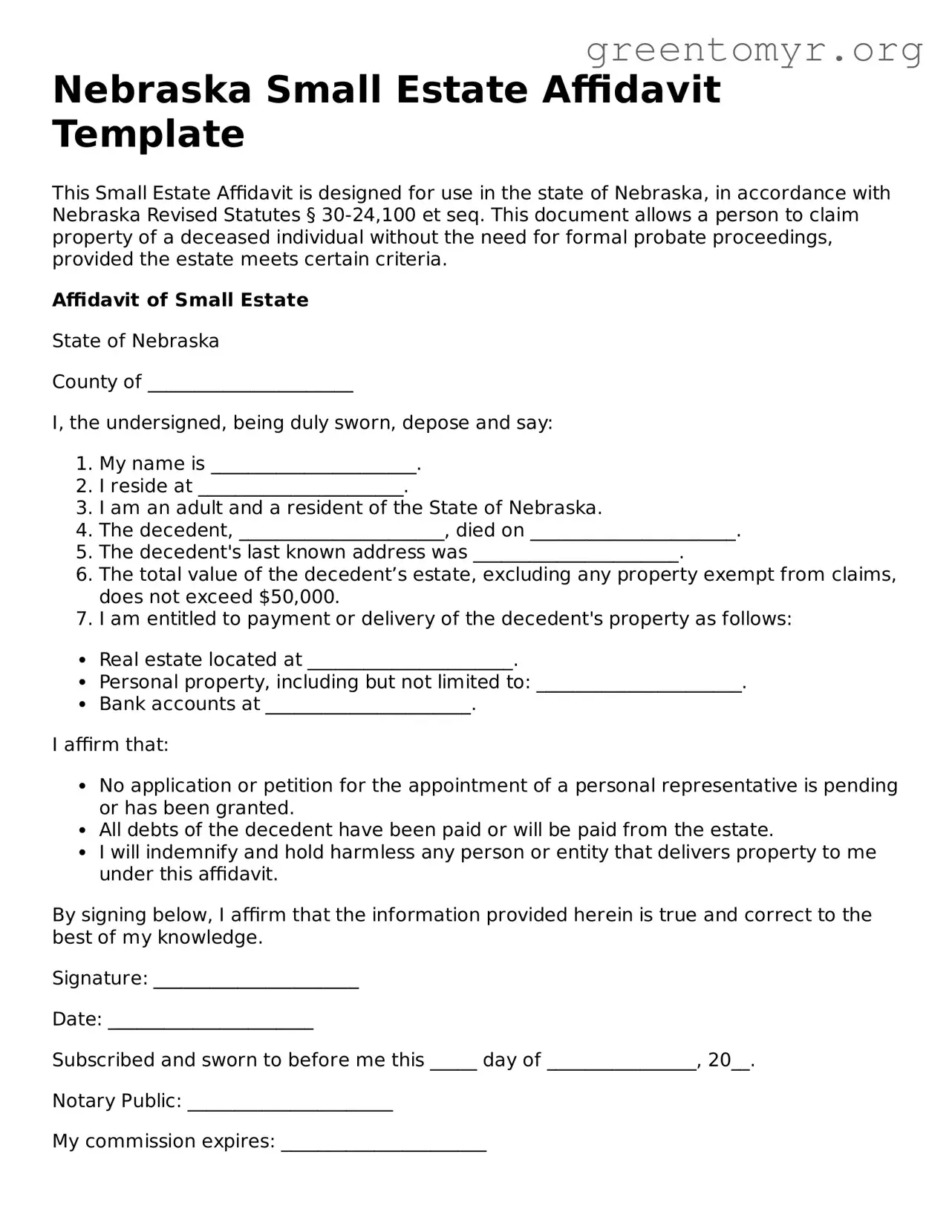
Nebraska Small Estate Affidavit Template
This Small Estate Affidavit is designed for use in the state of Nebraska, in accordance with Nebraska Revised Statutes § 30-24,100 et seq. This document allows a person to claim property of a deceased individual without the need for formal probate proceedings, provided the estate meets certain criteria.
Affidavit of Small Estate
State of Nebraska
County of ______________________
I, the undersigned, being duly sworn, depose and say:
I affirm that:
By signing below, I affirm that the information provided herein is true and correct to the best of my knowledge.
Signature: ______________________
Date: ______________________
Subscribed and sworn to before me this _____ day of ________________, 20__.
Notary Public: ______________________
My commission expires: ______________________
| Fact Name | Description |
|---|---|
| Purpose | The Nebraska Small Estate Affidavit allows heirs to claim assets without going through formal probate. |
| Eligibility | This form is applicable for estates valued at $50,000 or less, excluding real estate. |
| Governing Law | The use of the Small Estate Affidavit is governed by Nebraska Revised Statutes § 30-24,100. |
| Heirs' Rights | Only those entitled to inherit under Nebraska law can use the Small Estate Affidavit. |
| Filing Requirement | The affidavit must be filed with the county court where the decedent resided. |
| Signature Requirement | All heirs must sign the affidavit, affirming their right to the assets. |
| Asset Types | The affidavit can be used for bank accounts, personal property, and other non-real estate assets. |
| Real Estate Exclusion | Real estate assets cannot be claimed using the Small Estate Affidavit; a different process is required. |
| Timeframe | The affidavit can be filed immediately after the decedent's death, provided all conditions are met. |
| Legal Assistance | While legal representation is not required, consulting an attorney can help clarify the process. |
Completing the Nebraska Small Estate Affidavit form is a straightforward process that allows individuals to claim assets from a deceased person's estate without going through the lengthy probate process. After filling out the form, you will be able to present it to the appropriate financial institutions or entities to access the assets listed.
The Nebraska Small Estate Affidavit is a legal document that allows individuals to settle the estate of a deceased person without going through the formal probate process. This affidavit can be used when the total value of the estate is below a specific threshold, which is currently set at $50,000 for personal property and $100,000 for real estate. By using this affidavit, heirs can claim the deceased's assets more efficiently.
Eligibility to use the Small Estate Affidavit is limited to certain individuals. Generally, the following people can file the affidavit:
It is important to note that the estate must meet the value requirements, and the affidavit should be filed within a specific timeframe following the death of the individual.
Completing the Nebraska Small Estate Affidavit requires several key pieces of information, including:
Accurate and complete information is essential to ensure the affidavit is accepted by financial institutions and other entities holding the deceased's assets.
Filing a Small Estate Affidavit in Nebraska involves several steps:
In some cases, it may be advisable to file the affidavit with the county court to provide additional legal protection and clarity regarding the estate's administration.
While the Small Estate Affidavit offers a streamlined process for settling an estate, there are limitations to consider:
Understanding these limitations is crucial for individuals considering this option for estate settlement.
Filling out the Nebraska Small Estate Affidavit form can be a straightforward process, but many individuals encounter common pitfalls that can lead to complications. One frequent mistake is failing to accurately identify the decedent. It is crucial to provide the full legal name of the deceased, along with any aliases or maiden names. Inaccuracies here can delay the process or even result in the rejection of the affidavit.
Another common error involves the omission of required information regarding the estate's assets. The form mandates a detailed listing of all assets, including real estate, bank accounts, and personal property. Neglecting to include certain assets or providing vague descriptions can lead to issues during the probate process. Ensuring that all assets are accounted for is essential for a smooth transition.
People often underestimate the importance of signatures. The Small Estate Affidavit requires the signature of the affiant, who must be a qualified heir or representative of the estate. Additionally, if there are multiple heirs, it is vital that all necessary parties sign the document. Missing signatures can render the affidavit invalid, causing further delays and complications.
Lastly, individuals sometimes overlook the need for notarization. While the affidavit itself may seem straightforward, it must be properly notarized to be legally binding. Failing to have the document notarized can lead to challenges in its acceptance by financial institutions or other entities involved in the estate settlement. Taking the time to ensure that all requirements are met can save significant time and stress later on.
The Nebraska Small Estate Affidavit is a useful tool for settling the estate of a deceased individual when the total value of the estate is below a certain threshold. However, several other forms and documents may accompany this affidavit to ensure a smooth process. Below is a list of commonly used documents.
Having these documents ready can facilitate the process of handling a small estate in Nebraska. It is important to ensure all required paperwork is completed accurately and submitted in a timely manner to avoid delays.
The Small Estate Affidavit is a useful legal document for settling the affairs of a deceased person's estate, especially when the estate's value is below a certain threshold. Several other documents serve similar purposes in estate management. Here are eight documents that share similarities with the Small Estate Affidavit:
When dealing with the Nebraska Small Estate Affidavit form, it is essential to approach the process with care and attention to detail. This document allows individuals to settle a deceased person's estate without going through the lengthy probate process, provided the estate meets certain criteria. Below are ten important guidelines—five dos and five don’ts—to consider when filling out this form.
By adhering to these guidelines, individuals can navigate the process of completing the Nebraska Small Estate Affidavit with greater ease and confidence. Taking the time to ensure accuracy and compliance with legal requirements can significantly simplify the settlement of an estate.
Understanding the Nebraska Small Estate Affidavit form can be challenging. Here are nine common misconceptions that may lead to confusion.
While there is a limit on the value of the estate, it is not just about the total worth. Certain assets may be excluded from the calculation, so it’s important to review the specifics.
It is not necessary to settle all debts before using the Small Estate Affidavit. However, creditors must be notified, and some debts may need to be addressed.
Any individual who has a legal interest in the estate can use the Small Estate Affidavit, not just immediate family members.
The Small Estate Affidavit form may vary based on the specific circumstances of the estate. Always ensure you are using the correct version for your situation.
The process can take time. While it may be simpler than probate, it still requires careful attention to detail and may involve waiting for responses from financial institutions.
While some individuals may choose to navigate this process alone, consulting with a legal professional can provide valuable guidance and help avoid mistakes.
It is possible to amend the affidavit if errors are found or circumstances change. However, this should be done carefully and with proper guidance.
This form can be used for both personal and real property, as long as it falls within the guidelines set forth by Nebraska law.
While the affidavit allows for the transfer of assets, there may be waiting periods or additional steps required depending on the type of asset involved.
Being informed about these misconceptions can help ensure a smoother process when dealing with small estates in Nebraska.
When dealing with the Nebraska Small Estate Affidavit form, it is essential to understand its purpose and the requirements involved. Here are some key takeaways to guide you through the process:
Understanding these key points can help facilitate a smoother process when utilizing the Nebraska Small Estate Affidavit form. Always consider seeking guidance if uncertainties arise.