The Nebraska Transfer-on-Death Deed (TODD) serves as a vital tool for property owners seeking to streamline the transfer of real estate upon their passing. This legal instrument allows individuals to designate one or more beneficiaries who will automatically receive the property without the need for probate, thereby simplifying the transition and reducing associated costs. Importantly, the form must be executed with the same formalities as a traditional deed, requiring signatures and notarization to ensure its validity. Beneficiaries can be individuals, trusts, or even charitable organizations, offering flexibility in estate planning. Furthermore, property owners retain full control over their property during their lifetime, with the ability to revoke or modify the deed as circumstances change. By understanding the nuances of the Nebraska Transfer-on-Death Deed, individuals can make informed decisions that reflect their wishes and provide for their loved ones efficiently.
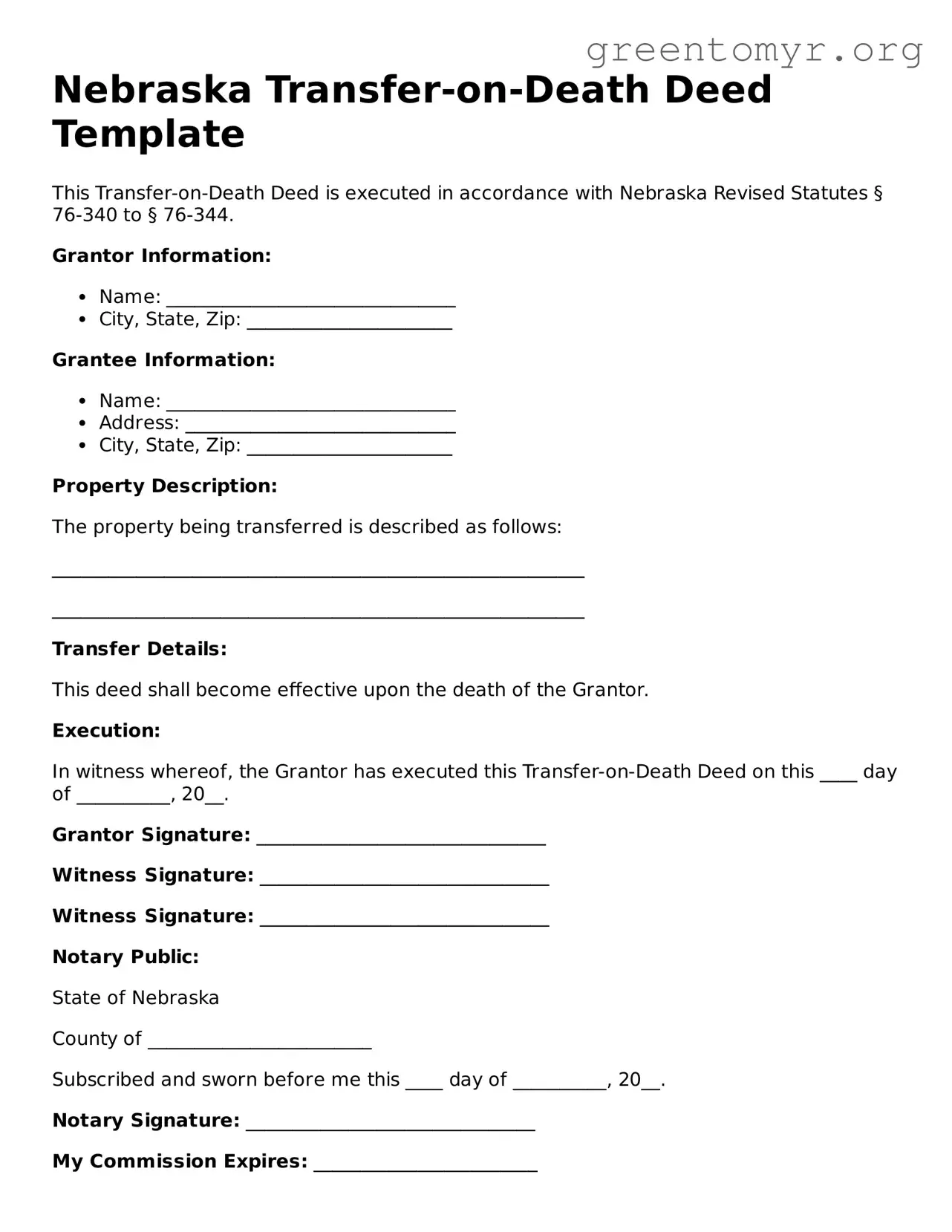
Nebraska Transfer-on-Death Deed Template
This Transfer-on-Death Deed is executed in accordance with Nebraska Revised Statutes § 76-340 to § 76-344.
Grantor Information:
Grantee Information:
Property Description:
The property being transferred is described as follows:
_________________________________________________________
_________________________________________________________
Transfer Details:
This deed shall become effective upon the death of the Grantor.
Execution:
In witness whereof, the Grantor has executed this Transfer-on-Death Deed on this ____ day of __________, 20__.
Grantor Signature: _______________________________
Witness Signature: _______________________________
Witness Signature: _______________________________
Notary Public:
State of Nebraska
County of ________________________
Subscribed and sworn before me this ____ day of __________, 20__.
Notary Signature: _______________________________
My Commission Expires: ________________________
| Fact Name | Details |
|---|---|
| Definition | A Transfer-on-Death Deed allows property owners in Nebraska to transfer real estate to beneficiaries upon their death without going through probate. |
| Governing Law | The Nebraska Transfer-on-Death Deed is governed by Nebraska Revised Statutes, specifically Section 76-3401 to 76-3417. |
| Eligibility | Any individual who owns real estate in Nebraska can create a Transfer-on-Death Deed, provided they are of sound mind and at least 18 years old. |
| Revocation | The deed can be revoked at any time by the property owner, as long as they follow the proper legal procedures for revocation. |
| Beneficiary Designation | Property owners can designate one or more beneficiaries in the deed, and they can also specify alternate beneficiaries in case the primary ones predecease them. |
| Filing Requirements | To be effective, the Transfer-on-Death Deed must be recorded with the county register of deeds in the county where the property is located. |
After obtaining the Nebraska Transfer-on-Death Deed form, you are ready to fill it out. This form allows you to designate a beneficiary who will receive your property upon your passing. It’s essential to ensure that all information is accurate and complete to avoid any complications in the future.
A Transfer-on-Death Deed (TODD) in Nebraska is a legal document that allows an individual to transfer real property to a designated beneficiary upon the individual's death. This deed enables property owners to bypass the probate process, simplifying the transfer of property and ensuring that the intended beneficiary receives the property without delay.
Any individual who is at least 18 years old and legally competent to manage their own affairs can create a Transfer-on-Death Deed in Nebraska. The property must be owned solely by the individual creating the deed, and it must be real property, such as land or a home.
Upon the death of the property owner, the designated beneficiary automatically receives the property without the need for probate. The deed must be properly executed, recorded with the county register of deeds, and must clearly identify the beneficiary. The transfer occurs immediately upon the death of the owner, ensuring a seamless transition of ownership.
Yes, there are several limitations to consider. A Transfer-on-Death Deed cannot be used for all types of property. For example, it cannot transfer personal property, such as vehicles or bank accounts. Additionally, if the property owner has outstanding debts or liens, these obligations may still affect the property after the owner's death.
To create a Transfer-on-Death Deed in Nebraska, follow these steps:
Yes, a Transfer-on-Death Deed can be revoked at any time prior to the death of the property owner. The revocation must be executed in writing, signed by the owner, and recorded in the same office where the original deed was recorded. It is advisable to consult with a legal professional to ensure proper revocation procedures are followed.
If the Transfer-on-Death Deed is not recorded, it may be considered invalid. Recording the deed is crucial as it provides public notice of the intended transfer and protects the rights of the beneficiary. Without recording, the property may be subject to probate, defeating the purpose of the deed.
Yes, there is typically a fee associated with recording a Transfer-on-Death Deed. The fee varies by county, so it is important to check with the local register of deeds for the specific amount. This fee is usually modest compared to the costs associated with probate proceedings.
While a Transfer-on-Death Deed is generally straightforward, it can be contested under certain circumstances. For example, if there is evidence of undue influence, fraud, or lack of capacity at the time the deed was executed, a court may consider a challenge. It is essential to ensure that the deed is created under proper legal standards to minimize the risk of disputes.
Filling out the Nebraska Transfer-on-Death Deed form can be a straightforward process, but there are common mistakes that individuals often make. One frequent error is failing to include all required information. This includes the names of both the property owner and the beneficiary. Omitting even one detail can lead to complications or delays in the transfer process.
Another mistake is not properly identifying the property. The form requires a legal description of the property, which is different from a simple address. Many people mistakenly think an address is sufficient, but without a precise legal description, the deed may not be valid.
People also sometimes forget to sign the deed in the presence of a notary public. The signature must be notarized to ensure the document is legally binding. Neglecting this step can result in the deed being challenged or deemed invalid.
Additionally, individuals may not understand the importance of recording the deed with the county clerk. After completing the form, it must be filed with the appropriate county office to take effect. Failing to do so can lead to confusion about property ownership.
Another common issue is not considering the implications of transferring property on death. Some individuals may not fully understand how this transfer affects their estate or the rights of heirs. It is crucial to think through these consequences to avoid unintended outcomes.
People often overlook the need to keep the deed updated. Life changes, such as marriage, divorce, or the birth of children, may necessitate modifications to the deed. If changes are not made, the original intentions may not be honored.
Lastly, many individuals fail to communicate their plans with beneficiaries. It is essential to inform those involved about the existence of the deed and the intentions behind it. This can prevent misunderstandings and disputes among family members in the future.
When completing a Nebraska Transfer-on-Death Deed, several other forms and documents may be useful. These documents can help clarify ownership, facilitate the transfer process, or address related legal matters. Below is a list of some commonly used forms.
These forms and documents can help ensure that the transfer of property is handled smoothly and according to the owner's wishes. It's important to consider which documents might be relevant based on individual circumstances.
The Transfer-on-Death Deed (TOD Deed) is a legal document that allows an individual to transfer real estate to a beneficiary upon their death, avoiding probate. Several other documents serve similar purposes in estate planning and property transfer. Here are ten documents that share similarities with the Transfer-on-Death Deed:
When filling out the Nebraska Transfer-on-Death Deed form, it is important to follow specific guidelines to ensure accuracy and legality. Below is a list of things you should and shouldn't do.
Understanding the Nebraska Transfer-on-Death Deed form is essential for effective estate planning. However, several misconceptions can lead to confusion. Here are seven common misconceptions explained:
Being informed about these misconceptions can help individuals make better decisions regarding their estate planning in Nebraska.
When considering the Nebraska Transfer-on-Death Deed form, it is essential to understand its implications and requirements. Below are key takeaways to guide you through the process.
These takeaways provide a foundational understanding of the Nebraska Transfer-on-Death Deed form, helping individuals make informed decisions regarding their property and estate planning.