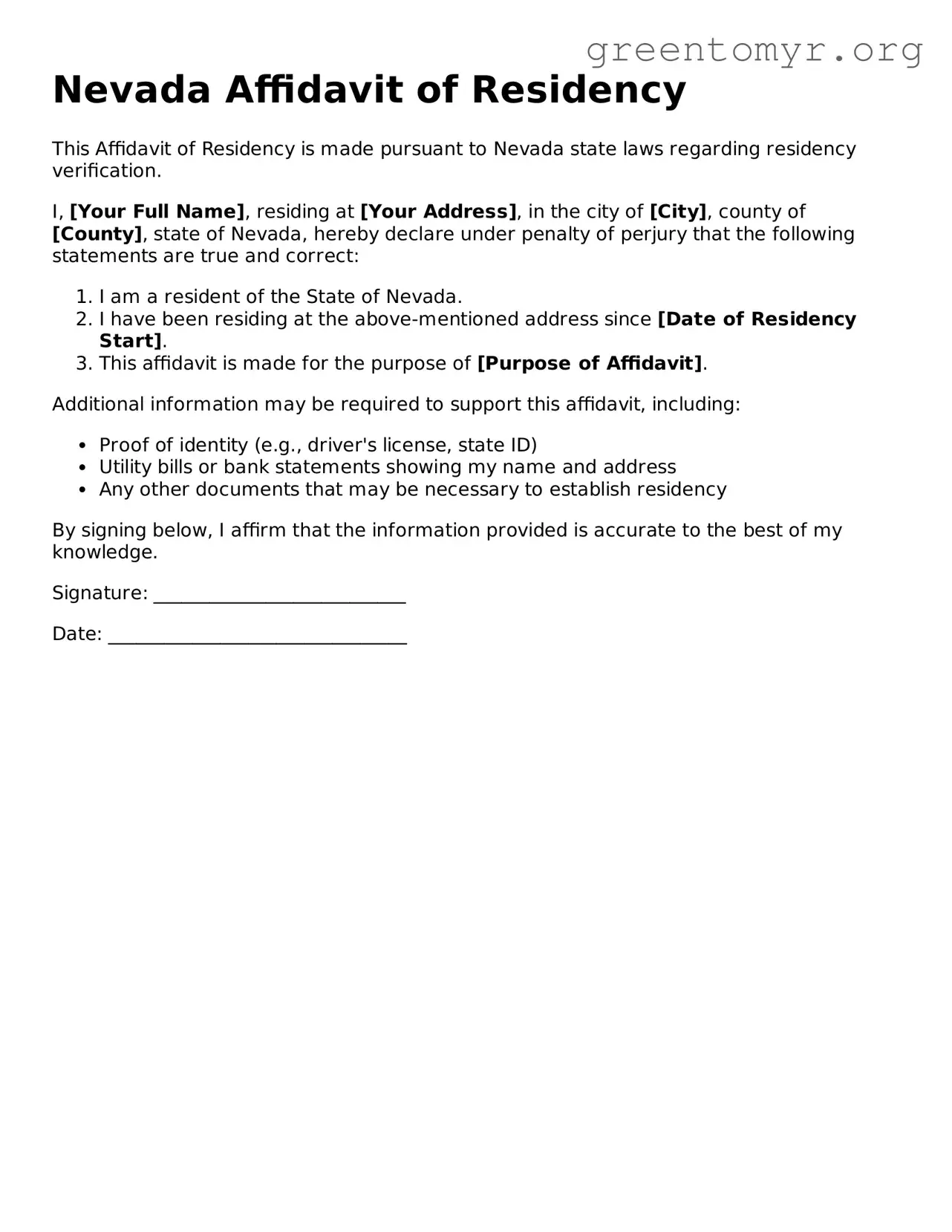
The Nevada Affidavit of Residency form serves as an essential document for individuals needing to verify their residency status within the state. This form is often required for various purposes, including obtaining a driver's license, registering to vote, or enrolling in local schools. By completing the affidavit, individuals affirm their current address and confirm their ties to the community. The form typically requires personal details such as the affiant's name, address, and the duration of residency. Additionally, it may ask for the signatures of witnesses or a notary public, adding an extra layer of authenticity. Understanding the requirements and implications of this form is crucial for anyone navigating legal processes in Nevada, ensuring that residents can access their rights and services without unnecessary complications.
Nevada Affidavit of Residency
This Affidavit of Residency is made pursuant to Nevada state laws regarding residency verification.
I, [Your Full Name], residing at [Your Address], in the city of [City], county of [County], state of Nevada, hereby declare under penalty of perjury that the following statements are true and correct:
Additional information may be required to support this affidavit, including:
By signing below, I affirm that the information provided is accurate to the best of my knowledge.
Signature: ___________________________
Date: ________________________________
| Fact Name | Description |
|---|---|
| Purpose | The Nevada Affidavit of Residency form is used to verify a person's residency in the state of Nevada. |
| Governing Law | This form is governed by Nevada Revised Statutes (NRS) 425.382. |
| Who Uses It | Residents of Nevada may need to complete this form for various legal purposes, such as applying for a driver's license or registering to vote. |
| Filing Requirements | The completed affidavit must be signed in the presence of a notary public to be considered valid. |
After obtaining the Nevada Affidavit of Residency form, you will need to fill it out accurately to ensure it meets the requirements for your intended purpose. Follow these steps carefully to complete the form.
Once you have completed the form, review all entries for accuracy. Ensure that all signatures and dates are correctly filled out before submitting it to the appropriate authority.
The Nevada Affidavit of Residency form is a legal document that confirms an individual's residence in the state of Nevada. This form is often required for various purposes, such as enrolling in schools, obtaining a driver's license, or registering to vote. By completing this affidavit, you affirm your current address and provide verification of your residency status.
Any individual who needs to establish their residency in Nevada may be required to complete this form. Common scenarios include:
In some cases, landlords or property owners may also need to complete this form to confirm a tenant's residency.
To complete the form, follow these steps:
Ensure that all information is accurate to avoid delays or issues with your application.
Typically, there is no fee for completing the Affidavit of Residency itself. However, if notarization is required, the notary may charge a fee for their services. Additionally, there may be fees associated with the specific purpose for which you are submitting the affidavit, such as school enrollment or obtaining a driver's license. It is advisable to check with the relevant agency for any potential costs.
The submission location depends on the purpose of the affidavit. Here are some common options:
Always verify the submission guidelines with the specific agency to ensure proper handling of your affidavit.
Completing the Nevada Affidavit of Residency form can be straightforward, but many individuals make common mistakes that can delay the process. One frequent error is not providing accurate information. When filling out personal details, such as name and address, it is crucial to ensure that everything is correct and up to date. Mistakes in these areas can lead to complications later on.
Another common mistake is failing to sign the affidavit. This form requires a signature to validate the information provided. Without a signature, the affidavit is incomplete and cannot be processed. Always double-check to ensure that you have signed the document before submitting it.
People often overlook the requirement for a witness. The Nevada Affidavit of Residency must be signed in the presence of a witness, who must also sign the form. Neglecting this step can render the affidavit invalid. It is important to arrange for a witness ahead of time to avoid delays.
Some individuals forget to include the date when signing the affidavit. This detail is essential, as it indicates when the affidavit was completed. Without a date, the form may be questioned, leading to potential issues with processing.
Additionally, using incorrect or outdated forms can cause confusion. It is important to use the latest version of the Nevada Affidavit of Residency form. Always check for updates or revisions to ensure compliance with current requirements.
Another mistake is not providing sufficient proof of residency. The affidavit may require supporting documents, such as utility bills or lease agreements. Failing to include these documents can result in the affidavit being rejected. Make sure to gather all necessary paperwork before submission.
Some people rush through the process and do not read the instructions carefully. Each section of the affidavit has specific requirements. Taking the time to read through the instructions can help avoid mistakes that could delay the processing of the affidavit.
Lastly, individuals may forget to keep a copy of the completed affidavit for their records. Having a copy can be beneficial for future reference or if any questions arise about the residency claim. Always make sure to keep a personal copy after submission.
When dealing with residency issues in Nevada, several forms and documents may accompany the Affidavit of Residency. Each of these documents serves a specific purpose and can help clarify residency status or support an application. Below is a list of commonly used forms and documents that you might encounter.
Understanding these documents can make the process smoother when establishing residency in Nevada. Each piece of information plays a vital role in supporting your case, so it's important to gather them carefully.
The Affidavit of Residency form serves an important purpose in verifying where a person lives. Several other documents share similar functions, helping to confirm residency or address. Here’s a look at eight documents that are comparable to the Affidavit of Residency:
Each of these documents plays a crucial role in affirming where someone lives, much like the Affidavit of Residency. Understanding these alternatives can help individuals navigate residency verification requirements more effectively.
When filling out the Nevada Affidavit of Residency form, it's important to follow certain guidelines to ensure accuracy and compliance. Here are some key do's and don'ts to keep in mind:
By following these guidelines, you can help ensure that your Affidavit of Residency is processed smoothly and efficiently.
The Nevada Affidavit of Residency form is often misunderstood. Here are ten common misconceptions about this important document.
This form can be used by minors as well, particularly for school enrollment or other official purposes.
While notarization can add credibility, it is not a requirement for the affidavit to be valid.
The affidavit serves various purposes, including proving residency for school enrollment, obtaining a driver's license, and more.
The person completing the form must be a resident of the address listed, ensuring accurate representation of residency.
If your residency status changes, you can submit a new affidavit reflecting your current situation.
The affidavit is recognized statewide, making it valid throughout Nevada.
Typically, there are no fees associated with filing the Affidavit of Residency.
The form is straightforward and user-friendly, designed to be filled out easily by residents.
While the affidavit itself is a declaration, you may need to provide proof of residency, such as utility bills or lease agreements.
The affidavit is not permanent; it reflects your residency at the time of submission and can be updated as needed.
Understanding these misconceptions can help ensure that residents use the Nevada Affidavit of Residency form correctly and effectively.
When filling out and using the Nevada Affidavit of Residency form, there are several important points to keep in mind. Below are key takeaways to ensure a smooth process.