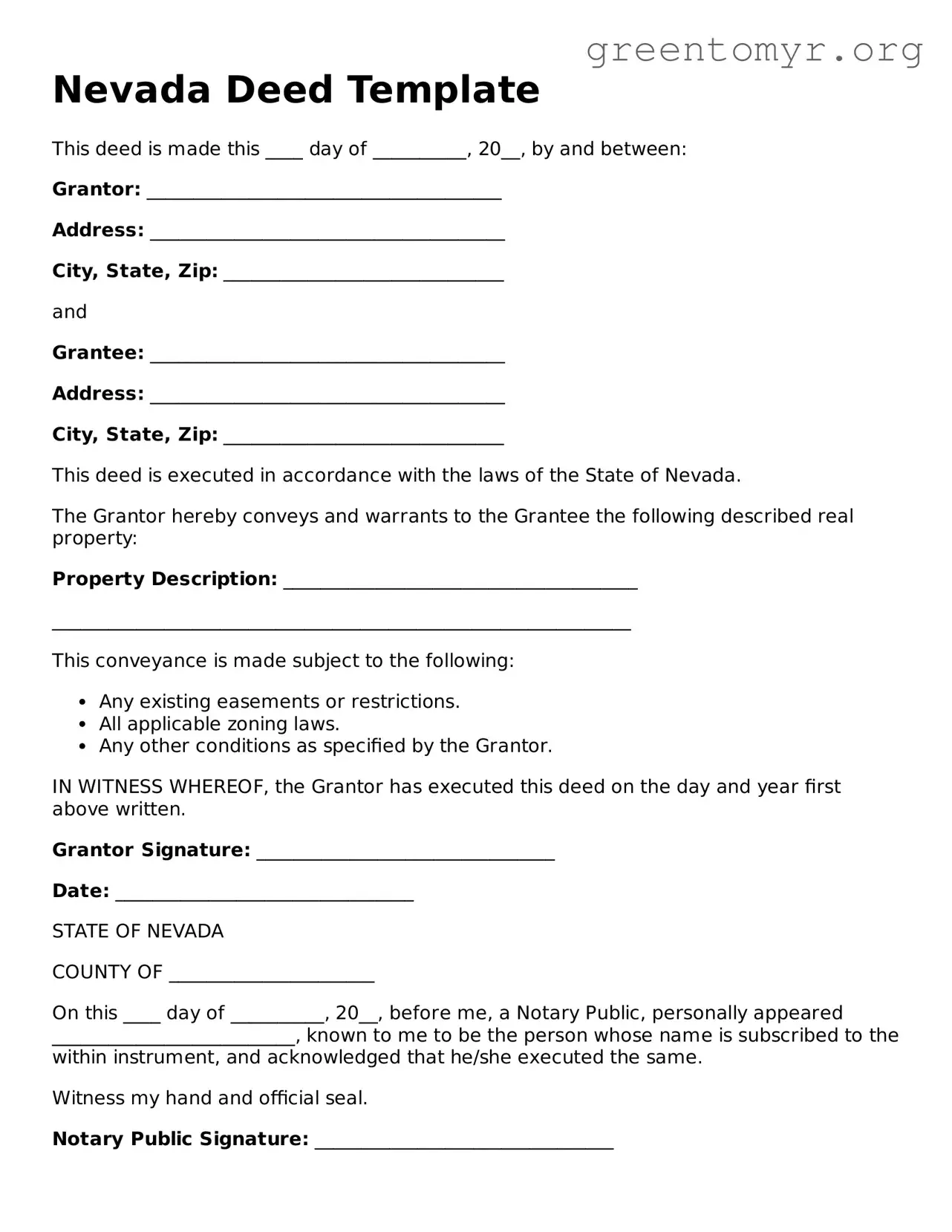
Nevada's Deed form serves as a crucial legal document in the transfer of property ownership, ensuring that the rights and responsibilities associated with real estate are clearly defined and legally binding. This form outlines essential details such as the names of the parties involved, a precise description of the property being conveyed, and the terms of the transfer. Importantly, it includes the signatures of the grantor and grantee, which solidify the agreement and signify mutual consent. The Deed also requires notarization, adding an extra layer of authenticity and protection against future disputes. Understanding the nuances of this form is vital for both buyers and sellers, as it not only facilitates a smooth transaction but also safeguards the interests of all parties involved. Whether you are a seasoned investor or a first-time homebuyer, grasping the significance of the Nevada Deed form can empower you to navigate the complexities of real estate transactions with confidence.
Nevada Deed Template
This deed is made this ____ day of __________, 20__, by and between:
Grantor: ______________________________________
Address: ______________________________________
City, State, Zip: ______________________________
and
Grantee: ______________________________________
Address: ______________________________________
City, State, Zip: ______________________________
This deed is executed in accordance with the laws of the State of Nevada.
The Grantor hereby conveys and warrants to the Grantee the following described real property:
Property Description: ______________________________________
______________________________________________________________
This conveyance is made subject to the following:
IN WITNESS WHEREOF, the Grantor has executed this deed on the day and year first above written.
Grantor Signature: ________________________________
Date: ________________________________
STATE OF NEVADA
COUNTY OF ______________________
On this ____ day of __________, 20__, before me, a Notary Public, personally appeared __________________________, known to me to be the person whose name is subscribed to the within instrument, and acknowledged that he/she executed the same.
Witness my hand and official seal.
Notary Public Signature: ________________________________
My Commission Expires: ________________________________
| Fact Name | Description |
|---|---|
| Governing Law | The Nevada Deed form is governed by the Nevada Revised Statutes (NRS) Title 10, Chapter 111. |
| Types of Deeds | Nevada recognizes several types of deeds, including warranty deeds, quitclaim deeds, and grant deeds. |
| Signature Requirements | The deed must be signed by the grantor (the person transferring the property) to be valid. |
| Notarization | A notary public must witness the signing of the deed to ensure its authenticity. |
| Recording | To protect the interests of the new owner, the deed should be recorded with the county recorder's office. |
| Transfer Tax | Nevada imposes a real property transfer tax on the transfer of real estate, which must be paid at the time of recording. |
| Effective Date | The deed becomes effective upon recording, not merely upon signing. |
Once you have your Nevada Deed form, it’s time to fill it out carefully. Make sure you have all the necessary information ready before you start. After completing the form, you will need to submit it for recording at your local county recorder's office.
A Nevada Deed form is a legal document used to transfer ownership of real property in the state of Nevada. It outlines the details of the transaction, including the parties involved, the property description, and any conditions of the transfer.
In Nevada, several types of Deeds are commonly used, including:
To complete a Nevada Deed form, follow these steps:
While it is not legally required to have a lawyer prepare a Deed, consulting one is advisable. A lawyer can ensure that the Deed complies with state laws and meets your specific needs.
To record a Deed in Nevada, you must file it with the county recorder's office in the county where the property is located. There may be a recording fee, and it is important to ensure that the Deed is properly executed and notarized before submission.
If a Deed is not recorded, it may not provide legal protection against claims from third parties. Recording a Deed establishes public notice of the ownership transfer and can prevent disputes over property rights.
Once a Deed is signed and recorded, it generally cannot be revoked or changed unilaterally. If changes are necessary, a new Deed may need to be executed to correct or clarify the terms.
Yes, transferring property can have tax implications. Depending on the nature of the transfer, the parties may be subject to transfer taxes or capital gains taxes. It is wise to consult a tax professional to understand the specific tax consequences of your property transfer.
When filling out the Nevada Deed form, many individuals make common mistakes that can lead to complications later on. One frequent error is failing to include the correct legal description of the property. The legal description is essential because it clearly identifies the property being transferred. Without this information, the deed may be considered invalid, causing delays in the transfer process.
Another mistake often seen is not properly signing the deed. All parties involved in the transaction must sign the document for it to be legally binding. If even one signature is missing, the deed could be challenged or rejected. It is crucial to ensure that each signer is present and that their signatures are clear and legible.
People sometimes overlook the importance of having the deed notarized. In Nevada, a deed must be notarized to be valid. This step serves as a safeguard against fraud and ensures that all parties understand the transaction. Failing to get the deed notarized can result in legal issues down the line.
Lastly, individuals may neglect to record the deed with the county recorder’s office. Recording the deed is vital for public notice and protects the new owner’s rights to the property. If the deed is not recorded, the new owner might face challenges from future buyers or creditors. Taking the time to complete this step can save significant headaches in the future.
When dealing with property transactions in Nevada, several forms and documents may accompany the Nevada Deed form. These documents play crucial roles in ensuring that the transfer of property rights is clear and legally binding. Below is a list of commonly used forms that you may encounter.
Understanding these documents is essential for anyone involved in real estate transactions in Nevada. Each form serves a specific purpose and helps to facilitate a smooth transfer of property ownership while protecting the interests of all parties involved.
The Deed form serves a specific purpose in property transactions, but it shares similarities with several other legal documents. Below is a list of nine documents that are comparable to the Deed form, along with a brief explanation of how they are similar.
When filling out the Nevada Deed form, it is essential to approach the task with care and attention to detail. Here is a list of things you should and shouldn't do:
By following these guidelines, you can help ensure that your deed is completed correctly and efficiently. This can prevent delays and potential legal issues in the future.
When it comes to understanding the Nevada Deed form, several misconceptions often arise. These misunderstandings can lead to confusion and potentially costly mistakes. Here are eight common misconceptions clarified:
Many people believe that all deeds serve the same purpose. However, there are various types of deeds, such as warranty deeds and quitclaim deeds, each serving different legal functions and offering different levels of protection.
While notarization is highly recommended for the validity of a deed, it is not always required in Nevada. However, having a deed notarized can help prevent disputes regarding its authenticity.
Some people think that recording a deed is optional. In reality, recording is crucial as it provides public notice of ownership and protects the new owner’s rights against claims from third parties.
While having legal counsel can be beneficial, it is not a legal requirement to have a lawyer for property transfers in Nevada. Many individuals choose to handle the process themselves, especially for straightforward transactions.
People often believe that a signed deed is set in stone. In fact, deeds can be amended or revoked under certain conditions, provided the proper legal processes are followed.
Some assume that holding a deed guarantees full ownership of the property. However, the existence of a deed does not eliminate the possibility of liens or other claims against the property.
This misconception can lead to issues during the transfer process. Both the seller and the buyer typically need to sign the deed to ensure that the transfer is legally binding.
While it may seem simple to create a deed, there are specific formalities that must be followed for it to be legally enforceable. These include proper wording, signatures, and, in many cases, notarization.
Understanding these misconceptions can help individuals navigate the complexities of property ownership and ensure that their transactions are handled correctly.
When filling out and using the Nevada Deed form, several important considerations can help ensure a smooth process. Here are key takeaways to keep in mind:
By following these guidelines, individuals can effectively navigate the process of filling out and using the Nevada Deed form.