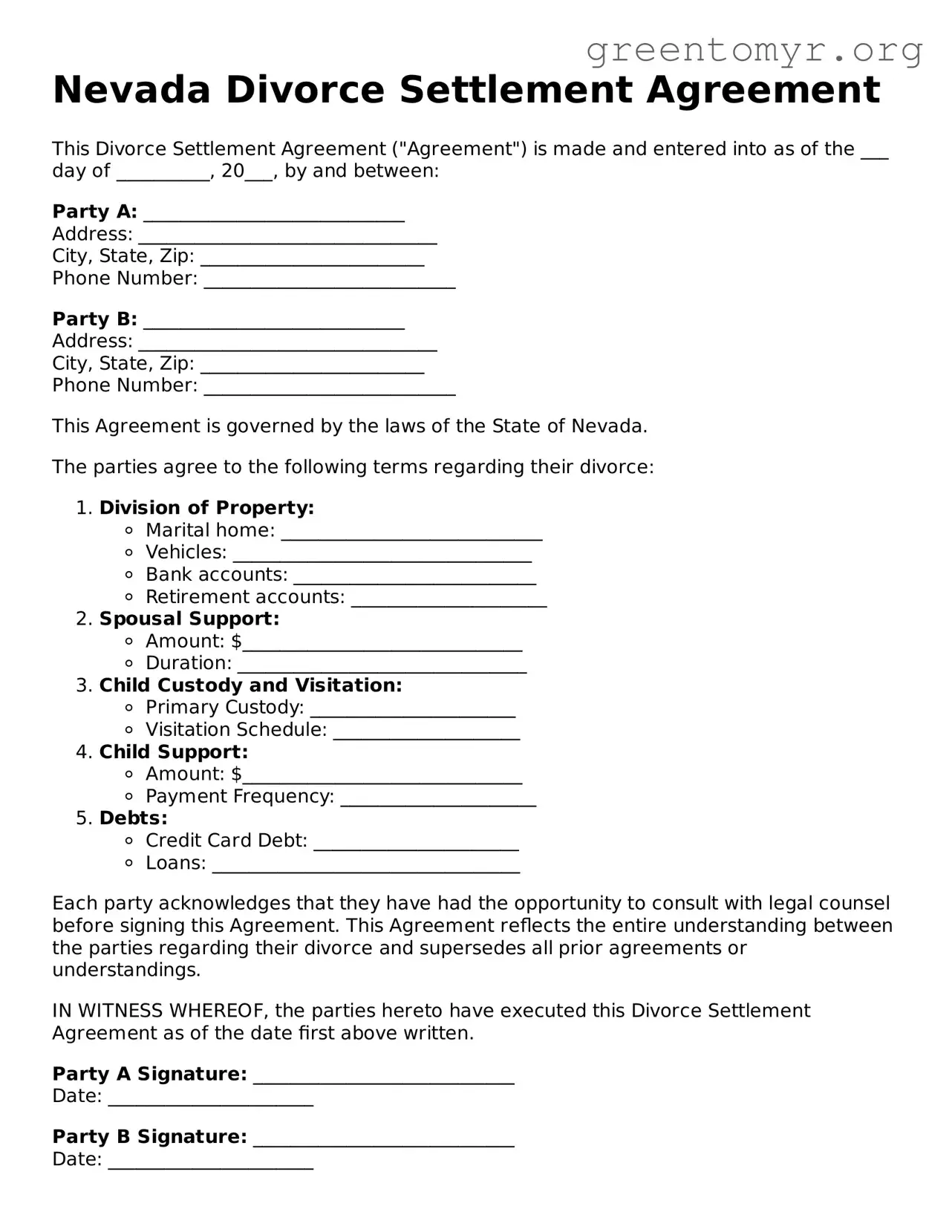
In Nevada, a Divorce Settlement Agreement is a critical document that outlines the terms agreed upon by both parties during a divorce. This form addresses various aspects of the separation, including the division of assets and debts, child custody arrangements, visitation rights, and spousal support. It serves to clarify each party's responsibilities and rights, ensuring that both individuals understand their obligations moving forward. Additionally, the agreement may include provisions for the division of retirement accounts and insurance policies. Once completed and signed, the form becomes a legally binding contract, which the court will enforce. Therefore, it is essential for both parties to fully comprehend the terms before finalizing the agreement. Properly completing this form can help facilitate a smoother divorce process and reduce potential conflicts in the future.
Nevada Divorce Settlement Agreement
This Divorce Settlement Agreement ("Agreement") is made and entered into as of the ___ day of __________, 20___, by and between:
Party A: ____________________________
Address: ________________________________
City, State, Zip: ________________________
Phone Number: ___________________________
Party B: ____________________________
Address: ________________________________
City, State, Zip: ________________________
Phone Number: ___________________________
This Agreement is governed by the laws of the State of Nevada.
The parties agree to the following terms regarding their divorce:
Each party acknowledges that they have had the opportunity to consult with legal counsel before signing this Agreement. This Agreement reflects the entire understanding between the parties regarding their divorce and supersedes all prior agreements or understandings.
IN WITNESS WHEREOF, the parties hereto have executed this Divorce Settlement Agreement as of the date first above written.
Party A Signature: ____________________________
Date: ______________________
Party B Signature: ____________________________
Date: ______________________
| Fact Name | Description |
|---|---|
| Purpose | The Nevada Divorce Settlement Agreement form outlines the terms of a divorce settlement between spouses. |
| Governing Law | This form is governed by Nevada Revised Statutes (NRS) Chapter 125, which covers divorce and related matters. |
| Content Requirements | The agreement must include provisions for property division, debt allocation, child custody, and support obligations. |
| Filing Process | Once completed, the form should be filed with the appropriate Nevada family court as part of the divorce proceedings. |
| Mutual Consent | Both parties must agree to the terms outlined in the settlement agreement for it to be valid and enforceable. |
| Modification | Changes to the agreement can be made only if both parties consent and a new agreement is drafted and filed. |
After obtaining the Nevada Divorce Settlement Agreement form, individuals should carefully complete it to ensure all necessary information is provided. This form is essential for finalizing the terms of a divorce, including asset division, child custody, and support obligations. Following the completion of the form, it will need to be filed with the appropriate court.
A Nevada Divorce Settlement Agreement is a legal document that outlines the terms agreed upon by both spouses during a divorce. This agreement covers various aspects, including property division, debt allocation, child custody, visitation rights, and spousal support. It serves as a binding contract once signed by both parties and approved by the court.
This agreement is crucial as it helps clarify the rights and responsibilities of each spouse post-divorce. It can prevent future disputes by providing a clear framework for how assets and responsibilities are divided. Having a well-drafted agreement can also expedite the divorce process and reduce court involvement.
Creating a Divorce Settlement Agreement involves several steps:
Your Divorce Settlement Agreement should include:
While it is not legally required to have a lawyer, it is highly advisable. A lawyer can ensure that your rights are protected, help you understand the implications of your agreement, and make sure that the document complies with Nevada law. If both parties agree on all terms, some may choose to draft the agreement themselves.
To file the Divorce Settlement Agreement, follow these steps:
If your spouse does not agree to the terms, negotiation is necessary. You may need to engage in mediation or seek legal counsel to help facilitate discussions. If an agreement cannot be reached, the court will intervene and make decisions regarding asset division, custody, and support based on the best interests of the parties involved.
Yes, a Divorce Settlement Agreement can be modified after it is signed, but both parties must agree to the changes. If circumstances change significantly, such as a job loss or a change in the needs of the children, you can petition the court for modifications. It is advisable to document any changes in writing and have them approved by the court to ensure enforceability.
The time it takes for the court to approve a Divorce Settlement Agreement varies. Generally, it can take anywhere from a few weeks to a few months, depending on the court's schedule and the complexity of the case. After filing, you may need to attend a hearing where the judge will review the agreement before granting the divorce.
Filling out the Nevada Divorce Settlement Agreement form can feel overwhelming, and it's easy to make mistakes. One common error is failing to provide complete information. Each section of the form requires specific details, and leaving anything blank can lead to delays or complications in the divorce process. Always double-check that all fields are filled out accurately.
Another frequent mistake is not clearly defining the terms of the agreement. Ambiguities can create confusion later on. For instance, when discussing property division or child custody arrangements, it's essential to be as specific as possible. Vague language can lead to misunderstandings and disputes down the line.
Many individuals overlook the importance of signatures. It’s crucial that both parties sign the document. A missing signature can render the entire agreement invalid. Make sure to review the form to ensure that all necessary signatures are present before submission.
People often underestimate the significance of including dates. When filling out the form, every section should have the appropriate dates noted. This includes the date of the agreement itself and any relevant dates for asset division or custody arrangements. Dates help establish timelines and clarify the terms agreed upon.
Another common mistake is failing to keep a copy of the completed form. Once the agreement is signed and submitted, it’s vital to have a record for your own reference. This can be invaluable if questions arise in the future regarding the terms of the divorce.
Additionally, some individuals neglect to consider tax implications. When dividing assets, it’s important to understand how these decisions may affect your tax situation. Consulting with a tax professional can provide clarity and help avoid future financial pitfalls.
People sometimes rush through the process without fully understanding the implications of their decisions. Each clause in the settlement agreement can have long-term effects on your life. Take the time to read through everything carefully and ask questions if something isn’t clear.
Another misstep is failing to consider future changes in circumstances. Life can be unpredictable, and agreements that seem fair now may not hold up in the future. It’s wise to include provisions for modifications in the event of significant life changes, such as job loss or relocation.
Some individuals also forget to address debts in the agreement. It’s not just assets that need to be divided; liabilities must be considered as well. Clearly outlining who is responsible for which debts can prevent future conflicts and ensure a smoother transition post-divorce.
Lastly, many people neglect to seek legal advice. Even if you feel confident in your understanding of the form, having a professional review it can help catch mistakes and ensure that your rights are protected. Legal counsel can provide valuable insights and help you navigate this complex process with ease.
When navigating the complex process of divorce in Nevada, various forms and documents come into play alongside the Divorce Settlement Agreement. Each of these documents serves a specific purpose, helping to ensure that all aspects of the divorce are addressed comprehensively. Below is a list of commonly used forms that may accompany the Divorce Settlement Agreement.
Understanding these documents is crucial for anyone going through a divorce in Nevada. Each serves a distinct purpose, ensuring that the rights and responsibilities of both parties are clearly defined and legally recognized. By familiarizing oneself with these forms, individuals can navigate the divorce process more effectively, ultimately leading to a smoother transition into the next chapter of their lives.
Separation Agreement: This document outlines the terms under which a couple separates, addressing issues such as property division, child custody, and support obligations. Like a Divorce Settlement Agreement, it aims to provide clarity and structure to the separation process.
Child Custody Agreement: This agreement specifically focuses on the arrangements for child custody and visitation. Similar to the Divorce Settlement Agreement, it is designed to ensure that the best interests of the child are prioritized and that both parents understand their rights and responsibilities.
Property Settlement Agreement: This document details how marital property will be divided between the spouses. It shares similarities with the Divorce Settlement Agreement in that both documents aim to finalize the distribution of assets and debts, reducing potential conflicts.
Spousal Support Agreement: This agreement outlines the terms of financial support one spouse may provide to the other after separation or divorce. It aligns with the Divorce Settlement Agreement by addressing financial responsibilities and ensuring that both parties are aware of their obligations.
Marital Settlement Agreement: This document encompasses all aspects of the divorce, including child custody, support, and property division. It is akin to the Divorce Settlement Agreement, as both serve to settle all disputes and provide a clear framework for the divorce process.
When filling out the Nevada Divorce Settlement Agreement form, it's important to approach the process carefully. Here are some dos and don'ts to keep in mind:
By following these guidelines, you can help ensure that your Divorce Settlement Agreement is completed correctly and efficiently.
When dealing with the Nevada Divorce Settlement Agreement form, several misconceptions can arise. Here is a list of ten common misunderstandings, along with clarifications for each.
Understanding these misconceptions can help individuals navigate the divorce process more effectively and ensure that their rights and interests are adequately represented.
Completing the Nevada Divorce Settlement Agreement form requires full disclosure of assets and debts. Both parties must provide accurate information to ensure a fair settlement.
Each section of the form addresses specific issues such as child custody, property division, and spousal support. Understanding these sections is crucial for a comprehensive agreement.
The agreement must be signed by both parties to be legally binding. Without signatures, the document holds no legal weight in court.
Once finalized, the agreement should be submitted to the court for approval. The court will review the document to ensure it meets legal standards and is in the best interest of any children involved.
It is advisable to consult with a legal professional before submitting the form. Legal guidance can help avoid potential pitfalls and ensure that rights are protected.