In the state of Nevada, the Do Not Resuscitate (DNR) Order form serves as a crucial tool for individuals who wish to make their end-of-life care preferences known. This legally binding document allows patients to decline resuscitation efforts in the event of a cardiac arrest or respiratory failure. By completing this form, individuals can ensure that their wishes regarding life-sustaining treatments are respected, thereby providing peace of mind for themselves and their loved ones. The DNR Order must be signed by a physician, confirming that the patient is fully informed about their condition and the implications of their decision. It is important to note that the DNR form is distinct from other advance directives, such as living wills, and specifically addresses the withholding of resuscitative measures. In Nevada, the DNR Order can be readily recognized by emergency medical personnel, ensuring that the patient's preferences are honored in critical situations. Understanding the significance and proper execution of this form can empower individuals to take control of their healthcare decisions and facilitate meaningful conversations with family members and healthcare providers.
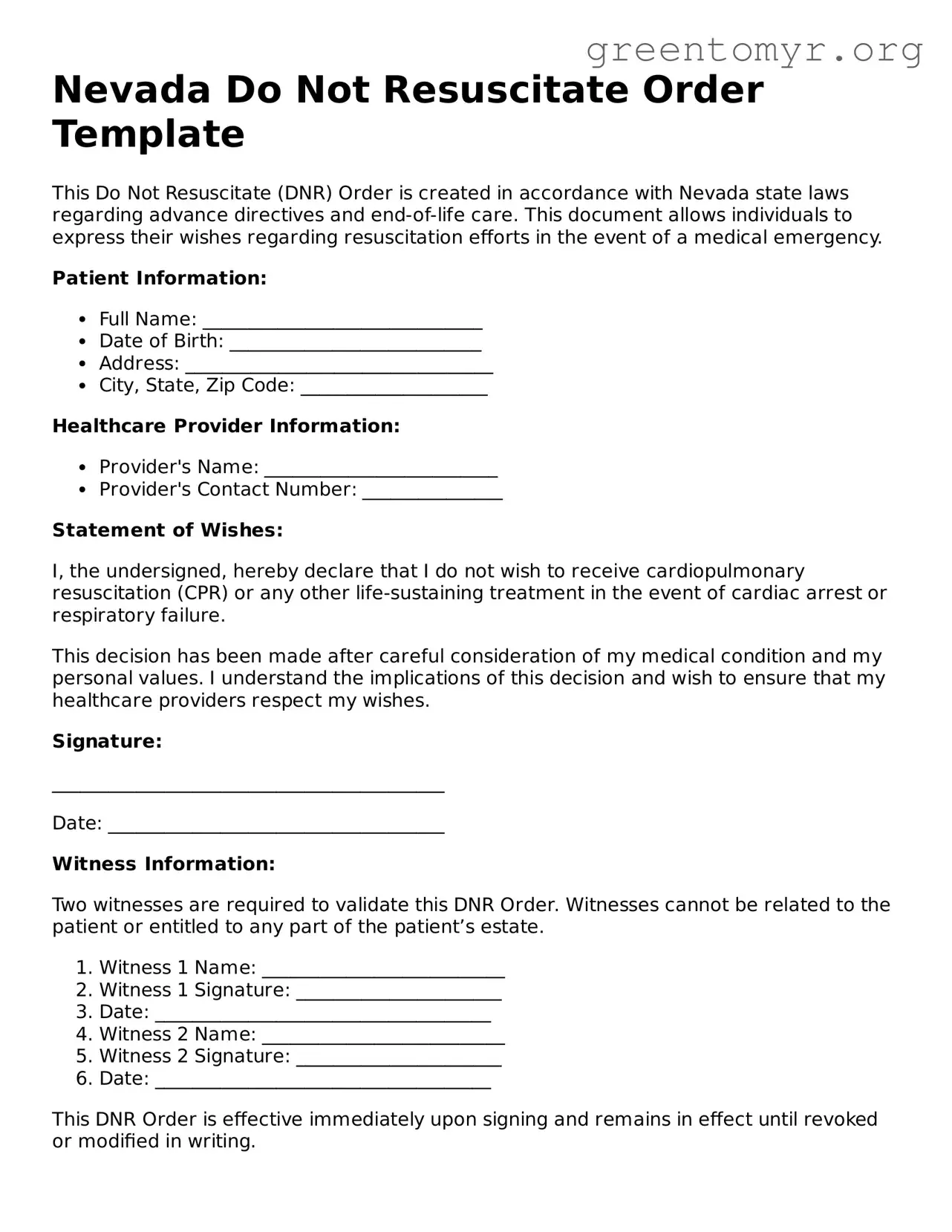
Nevada Do Not Resuscitate Order Template
This Do Not Resuscitate (DNR) Order is created in accordance with Nevada state laws regarding advance directives and end-of-life care. This document allows individuals to express their wishes regarding resuscitation efforts in the event of a medical emergency.
Patient Information:
Healthcare Provider Information:
Statement of Wishes:
I, the undersigned, hereby declare that I do not wish to receive cardiopulmonary resuscitation (CPR) or any other life-sustaining treatment in the event of cardiac arrest or respiratory failure.
This decision has been made after careful consideration of my medical condition and my personal values. I understand the implications of this decision and wish to ensure that my healthcare providers respect my wishes.
Signature:
__________________________________________
Date: ____________________________________
Witness Information:
Two witnesses are required to validate this DNR Order. Witnesses cannot be related to the patient or entitled to any part of the patient’s estate.
This DNR Order is effective immediately upon signing and remains in effect until revoked or modified in writing.
| Fact Name | Description |
|---|---|
| Definition | A Nevada Do Not Resuscitate (DNR) Order is a legal document that instructs medical personnel not to perform cardiopulmonary resuscitation (CPR) in the event of cardiac arrest. |
| Governing Law | The Nevada DNR Order is governed by Nevada Revised Statutes (NRS) Chapter 449. This chapter outlines the requirements and procedures for DNR orders in the state. |
| Eligibility | Any adult who is a resident of Nevada and has a terminal condition or a serious medical issue may complete a DNR Order. |
| Signature Requirement | The DNR Order must be signed by the patient or their legal representative. It also requires the signature of a physician to be valid. |
| Form Availability | The DNR Order form is available online through the Nevada Division of Public and Behavioral Health or can be obtained from healthcare providers. |
| Revocation | A DNR Order can be revoked at any time by the patient or their representative. It is important to inform healthcare providers of any changes. |
| Placement | It is advisable to keep the DNR Order visible, such as on the refrigerator or with other important medical documents, to ensure it is easily accessible to emergency personnel. |
| Emergency Medical Services | Emergency medical services (EMS) personnel are required to honor valid DNR Orders. They will check for the presence of the document before initiating resuscitation efforts. |
Filling out the Nevada Do Not Resuscitate Order form is a straightforward process. This form allows you to express your wishes regarding medical treatment in emergencies. After completing the form, you should keep it in a place where it can be easily accessed by medical personnel or family members.
A Do Not Resuscitate Order is a legal document that allows a person to refuse cardiopulmonary resuscitation (CPR) and other life-saving measures in the event of a medical emergency. In Nevada, this order is recognized by healthcare providers, ensuring that a patient’s wishes regarding resuscitation are respected.
In Nevada, any adult who is of sound mind can create a DNR Order. This includes individuals who are facing terminal illnesses or those who wish to avoid resuscitation in case of a medical emergency. Additionally, a legal guardian or an authorized representative can create a DNR on behalf of someone who is unable to do so.
You can obtain a DNR Order form through various sources, including:
The DNR Order form typically requires the following information:
Yes, a properly completed DNR Order is valid in all healthcare settings in Nevada, including hospitals, nursing homes, and emergency medical services. However, it is essential to ensure that the order is easily accessible and clearly documented in the patient’s medical records.
Absolutely. A DNR Order can be revoked or modified at any time by the patient or their authorized representative. To do so, simply notify your healthcare provider and complete a new DNR Order form if necessary. It’s important to communicate any changes to ensure that your current wishes are known and respected.
If you do not have a DNR Order in place, healthcare providers are required to perform life-saving measures, such as CPR, if you experience cardiac arrest or respiratory failure. This is done regardless of your wishes unless there is a clear indication that you do not want such interventions.
While many states recognize DNR Orders from other states, it is advisable to check the specific laws of the state you are visiting. Carrying a copy of your DNR Order with you while traveling can help ensure that your wishes are honored, but be aware that some states may have different requirements.
To ensure your DNR Order is respected, consider the following steps:
A DNR Order specifically addresses the refusal of resuscitation efforts in the event of cardiac arrest or respiratory failure. An advance directive, on the other hand, is a broader document that outlines a person's preferences for medical treatment and decision-making in various situations, including end-of-life care. While a DNR can be part of an advance directive, the two serve different purposes.
Filling out the Nevada Do Not Resuscitate Order form is an important task that requires careful attention. However, many individuals make common mistakes that can lead to confusion or invalidation of the order. One frequent error is not signing the form. A signature is essential to validate the document. Without it, healthcare providers may not recognize the order.
Another mistake is failing to date the form. An undated document can create uncertainty about when the order was established. This can lead to complications in emergency situations. Always ensure that the date is clearly marked.
Many people overlook the need for a witness signature. The Nevada Do Not Resuscitate Order requires a witness to sign the form. Not having a witness can render the document ineffective. It is crucial to include this step to ensure the order is legally binding.
In addition, some individuals do not provide clear instructions. The form should specify the exact wishes regarding resuscitation. Ambiguous language can lead to misinterpretation by medical personnel. Clarity is key to ensuring that your intentions are understood.
Another common error is neglecting to inform family members or healthcare providers about the order. Simply filling out the form is not enough. It is vital to communicate your wishes to those who may be involved in your care.
People also often forget to review the form for accuracy. Mistakes in personal information, such as name or date of birth, can cause issues. Double-checking the details can prevent unnecessary complications.
Some individuals fail to keep copies of the completed form. It is important to have copies available for personal records and to share with healthcare providers. Without copies, there may be delays in honoring your wishes.
Another mistake is using outdated forms. Ensure that you are using the most current version of the Nevada Do Not Resuscitate Order form. Using an old version can lead to legal challenges and confusion.
Additionally, many people do not understand the implications of their decision. It is essential to fully comprehend what a Do Not Resuscitate Order means. Take the time to discuss your choices with a healthcare professional or legal advisor.
Finally, some individuals make the mistake of not reviewing or updating the order regularly. Life circumstances can change, and so can your wishes. Regularly revisiting the order ensures that it still reflects your current preferences.
When considering end-of-life care options, it's essential to understand that the Nevada Do Not Resuscitate (DNR) Order form is often accompanied by several other important documents. These documents help ensure that an individual's healthcare preferences are clearly communicated and respected. Below is a list of commonly used forms that work alongside the DNR Order.
Each of these documents plays a vital role in ensuring that an individual's healthcare preferences are honored. By having these forms in place, individuals can have peace of mind knowing that their wishes regarding medical treatment will be respected, even in difficult circumstances.
The Do Not Resuscitate (DNR) Order form is an important document that expresses a person's wishes regarding medical treatment in emergency situations. Several other documents serve similar purposes, allowing individuals to communicate their healthcare preferences. Here’s a list of eight documents that share similarities with a DNR Order form:
Each of these documents plays a crucial role in ensuring that individuals' healthcare preferences are respected, particularly in critical situations. Understanding these documents can empower individuals to take control of their medical decisions.
When filling out the Nevada Do Not Resuscitate Order form, it is important to approach the process with care. Here are some things to consider doing and not doing:
Understanding the Nevada Do Not Resuscitate (DNR) Order form is crucial for individuals considering their end-of-life care options. Unfortunately, several misconceptions can lead to confusion. Here’s a list of ten common misunderstandings about the DNR form in Nevada, along with clarifications.
This is not true. A DNR specifically relates to resuscitation efforts in the event of cardiac arrest. Other medical treatments, such as pain management and comfort care, will still be provided.
A lawyer is not necessary to complete a DNR form. Individuals can fill it out on their own, although consulting with a healthcare provider is recommended to ensure it reflects their wishes accurately.
This is a misconception. While many people with terminal illnesses choose to have a DNR, anyone can request one based on their personal wishes regarding resuscitation, regardless of their current health status.
This is incorrect. A DNR can be revoked or modified at any time by the individual, as long as they are mentally competent to do so.
Healthcare providers are legally obligated to honor a valid DNR order. Ignoring it would violate the patient’s rights and could have legal repercussions.
This is a misconception. DNR orders can vary by state, and it is important to use the specific form and guidelines provided by Nevada to ensure it is legally recognized.
This belief is misleading. A DNR is a personal choice that reflects an individual’s values and preferences about their end-of-life care, not a decision to stop living.
This is not accurate. A DNR can be established for use in various settings, including at home or in a long-term care facility, as long as it is properly documented.
While a physician's signature is typically required for a DNR to be recognized in a medical setting, the individual can complete the form themselves. The doctor’s involvement usually comes into play during the process of making the order official.
This is false. Individuals can change their minds about their DNR status at any time. It is important to communicate any changes to family members and healthcare providers.
By understanding these misconceptions, individuals can make informed decisions regarding their healthcare preferences. It is always advisable to discuss these matters with healthcare professionals to ensure that one’s wishes are clearly understood and respected.
Filling out and using the Nevada Do Not Resuscitate Order (DNR) form is an important decision for individuals and their families. Here are some key takeaways to consider: