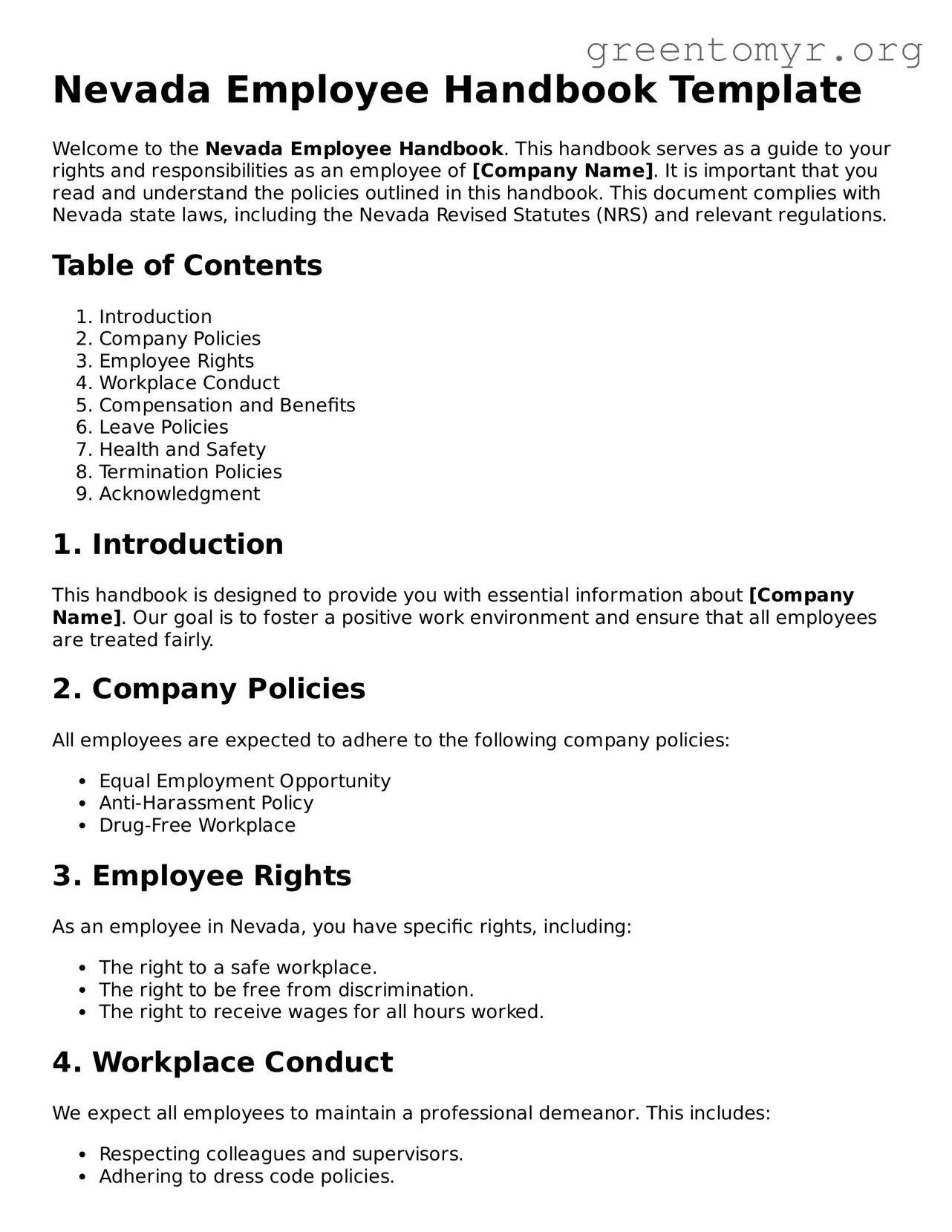
Creating a comprehensive employee handbook is a crucial step for any business operating in Nevada. This document serves as a vital resource for both employers and employees, outlining workplace policies, employee rights, and expectations. The Nevada Employee Handbook form encompasses essential components such as company culture, code of conduct, anti-discrimination policies, and employee benefits. It also addresses important topics like attendance, leave policies, and disciplinary procedures. By clearly defining these elements, the handbook helps to foster a positive work environment and minimizes potential legal disputes. Additionally, it provides employees with a clear understanding of their roles and responsibilities, ensuring everyone is on the same page. With the right information included, this handbook can serve as a foundational tool for effective communication within the organization.
Nevada Employee Handbook Template
Welcome to the Nevada Employee Handbook. This handbook serves as a guide to your rights and responsibilities as an employee of [Company Name]. It is important that you read and understand the policies outlined in this handbook. This document complies with Nevada state laws, including the Nevada Revised Statutes (NRS) and relevant regulations.
Table of Contents
1. Introduction
This handbook is designed to provide you with essential information about [Company Name]. Our goal is to foster a positive work environment and ensure that all employees are treated fairly.
2. Company Policies
All employees are expected to adhere to the following company policies:
3. Employee Rights
As an employee in Nevada, you have specific rights, including:
4. Workplace Conduct
We expect all employees to maintain a professional demeanor. This includes:
5. Compensation and Benefits
Employees are entitled to receive:
6. Leave Policies
Leave policies include:
7. Health and Safety
Your health and safety are our top priorities. We comply with all Occupational Safety and Health Administration (OSHA) regulations. Employees should report any unsafe conditions immediately.
8. Termination Policies
Termination can occur for various reasons, including:
9. Acknowledgment
By signing below, you acknowledge that you have received, read, and understood the policies outlined in this handbook.
Employee Name: ___________________________
Date: ___________________________
Supervisor Name: ___________________________
Date: ___________________________
| Fact Name | Description |
|---|---|
| Purpose | The Nevada Employee Handbook serves as a guide for employees, outlining company policies and procedures. |
| Governing Law | The handbook is governed by Nevada Revised Statutes (NRS) Chapter 613. |
| Mandatory Policies | Employers must include specific policies, such as anti-discrimination and harassment policies. |
| At-Will Employment | The handbook should clarify that employment is at-will, meaning either party can terminate the relationship at any time. |
| Employee Rights | Employees have rights under state and federal laws, which should be clearly stated in the handbook. |
| Updates | The handbook must be updated regularly to reflect changes in laws or company policies. |
| Acknowledgment | Employees should sign an acknowledgment form indicating they have received and understood the handbook. |
| Confidentiality | Confidentiality policies should be included to protect sensitive company information. |
| Compliance Training | The handbook may require employees to undergo training on compliance with workplace policies. |
| Non-Discrimination | It must include a commitment to a non-discriminatory workplace, in line with state and federal laws. |
Filling out the Nevada Employee Handbook form is a straightforward process. Once completed, you will have a document that outlines important workplace policies and guidelines. This ensures that you are aware of your rights and responsibilities as an employee. Follow the steps below to fill out the form accurately.
The Nevada Employee Handbook form is a document that outlines the policies, procedures, and expectations of an employer in Nevada. It serves as a guide for employees to understand their rights and responsibilities within the workplace.
This form is intended for employers operating in Nevada who wish to create a comprehensive handbook for their employees. It is suitable for businesses of all sizes and industries.
A typical Nevada Employee Handbook includes the following components:
While it is not legally required to provide an employee handbook in Nevada, it is highly recommended. A well-crafted handbook can help prevent misunderstandings and protect the employer from potential legal issues.
The employee handbook should be reviewed and updated regularly, at least annually, or whenever there are significant changes in laws or company policies. Keeping the handbook current ensures that employees have access to the latest information.
Yes, an employee handbook can be modified after distribution. Employers should communicate any changes to employees clearly and provide updated copies of the handbook to ensure everyone is informed.
If employees have questions about the handbook, they should reach out to their supervisor or the human resources department. It is important for employees to seek clarification on any policies or procedures they do not understand.
Yes, employers must ensure that their handbook complies with federal and state employment laws. It is advisable to consult with a legal professional to ensure that the handbook does not contain any discriminatory policies and adheres to labor laws.
Employers can ensure that employees understand the handbook by conducting training sessions, providing orientation for new hires, and encouraging questions. Acknowledgment forms can also be used to confirm that employees have read and understood the handbook.
If an employee violates a policy outlined in the handbook, the employer should follow the disciplinary procedures specified in the handbook. This may include verbal warnings, written warnings, or other disciplinary actions, depending on the severity of the violation.
Filling out the Nevada Employee Handbook form can seem straightforward, but many individuals make common mistakes that can lead to confusion or complications later on. One frequent error is failing to read the entire document thoroughly before signing. Understanding the policies and procedures outlined in the handbook is crucial for both employees and employers. Skipping this step may result in misunderstandings about workplace expectations.
Another mistake involves neglecting to provide accurate personal information. Employees often rush through this section, leading to typos or incomplete data. Incorrect information can hinder communication and create issues when employers need to reach out regarding important updates or benefits.
Many individuals overlook the importance of signing and dating the form. Without a signature, the document may not be considered valid. Furthermore, failing to date the form can create ambiguity about when the employee acknowledged the handbook, which is essential for record-keeping purposes.
Additionally, some employees do not take the time to ask questions about unclear policies. If something in the handbook is confusing, it is vital to seek clarification. Ignoring this step can lead to compliance issues or unintentional violations of company policies.
Another common error is not keeping a copy of the signed handbook. Employees should always retain a personal copy for their records. This can be beneficial if disputes arise regarding what was communicated in the handbook.
Some individuals may also fail to update their information after a life change, such as a marriage or relocation. This oversight can lead to communication breakdowns and potential issues with benefits or payroll.
Moreover, employees sometimes ignore the policies regarding social media and conduct outside of work. Not adhering to these guidelines can have repercussions for both the employee and the employer, particularly in a state like Nevada, where employment laws can be strict.
Lastly, many individuals do not familiarize themselves with the grievance procedure outlined in the handbook. Understanding how to address concerns or complaints is essential for maintaining a positive work environment. Employees should know their rights and the proper channels to follow if they encounter issues.
The Nevada Employee Handbook form serves as a crucial document for outlining workplace policies and expectations. Alongside this handbook, several other forms and documents are commonly utilized to ensure clarity and compliance within the workplace. Below is a list of these important documents.
These documents work together with the Nevada Employee Handbook to create a comprehensive framework for employee management and organizational policies. Each plays a vital role in fostering a clear understanding of expectations and responsibilities within the workplace.
The Employee Handbook serves as a vital resource for employees, outlining company policies, procedures, and expectations. Several other documents share similarities with the Employee Handbook, each serving a specific purpose within the workplace. Below is a list of these similar documents:
When filling out the Nevada Employee Handbook form, it’s important to approach the task thoughtfully. Here’s a list of things you should and shouldn’t do to ensure that your submission is accurate and complete.
Understanding the Nevada Employee Handbook form is essential for both employers and employees. However, there are several misconceptions that can lead to confusion. Below is a list of common misunderstandings along with clarifications.
While not legally required, having an Employee Handbook is highly recommended. It helps set clear expectations and policies, which can protect both the employer and employees.
A concise and straightforward handbook is often more effective. Clarity is key; employees should easily understand the policies.
Policies and laws change over time. Regular reviews and updates ensure that the handbook remains relevant and compliant.
While it’s beneficial to have employees acknowledge receipt, it is not a legal requirement. However, having a signed acknowledgment can help prevent disputes.
It is impractical to address every situation. Instead, the handbook should provide general guidelines and direct employees to appropriate resources for specific issues.
The handbook is typically not a binding contract unless explicitly stated. It serves as a guide for policies and procedures.
All employees should be familiar with the handbook. It is a tool for everyone, promoting a better understanding of workplace expectations.
Ignoring state laws can lead to legal issues. The handbook should comply with Nevada laws and regulations to ensure protection for both parties.
Having a legal professional review the handbook can help identify potential issues and ensure compliance with applicable laws.
By addressing these misconceptions, both employers and employees can better navigate the policies outlined in the Nevada Employee Handbook.
When filling out and using the Nevada Employee Handbook form, keep the following key takeaways in mind: