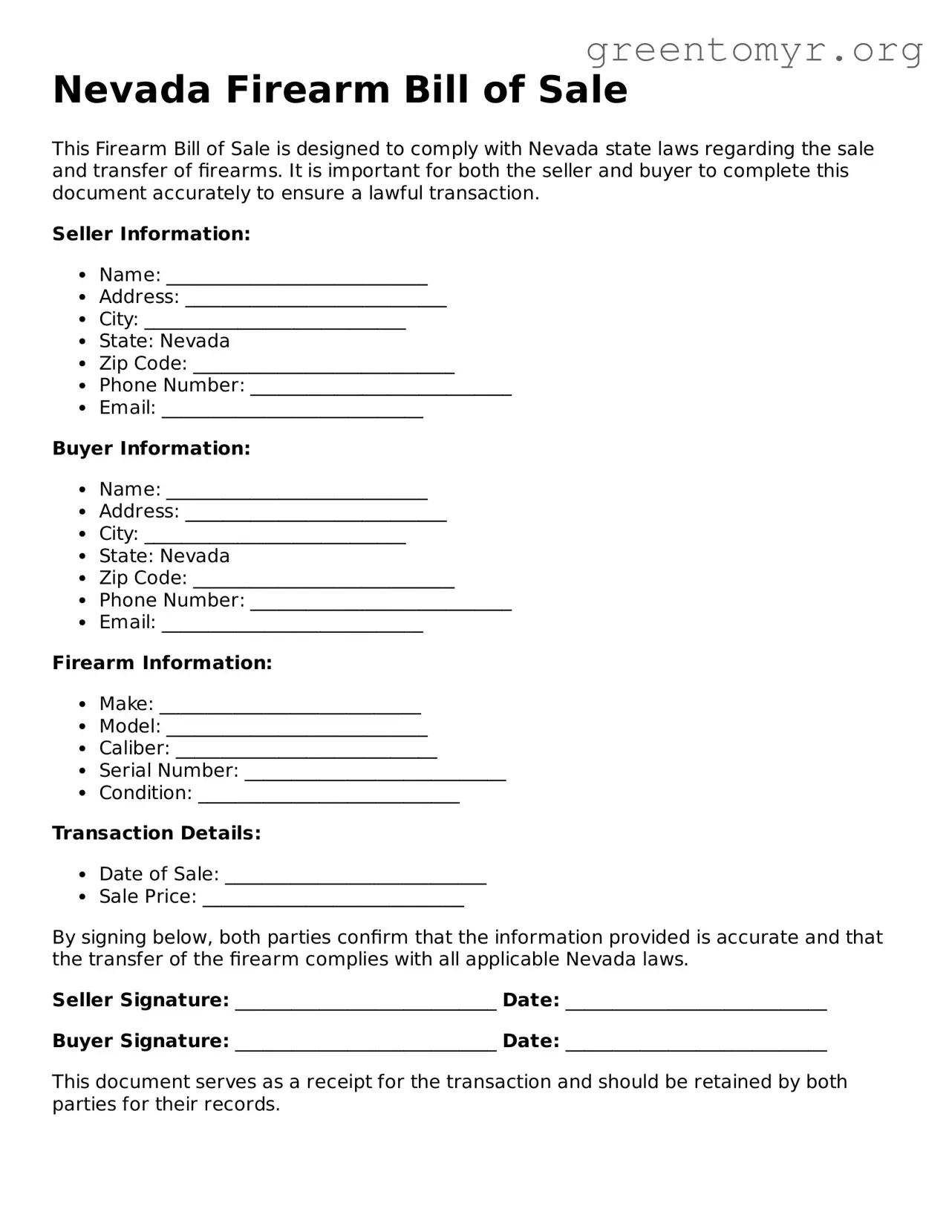
The Nevada Firearm Bill of Sale form serves as a crucial document for individuals engaged in the private sale or transfer of firearms within the state. This form provides a clear record of the transaction, detailing essential information such as the names and addresses of both the seller and buyer, the make and model of the firearm, and its serial number. Importantly, it also includes a declaration that the buyer is legally permitted to own a firearm, ensuring compliance with state laws. By documenting the sale, both parties protect themselves from potential legal issues that may arise in the future. Additionally, the form may serve as a reference for ownership and can aid in the reporting of lost or stolen firearms. Understanding the components of this form is vital for anyone looking to navigate the firearm transfer process in Nevada responsibly.
Nevada Firearm Bill of Sale
This Firearm Bill of Sale is designed to comply with Nevada state laws regarding the sale and transfer of firearms. It is important for both the seller and buyer to complete this document accurately to ensure a lawful transaction.
Seller Information:
Buyer Information:
Firearm Information:
Transaction Details:
By signing below, both parties confirm that the information provided is accurate and that the transfer of the firearm complies with all applicable Nevada laws.
Seller Signature: ____________________________ Date: ____________________________
Buyer Signature: ____________________________ Date: ____________________________
This document serves as a receipt for the transaction and should be retained by both parties for their records.
| Fact Name | Description |
|---|---|
| Purpose | The Nevada Firearm Bill of Sale form is used to document the sale or transfer of a firearm between individuals. |
| Governing Law | This form is governed by Nevada Revised Statutes (NRS) 597.970. |
| Parties Involved | The form includes sections for both the seller and the buyer to provide their information. |
| Identification Requirement | Both parties must present valid identification to complete the transaction legally. |
| Firearm Details | The form requires specific details about the firearm, including make, model, and serial number. |
| Notarization | While notarization is not mandatory, it is recommended to enhance the document's validity. |
| Record Keeping | Both the buyer and seller should keep a copy of the completed bill of sale for their records. |
| Legal Protection | Using this form can provide legal protection for both parties in case of future disputes regarding the firearm. |
Once you have the Nevada Firearm Bill of Sale form in hand, it’s time to fill it out accurately. This document serves as a record of the transaction between the seller and the buyer. Carefully following the steps below will help ensure that all necessary information is provided correctly.
A Firearm Bill of Sale is a legal document that serves as proof of the transfer of ownership of a firearm from one person to another in Nevada. This document is important for both the buyer and the seller, as it provides a record of the transaction and can help protect both parties in case of any future disputes.
While Nevada law does not require a Bill of Sale for private firearm sales, it is highly recommended. Having a Bill of Sale can help establish ownership and provide legal protection. Additionally, if the firearm is ever used in a crime, having documentation of the sale can help prove that you were not the owner at the time of the incident.
A comprehensive Firearm Bill of Sale should include the following information:
Including this information helps ensure that the document is complete and legally binding.
Yes, you can create your own Firearm Bill of Sale. There are many templates available online that can guide you in drafting a document that meets your needs. Just make sure to include all necessary details to ensure the transaction is documented properly. Alternatively, you can also consult with a legal professional to create a customized Bill of Sale.
In Nevada, notarization of the Firearm Bill of Sale is not required. However, having the document notarized can add an extra layer of authenticity and may be beneficial in case of any future disputes. It can also serve as a safeguard for both parties involved in the transaction.
After the transaction is complete, both the buyer and the seller should keep a copy of the Firearm Bill of Sale for their records. This document may be needed in the future for various reasons, such as proving ownership or for legal matters. Store it in a safe place where you can easily access it if necessary.
When filling out the Nevada Firearm Bill of Sale form, individuals often make several common mistakes that can lead to complications. One frequent error is failing to include all required information. Each section of the form must be completed accurately. Missing details can render the document invalid.
Another mistake is not providing the correct identification for both the buyer and the seller. This includes full names, addresses, and valid identification numbers. Incomplete or inaccurate identification can create issues during the transaction.
Many people overlook the importance of documenting the firearm's details. The make, model, caliber, and serial number should all be included. Without this information, it may be challenging to prove ownership or trace the firearm in the future.
Some individuals forget to sign the form. Both parties must sign the Bill of Sale for it to be legally binding. A missing signature can lead to disputes later on.
Another common mistake is not keeping a copy of the completed Bill of Sale. Both the buyer and the seller should retain a copy for their records. This can be crucial if any questions arise about the transaction in the future.
It's also important to ensure that the form is filled out in ink, not pencil. Pencil can smudge or be altered easily, which could lead to issues with the document's integrity.
People sometimes fail to check the date on the form. The date of the transaction must be clearly indicated. An incorrect date can lead to confusion about when the sale took place.
Additionally, some individuals do not verify that they are legally allowed to buy or sell firearms. Both parties should confirm their eligibility to avoid legal repercussions.
In some cases, buyers or sellers may not understand the local laws regarding firearm sales. Each state has specific regulations, and failing to comply with them can lead to legal issues.
Finally, rushing through the process can lead to mistakes. Taking the time to carefully review the form before submission can prevent errors that could complicate the transaction.
When engaging in the sale or transfer of a firearm in Nevada, several forms and documents may be required alongside the Nevada Firearm Bill of Sale form. These documents help ensure compliance with state laws and provide clarity for both the buyer and the seller.
Utilizing these documents alongside the Nevada Firearm Bill of Sale can facilitate a smoother transaction and provide necessary legal protections for both parties involved. Always ensure that you are following current state regulations and guidelines when completing these forms.
The Firearm Bill of Sale form serves as a legal document for the transfer of ownership of a firearm. It shares similarities with several other documents used in various transactions. Below is a list of documents that are comparable to the Firearm Bill of Sale form:
Each of these documents plays a crucial role in ensuring that transactions are documented clearly and legally, similar to the Firearm Bill of Sale form.
When filling out the Nevada Firearm Bill of Sale form, it is important to follow certain guidelines to ensure that the process is smooth and legally compliant. Here are some key dos and don’ts to keep in mind:
There are several misconceptions surrounding the Nevada Firearm Bill of Sale form. Understanding these can help clarify the process for individuals looking to buy or sell firearms in the state.
Many believe that a Bill of Sale is optional. In Nevada, while not legally required for private sales, it is highly recommended to provide proof of the transaction.
Some people think that notarization is mandatory. However, notarization is not required for the Bill of Sale to be valid in Nevada.
It is a common belief that only licensed firearm dealers can utilize this form. In fact, private individuals can also use it for personal transactions.
Many assume that the Bill of Sale must be submitted to a government agency. In reality, it is kept by the buyer and seller for their records.
While the form serves as proof of sale, it does not guarantee immunity from future legal issues related to the firearm.
Some believe that a background check is required for all private sales. In Nevada, background checks are only mandatory when purchasing from a licensed dealer.
While it is possible to create a handwritten Bill of Sale, using a standardized form is recommended for clarity and completeness.
People often think this document is exclusive to handguns. However, it can be used for all types of firearms, including rifles and shotguns.
Some individuals believe any format will suffice. In reality, the Bill of Sale should include specific details about the firearm and the transaction to be effective.
When dealing with the Nevada Firearm Bill of Sale form, understanding its nuances is crucial for both buyers and sellers. Here are some key takeaways to keep in mind:
By keeping these key points in mind, individuals can navigate the process of buying or selling a firearm in Nevada more effectively and responsibly.