Content Navigation

In Nevada, the General Power of Attorney form is a crucial document that allows individuals to appoint someone they trust to manage their financial and legal affairs on their behalf. This form grants the designated agent broad authority, enabling them to make decisions regarding property, bank accounts, investments, and other financial matters. It is particularly useful in situations where a person may be unable to handle their affairs due to illness, travel, or other circumstances. The form must be completed with care, as it requires specific information about both the principal—the person granting the authority—and the agent—the person receiving it. Additionally, the document typically needs to be signed in front of a notary public to ensure its validity. Understanding the implications of this form is essential, as it can empower someone to act decisively in your best interest while also carrying significant responsibilities. By using the General Power of Attorney, individuals can ensure that their wishes are respected and that their affairs are managed effectively, even when they are unable to do so themselves.

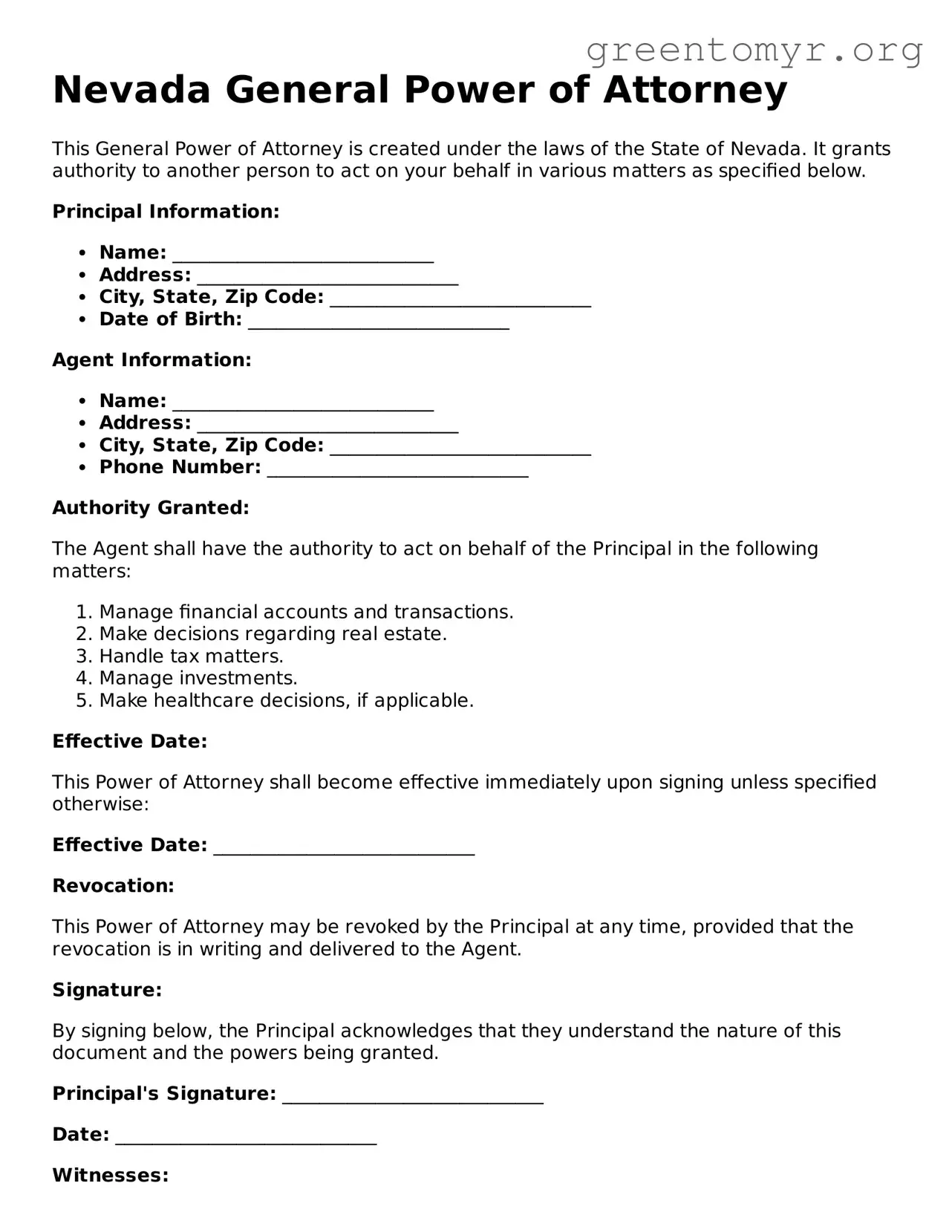
Nevada General Power of Attorney Example

Nevada General Power of Attorney

This General Power of Attorney is created under the laws of the State of Nevada. It grants authority to another person to act on your behalf in various matters as specified below.

Principal Information:

  • Name: ____________________________
  • Address: ____________________________
  • City, State, Zip Code: ____________________________
  • Date of Birth: ____________________________

Agent Information:

  • Name: ____________________________
  • Address: ____________________________
  • City, State, Zip Code: ____________________________
  • Phone Number: ____________________________

Authority Granted:

The Agent shall have the authority to act on behalf of the Principal in the following matters:

  1. Manage financial accounts and transactions.
  2. Make decisions regarding real estate.
  3. Handle tax matters.
  4. Manage investments.
  5. Make healthcare decisions, if applicable.

Effective Date:

This Power of Attorney shall become effective immediately upon signing unless specified otherwise:

Effective Date: ____________________________

Revocation:

This Power of Attorney may be revoked by the Principal at any time, provided that the revocation is in writing and delivered to the Agent.

Signature:

By signing below, the Principal acknowledges that they understand the nature of this document and the powers being granted.

Principal's Signature: ____________________________

Date: ____________________________

Witnesses:

Two witnesses are required for this document to be valid in Nevada.

  • Witness 1 Name: ____________________________
  • Witness 1 Signature: ____________________________
  • Date: ____________________________
  • Witness 2 Name: ____________________________
  • Witness 2 Signature: ____________________________
  • Date: ____________________________

Notary Public:

This document must be notarized to be legally binding.

Notary Signature: ____________________________

Date: ____________________________

PDF Form Features

Fact Name Details
Definition A Nevada General Power of Attorney allows an individual to appoint someone to manage their financial and legal affairs.
Governing Law The form is governed by Nevada Revised Statutes (NRS) Chapter 162.
Durability This power of attorney can be made durable, meaning it remains effective even if the principal becomes incapacitated.
Revocation The principal can revoke the power of attorney at any time, as long as they are mentally competent to do so.

Guide to Using Nevada General Power of Attorney

Once you have the Nevada General Power of Attorney form ready, it's important to fill it out accurately to ensure it serves its purpose effectively. This form allows you to appoint someone to act on your behalf in financial and legal matters. Follow these steps carefully to complete the form.

  1. Obtain the Form: Download the Nevada General Power of Attorney form from a reliable source or visit your local courthouse to get a physical copy.
  2. Read the Instructions: Familiarize yourself with the form’s sections and any specific instructions provided.
  3. Fill in Your Information: Start by entering your full name, address, and contact information in the designated areas.
  4. Select the Agent: Identify the person you wish to appoint as your agent. Provide their full name, address, and contact details.
  5. Define Powers Granted: Clearly specify the powers you are granting to your agent. This could include managing bank accounts, selling property, or making medical decisions.
  6. Include Effective Date: Indicate when the power of attorney becomes effective. You can choose to make it effective immediately or at a future date.
  7. Sign the Form: Sign and date the form in the designated area. Make sure to do this in the presence of a notary public.
  8. Notarization: Have the form notarized. This step is crucial for the form to be legally valid in Nevada.
  9. Distribute Copies: Make copies of the signed and notarized form. Provide copies to your agent and any relevant institutions or individuals.

After completing the form, ensure that you keep a copy for your records. It’s wise to inform your agent about their responsibilities and the extent of the powers you have granted them. This communication helps avoid any confusion in the future.

Get Answers on Nevada General Power of Attorney

What is a Nevada General Power of Attorney?

A Nevada General Power of Attorney is a legal document that allows one person, known as the principal, to appoint another person, known as the agent or attorney-in-fact, to manage their financial and legal affairs. This document grants broad powers to the agent, enabling them to make decisions on behalf of the principal regarding various matters, such as banking, real estate transactions, and personal property management. It is important to note that the powers granted can be tailored to meet specific needs, and the principal can choose to limit or expand the authority given to the agent.

How do I create a General Power of Attorney in Nevada?

Creating a General Power of Attorney in Nevada involves a few straightforward steps:

  1. Choose your agent: Select a trustworthy individual who will act in your best interest.
  2. Draft the document: You can use a template or work with an attorney to ensure the document meets Nevada’s legal requirements.
  3. Sign the document: The principal must sign the document in the presence of a notary public. This step is crucial, as notarization adds an extra layer of authenticity.
  4. Distribute copies: Provide copies of the signed document to your agent and any relevant financial institutions or parties involved.

Can I revoke a General Power of Attorney in Nevada?

Yes, you can revoke a General Power of Attorney in Nevada at any time, as long as you are mentally competent. To do this, you should follow these steps:

  • Draft a revocation document: Create a written statement that clearly indicates your intention to revoke the previous power of attorney.
  • Notify your agent: Inform your agent that their authority has been revoked. This can be done verbally, but it is best to provide them with a copy of the revocation document.
  • Notify third parties: If your agent has already used the power of attorney with any financial institutions or other parties, it’s wise to inform them of the revocation as well.

What happens if I become incapacitated and have a General Power of Attorney in place?

If you become incapacitated and have a General Power of Attorney in place, your agent will have the authority to make decisions on your behalf as outlined in the document. This includes managing your finances, paying bills, and handling legal matters. However, it’s important to ensure that the document is properly executed and that your agent understands your wishes. If the General Power of Attorney is durable, it remains effective even if you become incapacitated. If it is not durable, the authority of your agent will cease upon your incapacitation.

Common mistakes

Filling out the Nevada General Power of Attorney form can be a straightforward process, but many individuals make common mistakes that can lead to complications down the line. One frequent error is not specifying the powers granted to the agent clearly. It’s essential to outline the exact authority the agent will have, whether it’s managing finances, making healthcare decisions, or handling real estate transactions. Vague language can create confusion and may lead to disputes.

Another common mistake is failing to date the form properly. The date is crucial because it establishes when the power of attorney becomes effective. Without a clear date, there could be uncertainty regarding the validity of the document. Additionally, some individuals forget to sign the form in the presence of a notary. In Nevada, notarization is a requirement for the power of attorney to be legally binding, so neglecting this step can render the document ineffective.

Many people also overlook the importance of choosing the right agent. It’s vital to select someone who is trustworthy and capable of handling the responsibilities outlined in the document. Sometimes, individuals may appoint a family member out of obligation rather than considering their qualifications. This can lead to poor decision-making if the agent is not equipped to manage the tasks assigned to them.

Another mistake involves not considering the potential for revocation. Some individuals fill out the form without realizing that they can revoke the power of attorney at any time, as long as they are mentally competent. Failing to understand this can lead to unnecessary worry about losing control over one’s affairs.

In addition, many people neglect to discuss their wishes with the appointed agent before completing the form. Open communication is key. The agent should be aware of the principal’s preferences and values to make informed decisions on their behalf. Without this dialogue, the agent may inadvertently act against the principal’s wishes.

Moreover, some individuals mistakenly believe that a power of attorney remains effective indefinitely. In reality, certain powers may become invalid under specific circumstances, such as the principal’s incapacitation or death. It’s important to understand the limitations and conditions under which the power of attorney operates.

Lastly, individuals often fail to make copies of the completed form. After signing and notarizing, it’s essential to distribute copies to the agent and any relevant institutions, such as banks or healthcare providers. Without these copies, the agent may face challenges in exercising their authority when needed.

Documents used along the form

When creating a Nevada General Power of Attorney, several other forms and documents may be needed to ensure comprehensive management of financial and legal matters. Here are some common documents that often accompany the General Power of Attorney.

  • Durable Power of Attorney: This document allows an individual to appoint someone to make decisions on their behalf even if they become incapacitated. It remains effective until revoked or the individual passes away.
  • Medical Power of Attorney: This form designates a person to make healthcare decisions for someone if they are unable to do so. It is crucial for ensuring that medical preferences are honored.
  • Living Will: A living will outlines an individual's wishes regarding medical treatment in situations where they cannot communicate their preferences. It provides guidance to healthcare providers and family members.
  • Advance Healthcare Directive: This document combines a Medical Power of Attorney and a Living Will. It provides instructions for medical care and designates a healthcare agent to make decisions on behalf of the individual.

These documents work together to provide a clear plan for managing personal, financial, and medical decisions. It is essential to consider each one carefully to ensure that your wishes are respected and your affairs are handled appropriately.

Similar forms

  • Durable Power of Attorney: This document is similar to a General Power of Attorney but remains effective even if the principal becomes incapacitated. It ensures that the designated agent can continue to make decisions on behalf of the principal, providing a safety net during times of diminished capacity.
  • Limited Power of Attorney: Unlike the General Power of Attorney, which grants broad authority, a Limited Power of Attorney restricts the agent's powers to specific tasks or time frames. This allows individuals to delegate authority for particular transactions without giving up control over all their affairs.
  • Healthcare Power of Attorney: This document specifically focuses on medical decisions. It empowers an agent to make healthcare choices on behalf of the principal if they are unable to do so themselves, ensuring that medical preferences are honored even in critical situations.
  • Financial Power of Attorney: Similar to the General Power of Attorney, this document specifically targets financial matters. It allows an agent to manage financial transactions, pay bills, and handle investments, but may not cover other areas like healthcare or legal issues.
  • Living Will: While not a power of attorney in the traditional sense, a Living Will outlines an individual's preferences regarding medical treatment in end-of-life situations. It complements the Healthcare Power of Attorney by providing guidance on the principal’s wishes, ensuring that the appointed agent can make informed decisions.

Dos and Don'ts

When filling out the Nevada General Power of Attorney form, it is essential to approach the process with care. Here are some key dos and don'ts to consider:

  • Do read the entire form carefully before starting to fill it out. Understanding the document is crucial.
  • Do clearly identify the person you are appointing as your agent. Include their full name and address.
  • Do specify the powers you wish to grant to your agent. Be as detailed as possible to avoid confusion later.
  • Do sign the form in the presence of a notary public. This step is necessary for the document to be legally valid.
  • Don't leave any blank spaces on the form. Fill in all required fields to ensure clarity and completeness.
  • Don't rush through the process. Take your time to ensure that all information is accurate and reflects your wishes.

Taking these steps can help ensure that your General Power of Attorney is filled out correctly and meets your needs. It is always wise to seek guidance if you have questions or concerns.

Misconceptions

Understanding the Nevada General Power of Attorney form can be challenging. Here are some common misconceptions that people have about this important legal document:

  1. It only applies to financial matters. Many believe a General Power of Attorney is limited to financial decisions. In reality, it can cover a wide range of areas, including healthcare and property management.
  2. It is permanent and cannot be revoked. Some think once a General Power of Attorney is signed, it cannot be changed or revoked. However, the principal can revoke it at any time, as long as they are mentally competent.
  3. Only lawyers can create a General Power of Attorney. While it is advisable to consult a lawyer, individuals can create a valid General Power of Attorney on their own using the appropriate forms.
  4. It must be notarized to be valid. Although notarization is recommended for added validity, a General Power of Attorney can still be valid without it, depending on the specific circumstances.
  5. It becomes effective only when the principal is incapacitated. Many think that a General Power of Attorney only takes effect when the principal is unable to make decisions. In fact, it can be effective immediately upon signing, unless specified otherwise.
  6. All powers are granted automatically. Some assume that signing the form gives the agent unlimited power. The principal can specify which powers are granted and which are not.
  7. It is the same as a Durable Power of Attorney. People often confuse the two. A Durable Power of Attorney remains effective even if the principal becomes incapacitated, while a General Power of Attorney may not.
  8. Agents cannot be held accountable. There is a belief that agents can act without consequences. However, agents have a fiduciary duty to act in the principal's best interest and can be held liable for misuse of power.
  9. Once it is created, it cannot be updated. Some think that a General Power of Attorney is a one-time document. In fact, it can be updated or modified as needed to reflect changes in the principal's wishes.

Being informed about these misconceptions can help individuals make better decisions regarding their legal rights and responsibilities.

Key takeaways

When dealing with the Nevada General Power of Attorney form, it’s important to understand its purpose and how to use it effectively. Here are some key takeaways:

  • Understand the Purpose: A General Power of Attorney allows you to appoint someone you trust to handle your financial and legal matters if you become unable to do so yourself.
  • Choose Your Agent Wisely: Select someone responsible and trustworthy. This person will have significant authority over your affairs.
  • Specify Powers Clearly: Clearly outline the powers you are granting. This could include managing bank accounts, signing checks, or making investment decisions.
  • Consider a Durable Option: If you want the power of attorney to remain effective even if you become incapacitated, ensure it is a durable power of attorney.
  • Review and Update Regularly: Life circumstances change, so it’s wise to review and update your power of attorney regularly to reflect your current wishes.

These points will help ensure that your Nevada General Power of Attorney form serves its intended purpose effectively and protects your interests.