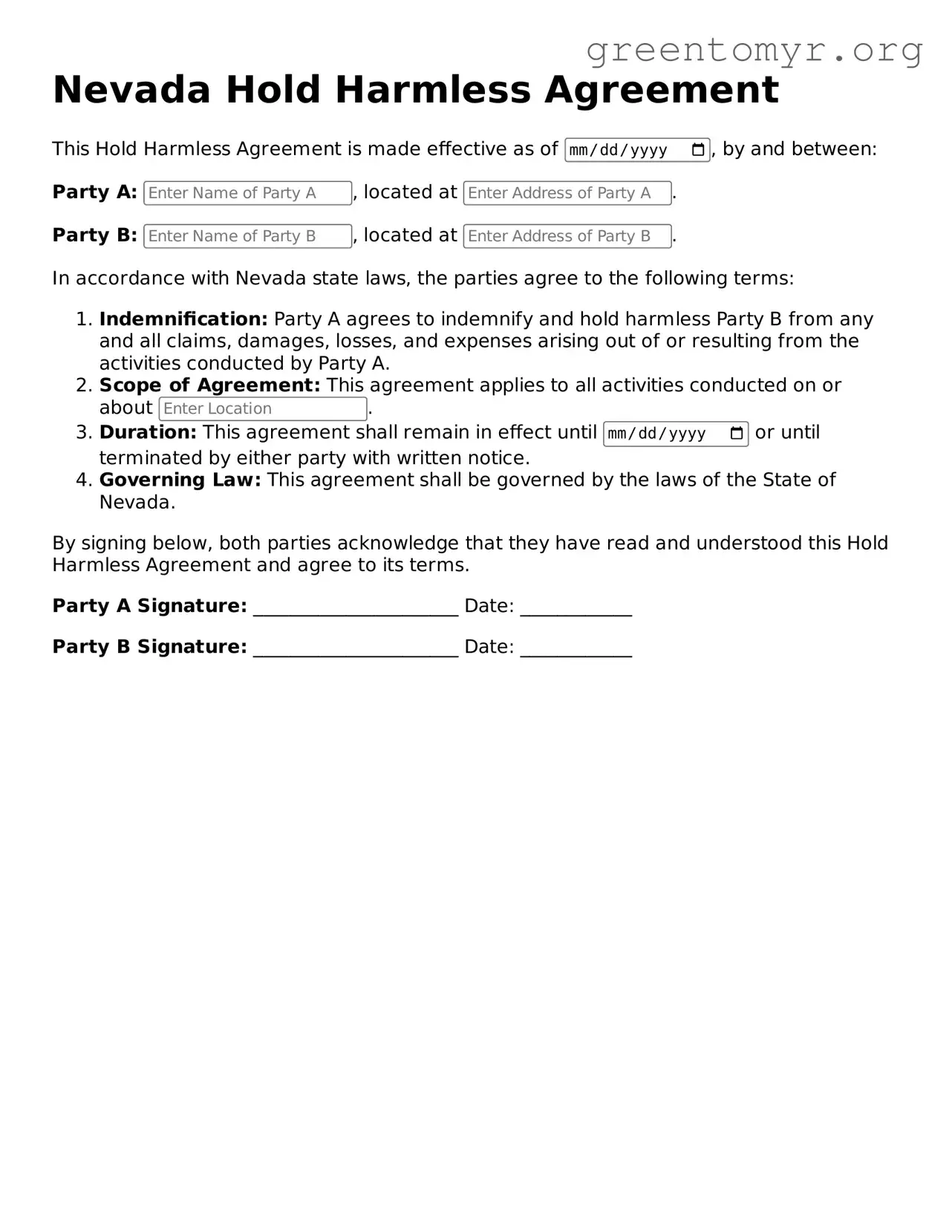
In the vibrant landscape of Nevada, where outdoor adventures and recreational activities abound, the Hold Harmless Agreement form plays a crucial role in protecting individuals and organizations from potential legal liabilities. This agreement serves as a written commitment, ensuring that one party agrees to assume responsibility for any injuries, damages, or losses that may occur during a specified activity or event. Whether it's a thrilling day at a local amusement park, a community sports event, or a private gathering, this form is designed to safeguard the interests of all parties involved. By clearly outlining the responsibilities and expectations, the Hold Harmless Agreement fosters a sense of security and trust among participants. It emphasizes the importance of informed consent, allowing individuals to understand the risks associated with their chosen activities while promoting a culture of safety and accountability. Understanding the nuances of this agreement can empower both organizers and participants to navigate potential risks with confidence.
Nevada Hold Harmless Agreement
This Hold Harmless Agreement is made effective as of , by and between:
Party A: , located at .
Party B: , located at .
In accordance with Nevada state laws, the parties agree to the following terms:
By signing below, both parties acknowledge that they have read and understood this Hold Harmless Agreement and agree to its terms.
Party A Signature: ______________________ Date: ____________
Party B Signature: ______________________ Date: ____________
| Fact Name | Description |
|---|---|
| Purpose | The Nevada Hold Harmless Agreement protects one party from liability for any damages or injuries that may occur during a specific activity. |
| Parties Involved | Typically, there are two parties: the indemnitor (the one who agrees to hold harmless) and the indemnitee (the one being protected). |
| Governing Law | This agreement is governed by the laws of the State of Nevada. |
| Common Uses | It is often used in rental agreements, event planning, and construction contracts. |
| Enforceability | For the agreement to be enforceable, it must be clear and unambiguous. |
| Consideration | Some form of consideration, like payment or a service, may be required for the agreement to be valid. |
| Limitations | It cannot protect against gross negligence or willful misconduct. |
| Written Form | A written agreement is recommended to avoid disputes over terms. |
| Signature Requirement | Both parties should sign the agreement to demonstrate mutual consent. |
| Legal Advice | Consulting with a legal professional before signing is advisable to understand rights and obligations. |
After obtaining the Nevada Hold Harmless Agreement form, you will need to fill it out carefully. This process ensures that all necessary information is accurately recorded. Follow these steps to complete the form correctly.
Once you have filled out the form, ensure that all parties involved receive their copies. This will help maintain clear communication and understanding moving forward.
A Nevada Hold Harmless Agreement is a legal document designed to protect one party from liability or claims that may arise from certain activities or events. By signing this agreement, one party agrees not to hold the other responsible for any injuries, damages, or losses that may occur.
This agreement is commonly used by businesses, contractors, event organizers, and property owners. It is particularly relevant in situations where there is a risk of injury or damage, such as construction sites, recreational activities, or rental agreements.
A comprehensive Hold Harmless Agreement should include the following elements:
Yes, a Hold Harmless Agreement is generally enforceable in Nevada, provided it is properly drafted and signed. However, it is important to note that certain limitations may apply, especially in cases of gross negligence or willful misconduct. Always consult with a legal professional to ensure the agreement meets all legal requirements.
Yes, a Hold Harmless Agreement can be modified after it has been signed. Both parties must agree to the changes, and it is advisable to document any modifications in writing. This helps to avoid misunderstandings in the future.
Without a Hold Harmless Agreement, parties may face significant financial risks. If an injury or damage occurs, the party without the agreement could be held liable for costs associated with medical bills, property damage, or legal fees. This could lead to costly lawsuits and financial strain. Therefore, it is wise to consider having this agreement in place to protect against unforeseen liabilities.
Filling out the Nevada Hold Harmless Agreement form can seem straightforward, but many people make common mistakes that can lead to complications later on. One frequent error is failing to provide complete information. When individuals leave out essential details, such as names, addresses, or dates, it can render the agreement invalid. Ensuring that all required fields are filled out accurately is crucial for the document's effectiveness.
Another mistake often encountered is not reading the entire form before signing. Many people may rush through the process, overlooking important clauses or stipulations. This can lead to misunderstandings about the responsibilities and liabilities being agreed upon. Taking the time to thoroughly review the document can prevent future disputes and ensure that all parties are on the same page.
Some individuals also neglect to understand the implications of the agreement. A Hold Harmless Agreement is designed to protect one party from legal liability for actions taken by another. If someone signs without fully grasping the terms, they may inadvertently agree to take on more risk than they intended. It’s vital to comprehend what you are agreeing to before putting pen to paper.
Additionally, people sometimes forget to have the agreement witnessed or notarized when required. In Nevada, certain agreements may need a witness or a notary public to be legally binding. Failing to include these steps can lead to challenges in enforcing the agreement later on.
Another common oversight is not keeping a copy of the signed agreement. After filling out the form, it's essential to retain a copy for personal records. Without documentation, individuals may find it difficult to prove the terms of the agreement if a dispute arises.
Lastly, some individuals may mistakenly believe that a Hold Harmless Agreement absolves them of all liability. While it does provide a level of protection, it does not cover every possible scenario. Understanding the limitations of the agreement is important to avoid false expectations about liability and legal protection.
When using a Nevada Hold Harmless Agreement, it’s essential to understand other related documents that may be required. These documents help clarify responsibilities and protect the interests of all parties involved. Below are some commonly used forms that often accompany a Hold Harmless Agreement.
Understanding these documents can help you navigate legal responsibilities effectively. Having the right forms in place is crucial for protecting your interests and ensuring smooth interactions between parties.
The Hold Harmless Agreement form shares similarities with several other legal documents. Each of these documents serves a purpose related to liability and risk management. Below is a list of six documents that are comparable to the Hold Harmless Agreement:
When filling out the Nevada Hold Harmless Agreement form, it’s important to be careful and thorough. Here are some things you should and shouldn’t do:
There are several misconceptions surrounding the Nevada Hold Harmless Agreement form. Understanding these can help individuals and businesses navigate their responsibilities and rights more effectively. Here are ten common misconceptions:
Clarifying these misconceptions can lead to better understanding and use of Hold Harmless Agreements in various situations.
When considering the Nevada Hold Harmless Agreement, it’s important to understand its implications and proper usage. Here are some key takeaways to keep in mind:
Understanding these points can help individuals and businesses navigate the complexities of liability and protection under Nevada law.