Planning for the future is an essential part of life, and one of the most important documents you can create is a Last Will and Testament. In Nevada, this form serves as a legal declaration of your wishes regarding the distribution of your assets after you pass away. It allows you to appoint an executor, the individual responsible for carrying out your instructions, ensuring that your estate is managed according to your desires. Additionally, the form provides the opportunity to designate guardians for minor children, offering peace of mind for their care. Whether you have a modest collection of belongings or a more extensive estate, a Last Will and Testament can help avoid confusion and disputes among your loved ones. Understanding the key components of this document is crucial, as it not only reflects your wishes but also serves as a guide for your family during a challenging time. In Nevada, specific legal requirements must be met for the will to be valid, including the need for witnesses and the proper signing process. By taking the time to create this important document, you ensure that your legacy is honored and that your loved ones are supported in accordance with your wishes.
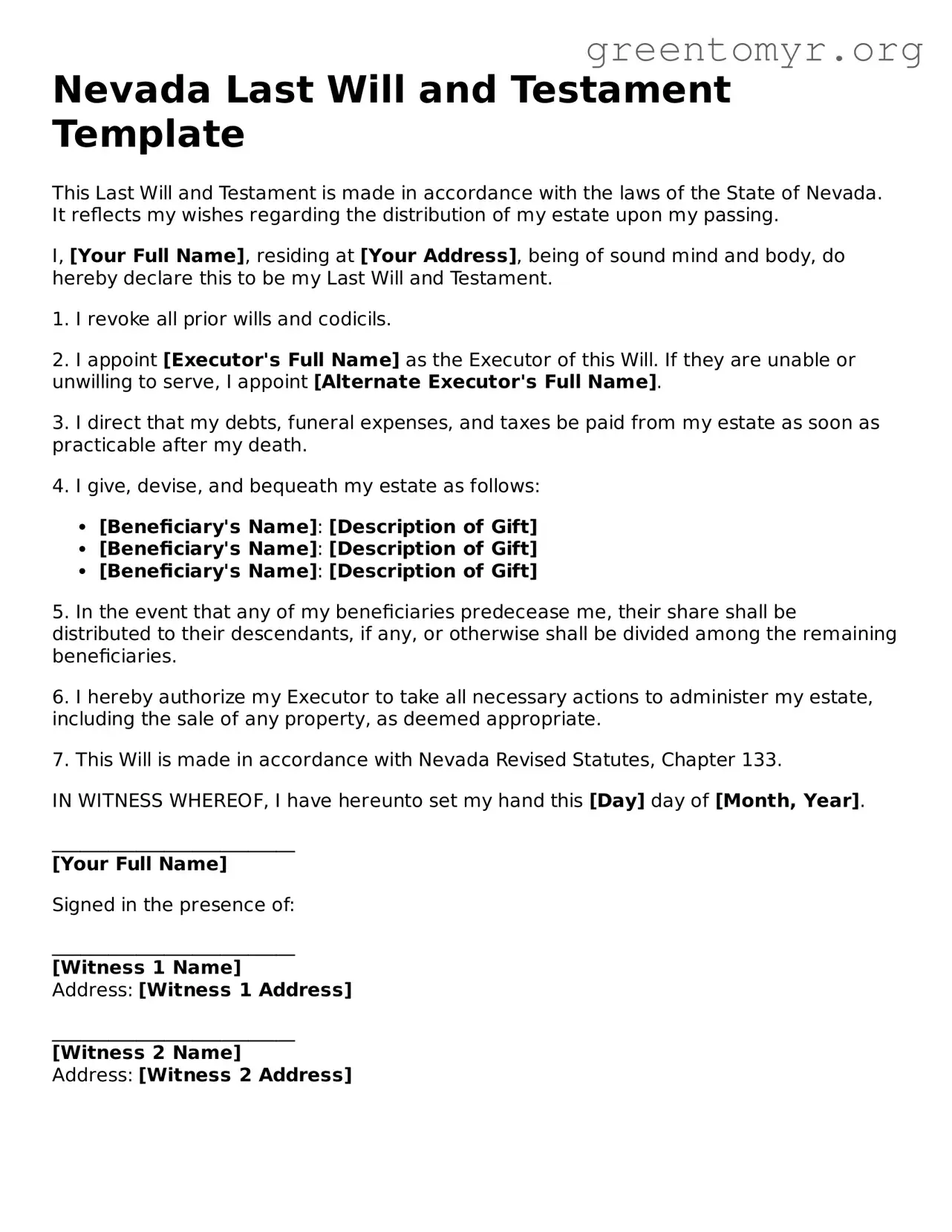
Nevada Last Will and Testament Template
This Last Will and Testament is made in accordance with the laws of the State of Nevada. It reflects my wishes regarding the distribution of my estate upon my passing.
I, [Your Full Name], residing at [Your Address], being of sound mind and body, do hereby declare this to be my Last Will and Testament.
1. I revoke all prior wills and codicils.
2. I appoint [Executor's Full Name] as the Executor of this Will. If they are unable or unwilling to serve, I appoint [Alternate Executor's Full Name].
3. I direct that my debts, funeral expenses, and taxes be paid from my estate as soon as practicable after my death.
4. I give, devise, and bequeath my estate as follows:
5. In the event that any of my beneficiaries predecease me, their share shall be distributed to their descendants, if any, or otherwise shall be divided among the remaining beneficiaries.
6. I hereby authorize my Executor to take all necessary actions to administer my estate, including the sale of any property, as deemed appropriate.
7. This Will is made in accordance with Nevada Revised Statutes, Chapter 133.
IN WITNESS WHEREOF, I have hereunto set my hand this [Day] day of [Month, Year].
__________________________
[Your Full Name]
Signed in the presence of:
__________________________
[Witness 1 Name]
Address: [Witness 1 Address]
__________________________
[Witness 2 Name]
Address: [Witness 2 Address]
| Fact Name | Description |
|---|---|
| Governing Law | The Nevada Last Will and Testament is governed by Nevada Revised Statutes (NRS) Chapter 133. |
| Age Requirement | In Nevada, individuals must be at least 18 years old to create a valid will. |
| Witness Requirement | A will in Nevada must be signed by at least two witnesses who are present at the same time. |
| Signature Requirement | The testator, or the person making the will, must sign the document or direct someone else to sign it in their presence. |
| Revocation | A will can be revoked in Nevada by creating a new will, physically destroying the existing will, or by a written declaration. |
| Holographic Wills | Nevada recognizes holographic wills, which are handwritten and do not require witnesses, provided they are signed by the testator. |
| Self-Proving Wills | A self-proving will includes a notarized affidavit from the witnesses, which can simplify the probate process. |
| Property Distribution | The will allows the testator to specify how their assets will be distributed after their death, including personal property and real estate. |
Once you have gathered the necessary information, you can begin filling out the Nevada Last Will and Testament form. This document is crucial for ensuring that your wishes regarding your assets and responsibilities are clearly stated and legally recognized. Follow these steps carefully to complete the form accurately.
After completing the form, ensure that it is stored in a safe place where it can be easily accessed when needed. Inform your executor and trusted family members about its location. This will help avoid any confusion or disputes regarding your wishes in the future.
A Last Will and Testament is a legal document that outlines how a person's assets and affairs should be handled after their death. In Nevada, this document allows individuals to specify beneficiaries for their property, appoint guardians for minor children, and name an executor to manage the estate. It serves as a crucial tool for ensuring that a person's wishes are respected and can help avoid disputes among family members.
While it is not legally required to have a lawyer to create a Last Will and Testament in Nevada, consulting with one can be beneficial. A lawyer can provide guidance on state laws, help ensure that the will is valid, and assist in addressing complex family situations or substantial assets. For straightforward estates, individuals may choose to use online templates or forms, but legal advice can help avoid potential pitfalls.
In Nevada, a valid Last Will and Testament must meet several requirements:
Yes, individuals in Nevada can change or revoke their Last Will and Testament at any time, as long as they are of sound mind. This can be done by creating a new will that explicitly revokes the previous one or by physically destroying the old will. It is important to ensure that any changes are clearly documented and that the new will meets all legal requirements to avoid confusion or disputes.
If a person dies without a will in Nevada, they are considered to have died "intestate." In such cases, state laws dictate how the deceased's assets will be distributed. Generally, the estate will be divided among surviving relatives according to a predetermined hierarchy. This may lead to outcomes that do not align with the deceased's wishes, emphasizing the importance of having a will in place.
To ensure that your will is executed properly, consider the following steps:
Yes, you can include specific gifts or bequests in your Last Will and Testament. This allows you to designate particular items or amounts of money to specific individuals or organizations. It is essential to be clear and specific about these gifts to avoid confusion. Additionally, consider including a residuary clause, which addresses how any remaining assets should be distributed after specific gifts are made.
A handwritten will, also known as a holographic will, can be valid in Nevada as long as it meets specific criteria. The entire will must be in the testator's handwriting, and it must be signed by the testator. While holographic wills can be valid, they may lead to disputes regarding their validity or interpretation, so it is often advisable to create a formally drafted will with witnesses.
If you believe you have grounds to contest a will in Nevada, it is important to consult with a qualified attorney who specializes in estate law. Common grounds for contesting a will include lack of testamentary capacity, undue influence, or improper execution. The process typically involves filing a petition with the court and providing evidence to support your claim. Legal guidance can help navigate the complexities of this process.
Filling out a Last Will and Testament form in Nevada can be a straightforward process, but several common mistakes can complicate matters. One significant error occurs when individuals fail to properly identify their beneficiaries. It is essential to clearly name each beneficiary and specify what they will receive. Ambiguities can lead to disputes among family members and may even result in unintended consequences.
Another frequent mistake is neglecting to sign the will in the presence of witnesses. Nevada law requires that a will be signed by the testator and at least two witnesses who are not beneficiaries. If this requirement is not met, the will may be deemed invalid. Ensuring that all signatures are in place is crucial for the will to hold up in court.
People also often overlook the importance of updating their wills. Life changes such as marriage, divorce, or the birth of a child can significantly affect one’s estate plan. Failing to revise the will to reflect these changes can lead to outdated provisions that no longer align with the testator’s wishes. Regular reviews of the document are vital to ensure it remains relevant.
Finally, many individuals make the mistake of not storing their will in a safe and accessible location. A will that cannot be found after the testator’s passing can cause delays in the probate process and may lead to confusion among heirs. It is advisable to keep the will in a secure place, such as a safe deposit box, while also informing trusted family members or an attorney of its location.
When creating a Last Will and Testament in Nevada, several other documents may be necessary to ensure your wishes are fully realized. Each of these documents serves a unique purpose and can help streamline the estate planning process. Below is a list of commonly used forms and documents that complement the Last Will and Testament.
Having these documents in place can help ensure that your estate is managed according to your wishes and can ease the burden on your loved ones during a difficult time. Proper planning is key to a smooth transition and peace of mind.
When filling out the Nevada Last Will and Testament form, it’s important to approach the process with care. Here are some key do's and don'ts to keep in mind:
When it comes to creating a Last Will and Testament in Nevada, several misconceptions can lead to confusion and potentially impact the effectiveness of your estate planning. Understanding these misconceptions is crucial for ensuring that your wishes are honored after your passing. Below are some common misunderstandings about the Nevada Last Will and Testament form.
By addressing these misconceptions, individuals can better navigate the process of creating a Last Will and Testament in Nevada, ensuring their intentions are clearly documented and respected.
Creating a Last Will and Testament in Nevada is an important step in ensuring your wishes are honored after your passing. Here are some key takeaways to consider when filling out and using this legal document:
By following these guidelines, you can create a clear and effective Last Will and Testament that reflects your wishes and provides peace of mind for your loved ones.