When couples in Nevada decide to take a step back from their marriage, a Marital Separation Agreement can serve as a crucial tool in navigating this challenging transition. This document outlines the terms of the separation, addressing key issues such as the division of property, spousal support, and child custody arrangements. By clearly defining each party's rights and responsibilities, the agreement helps to minimize misunderstandings and conflicts during a time that can be emotionally charged. It is essential for both spouses to consider their individual needs and circumstances while drafting the agreement, as it can significantly impact their lives moving forward. Additionally, having a well-structured separation agreement can lay the groundwork for a smoother divorce process, should the couple ultimately choose to pursue that route. Understanding the components of this form, including how to address financial obligations and parenting plans, is vital for anyone considering separation in Nevada.
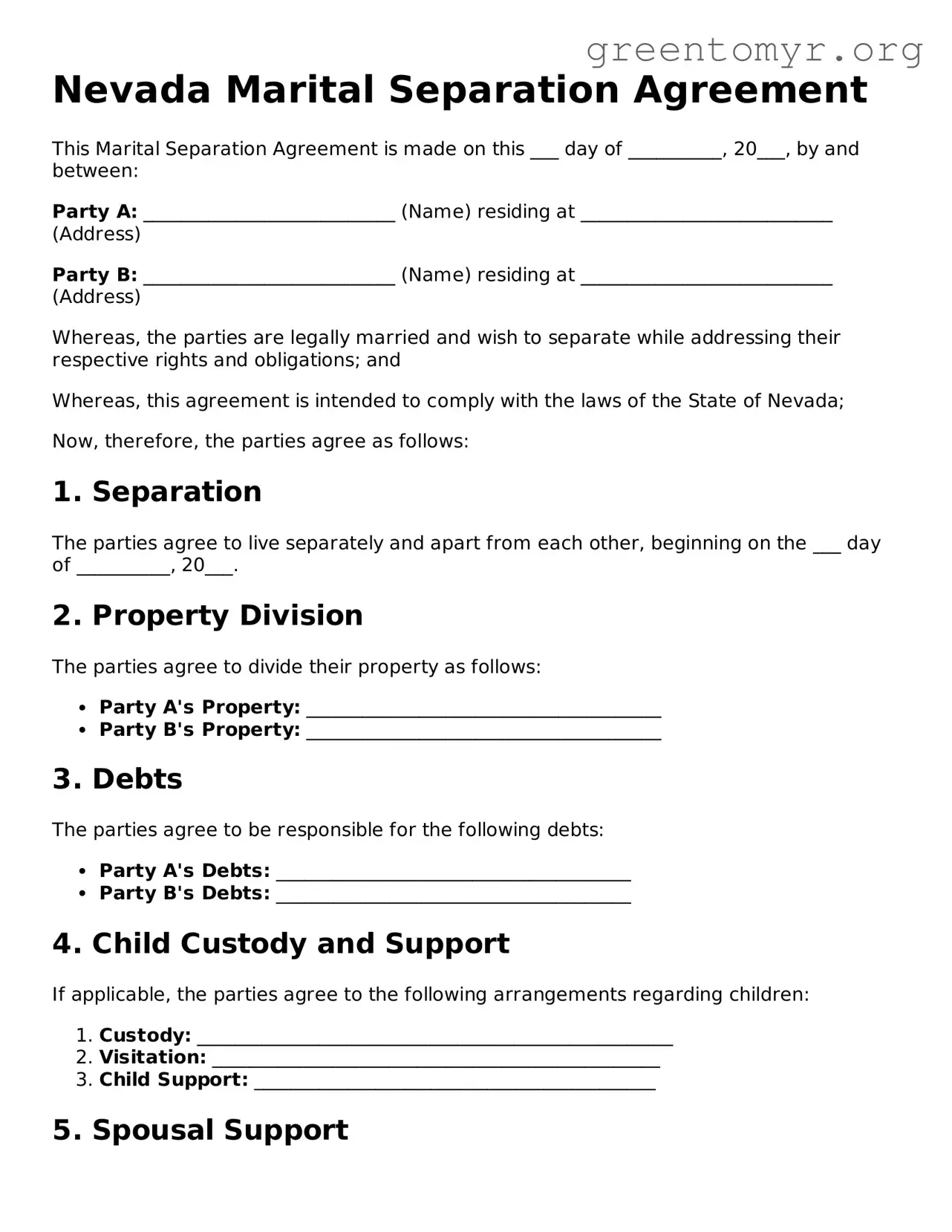
Nevada Marital Separation Agreement
This Marital Separation Agreement is made on this ___ day of __________, 20___, by and between:
Party A: ___________________________ (Name) residing at ___________________________ (Address)
Party B: ___________________________ (Name) residing at ___________________________ (Address)
Whereas, the parties are legally married and wish to separate while addressing their respective rights and obligations; and
Whereas, this agreement is intended to comply with the laws of the State of Nevada;
Now, therefore, the parties agree as follows:
1. Separation
The parties agree to live separately and apart from each other, beginning on the ___ day of __________, 20___.
2. Property Division
The parties agree to divide their property as follows:
3. Debts
The parties agree to be responsible for the following debts:
4. Child Custody and Support
If applicable, the parties agree to the following arrangements regarding children:
5. Spousal Support
The parties agree to the following terms regarding spousal support:
Spousal Support Amount: ______________________________________
6. Miscellaneous
This agreement represents the entire understanding between the parties. Any modifications must be in writing and signed by both parties.
This agreement shall be governed by the laws of the State of Nevada.
IN WITNESS WHEREOF, the parties have executed this Marital Separation Agreement as of the date first above written.
Party A Signature: ___________________________ Date: ___________
Party B Signature: ___________________________ Date: ___________
| Fact Name | Description |
|---|---|
| Definition | A Nevada Marital Separation Agreement is a legal document outlining the terms of separation between spouses. |
| Governing Law | The agreement is governed by Nevada Revised Statutes (NRS) Chapter 125. |
| Purpose | It serves to clarify the rights and responsibilities of each spouse during separation. |
| Property Division | The agreement addresses how marital property and debts will be divided. |
| Child Custody | Provisions for child custody and support can be included in the agreement. |
| Voluntary Nature | Both parties must voluntarily agree to the terms without coercion. |
| Enforceability | The agreement can be enforced in court if both parties sign it and it complies with state laws. |
Filling out the Nevada Marital Separation Agreement form is an important step for couples seeking to formalize their separation. This process allows both parties to outline the terms of their separation, ensuring clarity and mutual understanding. After completing the form, it will be necessary to review the terms with a legal professional to ensure that all aspects are fair and compliant with state laws.
A Nevada Marital Separation Agreement is a legal document that outlines the terms and conditions agreed upon by spouses who wish to separate but are not yet ready to divorce. This agreement can address various issues, including property division, child custody, and support obligations. It serves as a framework to help both parties navigate their separation amicably.
Considering a separation agreement can provide clarity and structure during a challenging time. It allows both parties to outline their expectations and responsibilities, reducing potential conflicts. Additionally, having a formal agreement can help protect your rights and interests, especially when it comes to children and shared assets.
A Nevada Marital Separation Agreement often includes the following topics:
Yes, once both parties sign the Nevada Marital Separation Agreement, it becomes legally binding. However, it is important to ensure that the agreement is fair and reasonable to both parties. If either party fails to adhere to the terms, the other may seek legal recourse to enforce the agreement.
Yes, a separation agreement can be modified if both parties agree to the changes. It is advisable to document any modifications in writing and have both parties sign the updated agreement. This helps maintain clarity and ensures that both parties are on the same page moving forward.
While it is not legally required to have an attorney draft a separation agreement, it is highly recommended. An attorney can provide valuable guidance, ensuring that the agreement complies with Nevada laws and adequately protects your interests. They can also help you understand your rights and obligations under the agreement.
To file the separation agreement with the court, you must first ensure that it is signed by both parties. Then, you will typically need to submit the agreement along with any required forms to the appropriate court in your jurisdiction. It is important to check local court rules for specific filing procedures and fees.
Once the separation agreement is signed, both parties are expected to adhere to its terms. This may include making arrangements for child custody, support payments, and property division. If either party fails to comply with the agreement, the other may seek legal intervention to enforce the terms. It is crucial to maintain open communication and revisit the agreement as circumstances change.
When completing the Nevada Marital Separation Agreement form, individuals often encounter several pitfalls that can lead to complications down the line. Understanding these common mistakes can help ensure that the agreement is both effective and legally sound.
One frequent error is failing to provide complete and accurate personal information. This includes not only names and addresses but also the correct date of marriage and any other relevant details. Inaccuracies can lead to delays in processing the agreement or even disputes later on.
Another common mistake involves overlooking the importance of detailing property division. Individuals may assume that verbal agreements or informal arrangements will suffice. However, without a clear written record of how assets and debts will be divided, misunderstandings can arise, potentially leading to legal disputes.
Many people also neglect to address spousal support or alimony in their agreements. This omission can create confusion and resentment, particularly if one party relies on financial support. It is crucial to explicitly outline any agreements regarding financial assistance to avoid future conflicts.
In addition, some individuals fail to consider the implications of child custody and support arrangements. Even if both parties agree on custody, it is essential to formalize these terms in the agreement. This ensures that both parents are clear on their responsibilities and rights, providing a stable environment for the children.
Another mistake is not including a dispute resolution clause. This clause can outline how disagreements will be handled in the future, such as through mediation or arbitration. Without this provision, parties may find themselves in prolonged conflicts that could have been easily resolved.
Additionally, people often forget to review the agreement thoroughly before signing. Rushing through this process can lead to missed errors or unclear language. Taking the time to read and understand every section is vital for ensuring that all parties are on the same page.
Some individuals may also overlook the necessity of notarization. In Nevada, having the agreement notarized can lend it additional legal weight and help prevent challenges in the future. Neglecting this step can undermine the enforceability of the agreement.
Lastly, individuals sometimes fail to keep copies of the signed agreement. Maintaining a record is essential for both parties, especially if disputes arise later. Without documentation, it may be difficult to enforce the terms of the agreement.
In summary, avoiding these common mistakes can lead to a more effective and harmonious separation process. Careful attention to detail, clear communication, and thorough documentation will serve both parties well in navigating this challenging time.
When navigating a marital separation in Nevada, various forms and documents may accompany the Marital Separation Agreement. Each of these documents serves a specific purpose and can help ensure a smoother transition during this challenging time. Below is a list of commonly used forms that may be relevant.
Understanding these documents can help individuals navigate the complexities of separation more effectively. Each form plays a vital role in ensuring that rights are protected and that both parties can move forward with clarity and fairness.
A Marital Separation Agreement is an important document for couples who decide to live apart while remaining legally married. It outlines the terms of the separation, including financial responsibilities, child custody arrangements, and property division. Here are eight documents that share similarities with the Marital Separation Agreement:
Understanding these documents can help individuals navigate the complexities of separation and ensure that their rights and interests are protected.
When filling out the Nevada Marital Separation Agreement form, it is essential to follow specific guidelines to ensure accuracy and compliance. Below are six important do's and don'ts to consider.
Following these guidelines can help facilitate a smoother separation process and ensure that all necessary details are addressed appropriately.
Understanding the Nevada Marital Separation Agreement form is crucial for anyone considering separation. However, several misconceptions can cloud the process. Here are five common misunderstandings:
Many people think that a marital separation agreement is equivalent to a divorce. In reality, a separation agreement allows couples to live apart while remaining legally married. It outlines the terms of their separation, but it does not terminate the marriage.
While a marital separation agreement can be legally binding, it is important to note that courts may not enforce certain provisions if they are deemed unfair or not in the best interest of any children involved. This means that some terms may be subject to revision.
Many believe that signing a separation agreement automatically resolves all financial matters. However, it typically addresses only specific financial aspects, such as spousal support and property division. Additional legal actions may be necessary to finalize these issues.
Some individuals think that a marital separation agreement is only relevant for couples with children. However, it can be beneficial for any couple seeking clarity on their rights and responsibilities during separation, regardless of whether children are present.
While it is possible to draft a marital separation agreement without legal help, doing so may lead to complications. Legal advisors can ensure that the agreement complies with state laws and adequately protects the interests of both parties.
When filling out and using the Nevada Marital Separation Agreement form, consider these key takeaways: