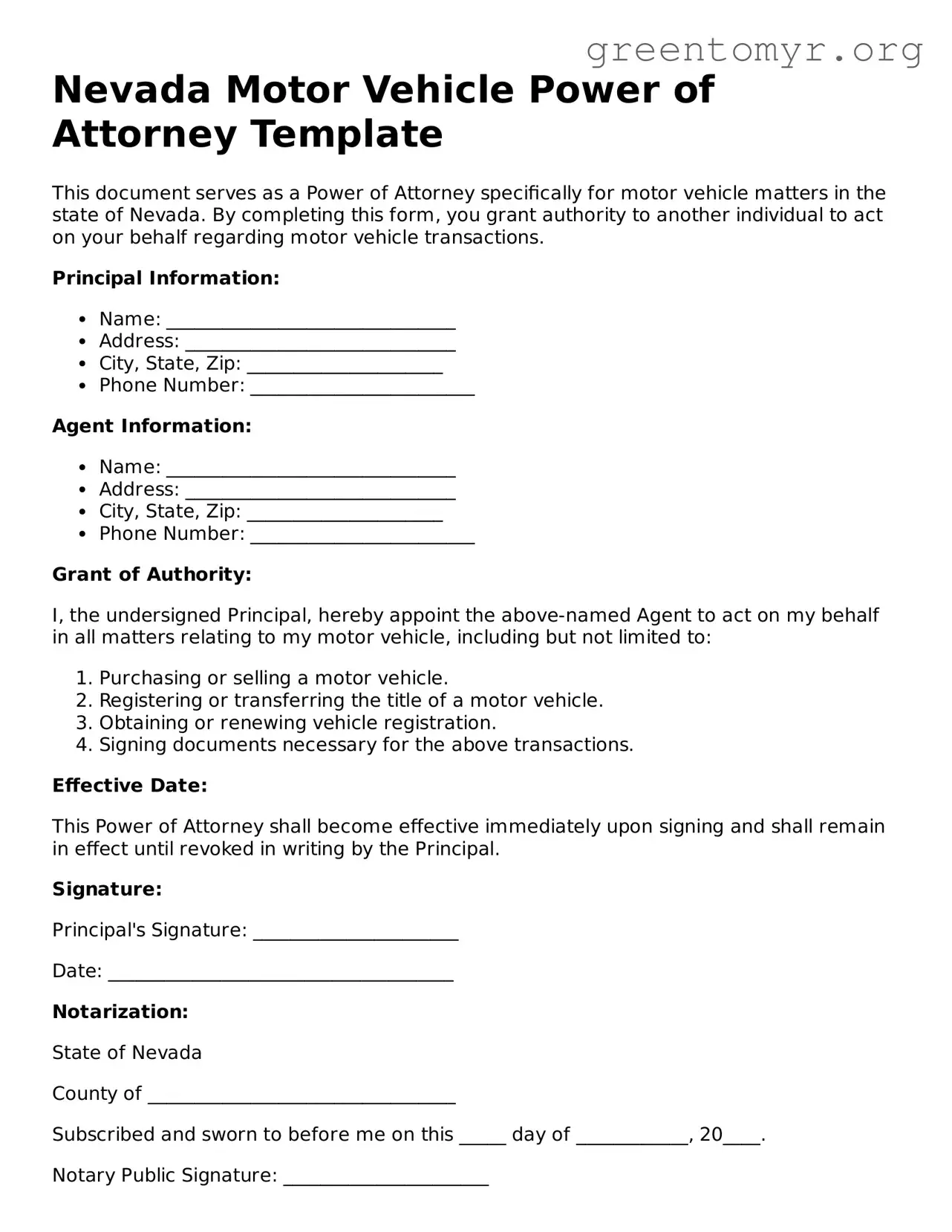
The Nevada Motor Vehicle Power of Attorney form is an essential document for anyone looking to delegate authority regarding their vehicle. This form allows a designated individual, known as the attorney-in-fact, to act on behalf of the vehicle owner in various matters related to motor vehicle transactions. These transactions can include registering the vehicle, transferring ownership, or handling other administrative tasks with the Department of Motor Vehicles (DMV). By using this form, vehicle owners can ensure that their interests are represented even when they cannot be present to handle the details themselves. The form is straightforward and requires specific information, such as the names of both the vehicle owner and the attorney-in-fact, along with details about the vehicle in question. Completing this form accurately is crucial, as it grants significant authority to the designated individual. Understanding its implications can help vehicle owners make informed decisions about who they trust to manage their vehicle-related affairs.
Nevada Motor Vehicle Power of Attorney Template
This document serves as a Power of Attorney specifically for motor vehicle matters in the state of Nevada. By completing this form, you grant authority to another individual to act on your behalf regarding motor vehicle transactions.
Principal Information:
Agent Information:
Grant of Authority:
I, the undersigned Principal, hereby appoint the above-named Agent to act on my behalf in all matters relating to my motor vehicle, including but not limited to:
Effective Date:
This Power of Attorney shall become effective immediately upon signing and shall remain in effect until revoked in writing by the Principal.
Signature:
Principal's Signature: ______________________
Date: _____________________________________
Notarization:
State of Nevada
County of _________________________________
Subscribed and sworn to before me on this _____ day of ____________, 20____.
Notary Public Signature: ______________________
My Commission Expires: ______________________
| Fact Name | Description |
|---|---|
| Purpose | The Nevada Motor Vehicle Power of Attorney form allows an individual to designate another person to act on their behalf regarding motor vehicle transactions. |
| Governing Law | This form is governed by Nevada Revised Statutes (NRS) Chapter 111, which outlines the legal framework for powers of attorney in the state. |
| Signature Requirement | The form must be signed by the principal, the person granting the power, to be valid and enforceable. |
| Revocation | A Power of Attorney can be revoked at any time by the principal, as long as they are of sound mind and notify the agent and relevant parties. |
| Use Cases | This form is commonly used for tasks such as transferring vehicle ownership, registering vehicles, or obtaining title documents. |
Filling out the Nevada Motor Vehicle Power of Attorney form is a straightforward process. This form allows one person to authorize another to handle specific motor vehicle transactions on their behalf. Follow these steps carefully to ensure that the form is completed correctly.
After completing the form, you can submit it along with any necessary documents to the DMV or keep it for your records as needed. Ensure that the authorized person understands their responsibilities and the scope of the power granted to them.
The Nevada Motor Vehicle Power of Attorney form is a legal document that allows one person to authorize another person to act on their behalf regarding motor vehicle transactions. This can include tasks like transferring ownership, registering a vehicle, or obtaining a duplicate title. It simplifies the process for those who may not be able to handle these tasks in person.
Any adult can be designated as an agent in the Nevada Motor Vehicle Power of Attorney form. This can be a family member, friend, or even a professional such as an attorney or a car dealership representative. It’s important to choose someone you trust, as they will have the authority to make decisions regarding your vehicle.
To complete the Nevada Motor Vehicle Power of Attorney form, follow these steps:
While notarization is not always required, it is highly recommended. Having the form notarized adds an extra layer of authenticity and can help prevent disputes in the future. Check with the Nevada DMV or your agent to confirm whether notarization is necessary for your specific situation.
Yes, you can revoke the Power of Attorney at any time. To do this, you should create a written revocation document and provide it to your agent and any relevant parties, such as the DMV. It’s also a good idea to inform anyone who may have relied on the original Power of Attorney that it has been revoked.
If you believe your agent is misusing the Power of Attorney, it is crucial to act quickly. You can revoke the Power of Attorney immediately and notify the DMV. Additionally, consider consulting with a legal professional to discuss any potential actions you may need to take, including reporting the misuse to law enforcement if necessary.
Filling out the Nevada Motor Vehicle Power of Attorney form can be straightforward, but several common mistakes can lead to complications. One frequent error is failing to provide accurate information. When individuals do not double-check their details, such as names, addresses, or vehicle identification numbers, it can result in delays or rejection of the form.
Another mistake is neglecting to sign the form. A signature is a critical component of the document. Without it, the form lacks legal validity. Additionally, many people forget to date the form. The date is important for establishing when the power of attorney takes effect and can affect the document’s enforceability.
Some individuals may also overlook the need for a witness or notary signature. Depending on the specific requirements for the power of attorney, a witness or notary may be necessary to validate the document. Failing to include this can lead to issues when presenting the form to the DMV.
Inaccurate designation of the attorney-in-fact is another common error. The person chosen to act on behalf of the vehicle owner must be clearly identified. If the information is vague or incomplete, it can create confusion about who has the authority to act.
People sometimes use outdated versions of the form. Using an old version may not comply with current regulations or requirements. It is essential to obtain the most recent version of the form from a reliable source.
Additionally, individuals may not fully understand the scope of authority they are granting. The form allows for various powers, and it is important to clearly specify what the attorney-in-fact can and cannot do. Vague language can lead to misunderstandings and misuse of authority.
Some individuals also fail to provide the necessary supporting documentation. Depending on the situation, additional documents may be required to accompany the power of attorney form. Not including these can delay processing.
Finally, many people do not keep a copy of the completed form for their records. Retaining a copy is vital for reference and can help resolve any disputes or questions that may arise later.
When dealing with vehicle transactions in Nevada, several forms and documents often accompany the Motor Vehicle Power of Attorney. These documents help streamline the process and ensure that everything is in order. Below is a list of commonly used forms that you might encounter.
Having these documents ready can make the process smoother and more efficient. Each form plays a specific role in ensuring that vehicle transactions are handled correctly and legally. Being prepared can save time and prevent potential issues down the line.
When filling out the Nevada Motor Vehicle Power of Attorney form, it’s essential to follow certain guidelines to ensure everything is completed correctly. Here’s a list of dos and don’ts to help you navigate the process.
By following these guidelines, you can help ensure that your Power of Attorney form is processed smoothly and effectively.
Many people have misunderstandings about the Nevada Motor Vehicle Power of Attorney form. Here are seven common misconceptions:
Understanding these misconceptions can help you navigate the process more effectively. Always consider consulting with a professional if you have questions about your specific situation.
When dealing with the Nevada Motor Vehicle Power of Attorney form, there are several important points to keep in mind. This form allows you to designate someone else to handle specific vehicle-related tasks on your behalf. Below are key takeaways to consider:
By following these guidelines, you can ensure that the Nevada Motor Vehicle Power of Attorney form serves its intended purpose effectively.