Content Navigation

In the competitive landscape of Nevada's job market, employers often seek to protect their business interests through Non-compete Agreements. These agreements serve as a legal tool to restrict employees from engaging in similar work within a specified geographic area and timeframe after leaving a company. A well-drafted Nevada Non-compete Agreement includes essential elements such as the duration of the restriction, the geographic scope, and the specific activities that are prohibited. It is crucial for both employers and employees to understand the implications of these agreements, as they can significantly affect career opportunities and business operations. Nevada law provides certain guidelines to ensure that these agreements are reasonable and enforceable, balancing the interests of employers with the rights of employees. By examining the key components and legal considerations of the Nevada Non-compete Agreement form, individuals can better navigate their rights and obligations in the employment landscape.

Nevada Non-compete Agreement Example

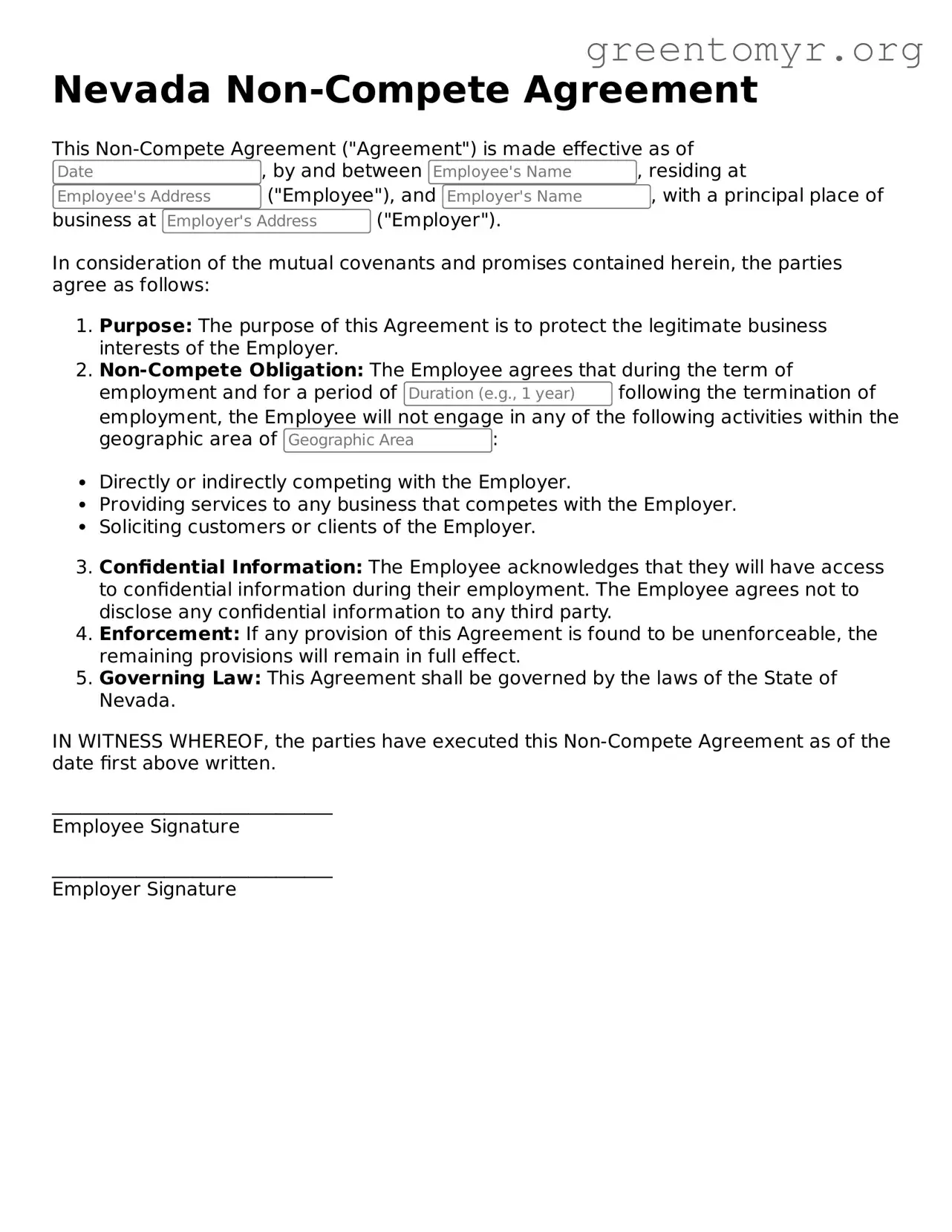
Nevada Non-Compete Agreement

This Non-Compete Agreement ("Agreement") is made effective as of , by and between , residing at ("Employee"), and , with a principal place of business at ("Employer").

In consideration of the mutual covenants and promises contained herein, the parties agree as follows:

  1. Purpose: The purpose of this Agreement is to protect the legitimate business interests of the Employer.
  2. Non-Compete Obligation: The Employee agrees that during the term of employment and for a period of following the termination of employment, the Employee will not engage in any of the following activities within the geographic area of :
  • Directly or indirectly competing with the Employer.
  • Providing services to any business that competes with the Employer.
  • Soliciting customers or clients of the Employer.
  1. Confidential Information: The Employee acknowledges that they will have access to confidential information during their employment. The Employee agrees not to disclose any confidential information to any third party.
  2. Enforcement: If any provision of this Agreement is found to be unenforceable, the remaining provisions will remain in full effect.
  3. Governing Law: This Agreement shall be governed by the laws of the State of Nevada.

IN WITNESS WHEREOF, the parties have executed this Non-Compete Agreement as of the date first above written.

______________________________
Employee Signature

______________________________
Employer Signature

PDF Form Features

Fact Name Description
Governing Law The Nevada Non-compete Agreement is governed by Nevada Revised Statutes (NRS) Chapter 613.
Enforceability Non-compete agreements in Nevada are enforceable if they are reasonable in scope, duration, and geographic area.
Duration Limit Typically, a non-compete agreement should not exceed three years in duration to be considered reasonable.
Geographic Scope The geographic area must be clearly defined and reasonable, often limited to the area where the employee worked.
Consideration Requirement A valid non-compete agreement must include consideration, such as a job offer or promotion.
Exceptions Certain professions, like physicians, have specific regulations that may affect the enforceability of non-compete agreements.
Judicial Review Courts in Nevada may modify overly broad non-compete agreements to make them enforceable, rather than voiding them entirely.

Guide to Using Nevada Non-compete Agreement

Once you have the Nevada Non-compete Agreement form in hand, it’s important to fill it out accurately to ensure it meets your needs. Follow these steps carefully to complete the form correctly.

  1. Begin by entering your full name at the top of the form.
  2. Next, provide the name of your employer or the company involved in the agreement.
  3. Fill in the address of the employer, including the city, state, and zip code.
  4. Specify the start date of your employment or the date the agreement takes effect.
  5. Clearly outline the specific activities or businesses that the non-compete clause will cover.
  6. Indicate the duration of the non-compete period, usually in months or years.
  7. Include the geographical area where the non-compete will apply.
  8. Sign and date the form at the bottom. Ensure you also print your name below your signature.
  9. If required, have a witness sign the document as well.

After completing the form, make sure to keep a copy for your records. It’s advisable to review the agreement with a legal professional to confirm it aligns with your interests and complies with Nevada law.

Get Answers on Nevada Non-compete Agreement

  1. What is a Non-compete Agreement in Nevada?

    A Non-compete Agreement is a legal contract between an employer and an employee. It restricts the employee from working for competitors or starting a competing business for a specified period after leaving the company. In Nevada, these agreements must be reasonable in scope and duration to be enforceable.

  2. Are Non-compete Agreements enforceable in Nevada?

    Yes, Non-compete Agreements can be enforceable in Nevada, but they must meet certain criteria. They should protect legitimate business interests, such as trade secrets or customer relationships. The agreement must also be reasonable in terms of geographic area and duration.

  3. What is considered a reasonable duration for a Non-compete Agreement?

    While there is no strict rule, a duration of six months to two years is generally considered reasonable in Nevada. The specific circumstances of the business and the employee's role will influence what is deemed appropriate.

  4. Can I negotiate the terms of a Non-compete Agreement?

    Absolutely. Employees can negotiate the terms before signing. It's important to understand your rights and the implications of the agreement. If you feel the terms are too restrictive, discussing modifications with your employer is advisable.

  5. What happens if I violate a Non-compete Agreement?

    If you violate a Non-compete Agreement, your former employer may take legal action against you. This could include seeking an injunction to prevent you from working with a competitor or pursuing damages for any losses incurred due to the breach.

  6. How can I get out of a Non-compete Agreement?

    Exiting a Non-compete Agreement can be challenging. You may seek to negotiate a release with your former employer. Alternatively, if the agreement is deemed unreasonable or overly broad, you could challenge its enforceability in court.

  7. What should I consider before signing a Non-compete Agreement?

    Before signing, consider the following:

    • Your career goals and future job prospects.
    • The specific restrictions outlined in the agreement.
    • The duration and geographic scope of the non-compete.
    • Whether the agreement protects legitimate business interests.
  8. Are there any exceptions to Non-compete Agreements in Nevada?

    Yes, certain exceptions exist. For example, in Nevada, Non-compete Agreements are generally not enforceable against employees who are laid off or terminated without cause. Additionally, agreements cannot restrict employees from engaging in lawful employment.

  9. Where can I find a Nevada Non-compete Agreement form?

    You can find templates for Non-compete Agreements online, but it's crucial to ensure they comply with Nevada law. Consulting with a legal professional is highly recommended to tailor the agreement to your specific situation and ensure its enforceability.

Common mistakes

Filling out the Nevada Non-compete Agreement form can be a complex process. Many individuals make common mistakes that can lead to misunderstandings or even legal issues down the line. One frequent error is failing to clearly define the scope of the agreement. A vague description of what constitutes competition can lead to disputes. It’s crucial to specify the types of activities that are restricted.

Another mistake involves overlooking the duration of the non-compete clause. People often either set the time frame too long or too short. An excessively long duration may be deemed unenforceable by a court, while a very short duration may not provide adequate protection. It’s essential to strike a balance that reflects the nature of the business and the industry standards.

Many individuals also neglect to include geographical limitations in their agreements. Without clearly defining the area where the non-compete applies, the agreement may be considered overly broad. This can lead to challenges in enforcement. A well-defined geographic scope helps to ensure that the agreement is reasonable and enforceable.

Additionally, some people fail to consider the consideration element of the agreement. In legal terms, consideration refers to what each party stands to gain from the agreement. If one party does not receive something of value in exchange for signing the non-compete, the agreement may be challenged in court. It’s important to outline what each party is receiving to avoid this pitfall.

Lastly, individuals often forget to review the entire document before signing. Skimming through the agreement can lead to missed clauses or terms that could significantly impact their rights. Taking the time to thoroughly read and understand the entire document is vital. Seeking legal advice can also help clarify any uncertainties and ensure that the agreement is fair and enforceable.

Documents used along the form

When entering into a Non-compete Agreement in Nevada, several other forms and documents may be relevant to ensure comprehensive legal protection and clarity for all parties involved. Understanding these documents can help in navigating the complexities of employment agreements and safeguarding business interests.

  • Employment Agreement: This document outlines the terms of employment, including job responsibilities, compensation, and benefits. It serves as the foundational contract between the employer and employee.
  • Confidentiality Agreement: Also known as a Non-disclosure Agreement (NDA), this form protects sensitive information shared between the parties. It ensures that proprietary information remains confidential during and after the employment period.
  • Intellectual Property Assignment Agreement: This document specifies that any inventions or creative works developed by the employee during their employment belong to the employer. It helps secure ownership of intellectual property created in the course of work.
  • Severance Agreement: In the event of termination, this agreement outlines the terms under which an employee will receive severance pay or benefits. It can include clauses related to non-compete and confidentiality obligations.
  • Independent Contractor Agreement: If a business engages independent contractors, this document clarifies the relationship, responsibilities, and expectations. It may also include non-compete clauses tailored to contractors.
  • Non-solicitation Agreement: This document prevents an employee from soliciting clients or employees of the company for a specified period after leaving. It complements the non-compete agreement by targeting specific business relationships.
  • Release of Claims: Often part of a severance package, this document requires the employee to waive their right to pursue legal claims against the employer in exchange for certain benefits or compensation.
  • Employee Handbook: While not a formal agreement, this document provides guidelines on company policies, including non-compete and confidentiality expectations. It serves as a reference for employees throughout their tenure.

Each of these documents plays a vital role in establishing clear expectations and protecting the interests of both employers and employees. It is crucial to ensure that all agreements are well-drafted and understood by all parties involved to avoid potential disputes in the future.

Similar forms

A Non-compete Agreement is a legal document designed to restrict an individual's ability to engage in competitive activities after leaving a particular job. Several other documents serve similar purposes in protecting business interests and ensuring confidentiality. Here are nine documents that share similarities with a Non-compete Agreement:

  • Non-disclosure Agreement (NDA): This document prevents individuals from sharing confidential information acquired during their employment. Like a Non-compete Agreement, it aims to protect sensitive business information.
  • Employment Contract: An employment contract outlines the terms of employment, including responsibilities and obligations. Often, it may include clauses that restrict competitive activities, resembling a Non-compete Agreement.
  • Confidentiality Agreement: Similar to an NDA, a confidentiality agreement ensures that employees do not disclose proprietary information. Both documents focus on protecting a company's intellectual property.
  • Non-solicitation Agreement: This agreement prevents former employees from soliciting clients or employees of the company after leaving. It shares the goal of protecting business relationships, akin to a Non-compete Agreement.
  • Trade Secret Agreement: This document specifically protects a company's trade secrets from being disclosed or used by former employees. It serves a similar purpose of safeguarding valuable business information.
  • Severance Agreement: Often provided when an employee leaves a company, this document may include clauses that restrict future employment with competitors, paralleling the objectives of a Non-compete Agreement.
  • Intellectual Property Assignment Agreement: This document ensures that any intellectual property created by an employee during their tenure belongs to the company. It helps maintain control over innovations, similar to a Non-compete Agreement's protective nature.
  • Release of Claims Agreement: This agreement may include provisions that limit a former employee's ability to work for competitors, thus aligning with the protective measures of a Non-compete Agreement.
  • Consulting Agreement: For individuals who provide consulting services, this document may contain non-compete clauses to prevent them from advising competing businesses, reflecting the same intent as a Non-compete Agreement.

Dos and Don'ts

When filling out the Nevada Non-compete Agreement form, it's essential to follow certain guidelines to ensure clarity and compliance. Here are eight things to consider:

  • Do read the entire agreement carefully before signing.
  • Do provide accurate and complete information in all sections.
  • Do consult with a legal professional if you have questions.
  • Do ensure that the terms are reasonable and not overly restrictive.
  • Don't rush through the form; take your time to understand each clause.
  • Don't sign the agreement if you feel pressured or uncertain.
  • Don't ignore any specific state laws that may affect the agreement.
  • Don't assume verbal agreements will hold up; always get it in writing.

Misconceptions

Non-compete agreements can often be misunderstood, especially in a state like Nevada where the laws surrounding them can be complex. Here are nine common misconceptions about the Nevada Non-compete Agreement form:

  1. Non-compete agreements are always enforceable. Many people believe that once a non-compete is signed, it is automatically valid. However, in Nevada, these agreements must meet certain criteria to be enforceable, such as being reasonable in scope and duration.
  2. All employees must sign a non-compete agreement. Not every employee is required to sign a non-compete agreement. Employers often reserve these agreements for key employees who have access to sensitive information or trade secrets.
  3. Non-compete agreements can last indefinitely. Some individuals think that a non-compete agreement can last forever. In Nevada, these agreements must have a reasonable time limit, typically no longer than one to two years.
  4. Non-compete agreements prevent all future employment. A common belief is that a non-compete agreement prohibits any future employment in the same industry. In reality, these agreements often only restrict employment with specific competitors or within a defined geographical area.
  5. Signing a non-compete means you cannot start your own business. Many people assume that signing a non-compete agreement completely bars them from starting their own business. While there may be restrictions, individuals can often start a business as long as they do not directly compete with their former employer.
  6. Non-compete agreements are the same as non-disclosure agreements. Some individuals confuse non-compete agreements with non-disclosure agreements. While both protect business interests, a non-compete restricts employment opportunities, whereas a non-disclosure agreement focuses on keeping sensitive information confidential.
  7. Only high-level employees need to worry about non-compete agreements. There is a misconception that only executives or high-ranking employees are subject to non-compete agreements. In fact, many companies require non-compete agreements from employees at various levels, especially those with access to proprietary information.
  8. Non-compete agreements are not subject to negotiation. Some individuals believe that the terms of a non-compete agreement are set in stone. However, these agreements can often be negotiated, especially if the employee has leverage or unique skills.
  9. All non-compete agreements are the same across states. People often think that non-compete agreements are uniform nationwide. In reality, each state, including Nevada, has its own laws and regulations that govern the enforceability and terms of these agreements.

Understanding these misconceptions can help individuals navigate their rights and obligations regarding non-compete agreements in Nevada more effectively.

Key takeaways

When dealing with the Nevada Non-compete Agreement form, understanding its implications is crucial for both employers and employees. Here are some key takeaways to keep in mind:

  • Clarity is Key: Ensure that the terms of the agreement are clear and specific. Ambiguities can lead to legal disputes.
  • Reasonable Duration: The agreement should specify a reasonable duration for the non-compete clause. Courts often scrutinize overly long restrictions.
  • Geographic Scope: Define the geographic area where the non-compete applies. A well-defined area is essential for enforceability.
  • Consideration is Necessary: There must be something of value exchanged for the agreement to be valid. This could be a job offer, training, or other benefits.

By keeping these points in mind, both parties can better navigate the complexities of non-compete agreements in Nevada.