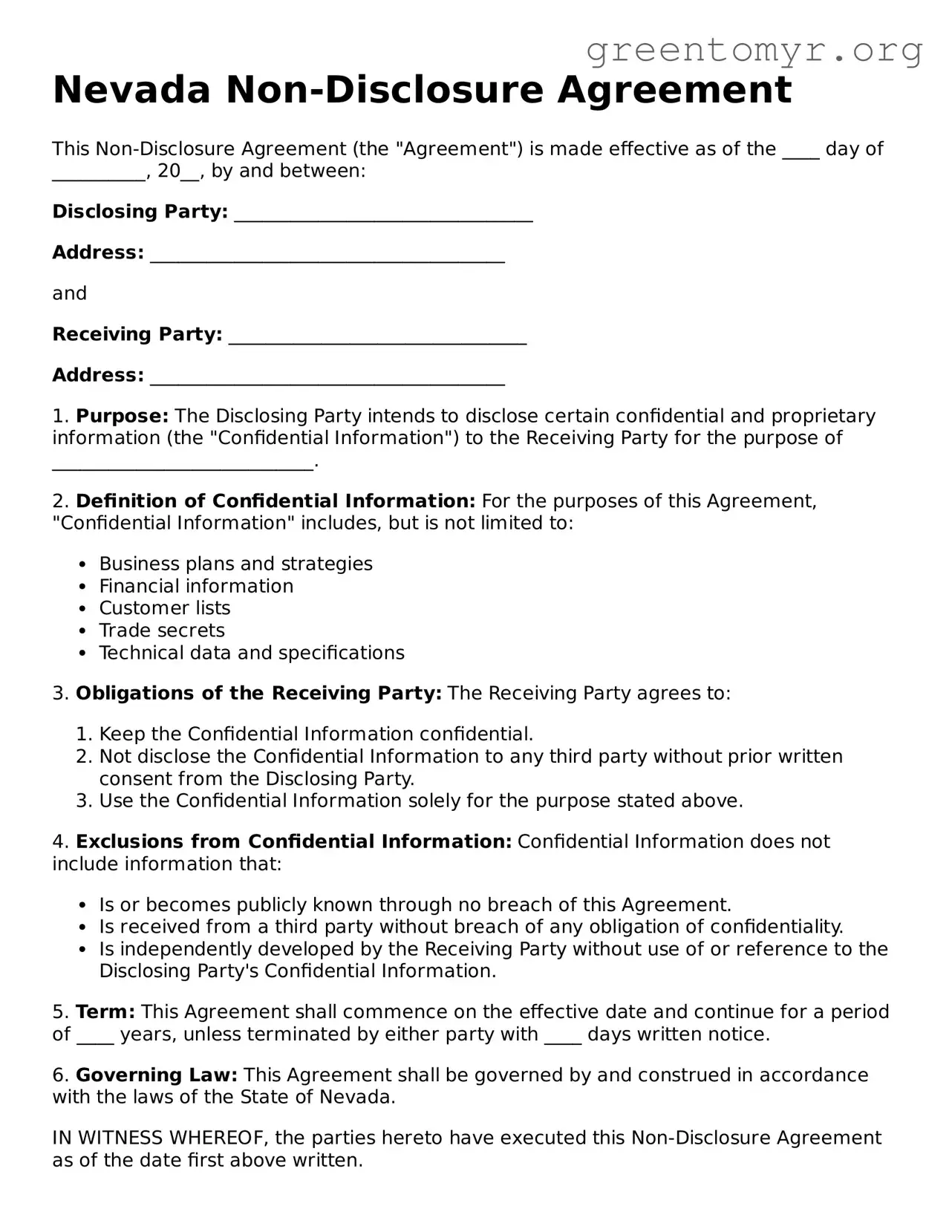
The Nevada Non-disclosure Agreement (NDA) serves as a vital tool for individuals and businesses seeking to protect sensitive information from unauthorized disclosure. In an increasingly competitive environment, safeguarding proprietary data, trade secrets, and confidential communications has never been more crucial. This agreement outlines the obligations of the parties involved, specifying what information is deemed confidential and the circumstances under which it can be disclosed. It typically includes provisions regarding the duration of confidentiality, the consequences of breach, and the governing law, which in this case is Nevada. By establishing clear guidelines, the NDA helps foster trust between parties while allowing for collaboration and innovation. Understanding the key components of this form is essential for anyone looking to navigate the complexities of confidentiality in business dealings.
Nevada Non-Disclosure Agreement
This Non-Disclosure Agreement (the "Agreement") is made effective as of the ____ day of __________, 20__, by and between:
Disclosing Party: ________________________________
Address: ______________________________________
and
Receiving Party: ________________________________
Address: ______________________________________
1. Purpose: The Disclosing Party intends to disclose certain confidential and proprietary information (the "Confidential Information") to the Receiving Party for the purpose of ____________________________.
2. Definition of Confidential Information: For the purposes of this Agreement, "Confidential Information" includes, but is not limited to:
3. Obligations of the Receiving Party: The Receiving Party agrees to:
4. Exclusions from Confidential Information: Confidential Information does not include information that:
5. Term: This Agreement shall commence on the effective date and continue for a period of ____ years, unless terminated by either party with ____ days written notice.
6. Governing Law: This Agreement shall be governed by and construed in accordance with the laws of the State of Nevada.
IN WITNESS WHEREOF, the parties hereto have executed this Non-Disclosure Agreement as of the date first above written.
Disclosing Party:
______________________________
Signature: ______________________
Receiving Party:
______________________________
Signature: ______________________
| Fact Name | Details |
|---|---|
| Definition | A Non-disclosure Agreement (NDA) is a legally binding contract that establishes a confidential relationship between parties. |
| Purpose | NDAs protect sensitive information from being disclosed to unauthorized individuals or entities. |
| Governing Law | The laws of the State of Nevada govern the interpretation and enforcement of NDAs. |
| Duration | NDAs can specify a duration for confidentiality, often ranging from a few years to indefinitely, depending on the nature of the information. |
| Enforcement | Violating an NDA can lead to legal consequences, including monetary damages and injunctive relief. |
| Types of Information | Commonly protected information includes trade secrets, business strategies, and proprietary data. |
| Mutual vs. Unilateral | NDAs can be mutual, where both parties share confidential information, or unilateral, where only one party discloses information. |
Filling out the Nevada Non-disclosure Agreement form is an important step in ensuring that confidential information is protected. After completing the form, it should be reviewed for accuracy before being signed by all parties involved.
A Non-disclosure Agreement (NDA) is a legal contract that protects confidential information shared between parties. In Nevada, this agreement ensures that sensitive information, such as business secrets or proprietary data, is not disclosed to unauthorized individuals. NDAs are commonly used in various industries to maintain privacy and protect intellectual property.
Any individual or business that plans to share confidential information may benefit from using an NDA. This includes:
By having an NDA in place, parties can help ensure that their confidential information remains secure.
A typical NDA in Nevada should include the following components:
The duration of a Non-disclosure Agreement can vary. Parties typically agree on a specific time frame, which can range from a few years to indefinitely, depending on the nature of the information shared. It is essential to clearly outline this duration within the NDA to avoid misunderstandings in the future.
Yes, NDAs are enforceable in Nevada as long as they meet certain legal requirements. The agreement must be clear, reasonable, and not violate public policy. If a party breaches the NDA, the other party may seek legal remedies, which can include monetary damages or injunctive relief to prevent further disclosure.
If you suspect a breach of an NDA, consider taking the following steps:
Taking prompt action can help protect your interests and confidential information.
When filling out the Nevada Non-disclosure Agreement (NDA) form, many individuals make common mistakes that can lead to complications later on. One frequent error is failing to clearly define the confidential information. It's crucial to specify what information is considered confidential to avoid ambiguity. Without a precise definition, parties may have different interpretations, which can result in disputes down the line.
Another common mistake is neglecting to include the duration of the confidentiality obligation. An NDA should clearly state how long the information must remain confidential. If this is left vague or omitted, it can create uncertainty about the responsibilities of each party. This oversight can lead to misunderstandings and potential legal challenges in the future.
Additionally, individuals often overlook the importance of including all relevant parties in the agreement. It’s essential that all parties who will have access to the confidential information are named in the NDA. If someone is inadvertently left out, they may not be bound by the terms of the agreement, which could expose sensitive information to unauthorized individuals.
Lastly, many people fail to review the NDA thoroughly before signing. Rushing through the process can result in missed clauses or terms that may not be favorable. Taking the time to read and understand the entire document can prevent unintended consequences. It's always wise to consult with a professional if there are any uncertainties about the terms of the agreement.
When entering into a Non-disclosure Agreement (NDA) in Nevada, there are several other forms and documents that may be relevant to ensure comprehensive protection of sensitive information. Each of these documents serves a specific purpose and can help clarify the terms of the agreement or support its enforcement. Below is a list of commonly used forms alongside the NDA.
Understanding these additional documents can enhance the effectiveness of your Non-disclosure Agreement and provide a more robust framework for protecting sensitive information. Each form plays a critical role in various business interactions, ensuring that all parties are on the same page regarding confidentiality and other important terms.
A Non-disclosure Agreement (NDA) is a crucial document for protecting sensitive information. Several other documents serve similar purposes, focusing on confidentiality and the protection of proprietary information. Here’s a list of eight documents that are similar to an NDA:
Each of these documents plays a vital role in ensuring that sensitive information remains protected in various business contexts.
When filling out a Non-disclosure Agreement (NDA) form in Nevada, there are several important dos and don'ts to keep in mind. This will help ensure that your agreement is effective and legally sound.
By following these guidelines, you can help ensure that your Non-disclosure Agreement serves its intended purpose and protects your confidential information effectively.
Many people have misunderstandings about the Nevada Non-disclosure Agreement (NDA) form. Here are five common misconceptions:
While businesses often use NDAs, individuals can also benefit from them. Anyone sharing sensitive information can protect their interests with an NDA.
Not all NDAs are created equal. Each agreement can be tailored to fit specific situations and needs. It's important to understand the terms and conditions of each NDA.
This is not entirely true. NDAs typically restrict sharing information with unauthorized parties, but you can often discuss the information with those who are also bound by the NDA.
While court enforcement is one option, many NDAs include clauses for mediation or arbitration. This can provide a faster and less costly resolution to disputes.
This is a misconception. NDAs can have specific time limits. After a certain period, the obligations may expire, depending on the agreement's terms.
When filling out and using the Nevada Non-disclosure Agreement (NDA) form, it is important to keep several key points in mind. Understanding these aspects can help ensure that the agreement is effective and legally binding.
By adhering to these guidelines, parties can better protect their confidential information and foster trust in their business relationships.