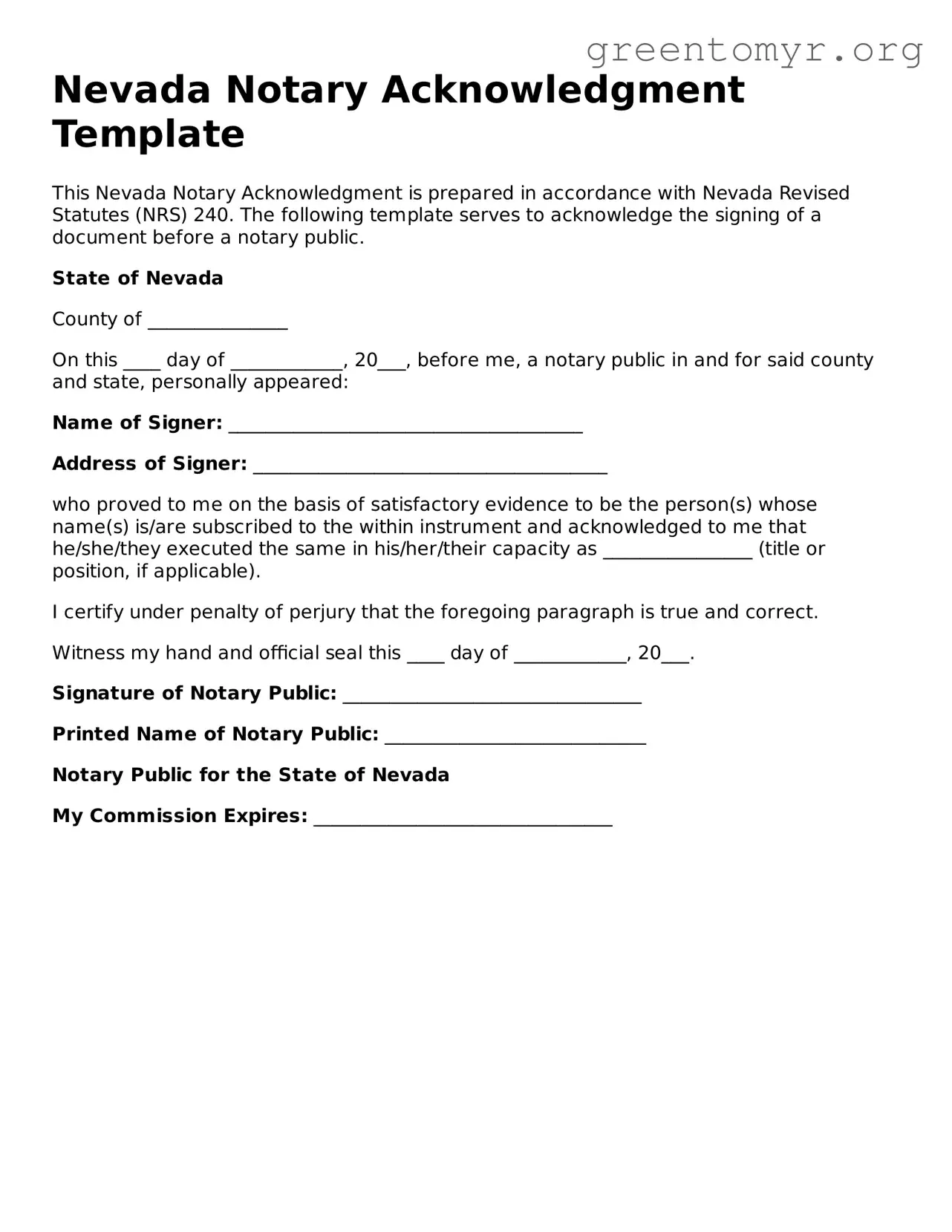
The Nevada Notary Acknowledgement form plays a crucial role in the notarization process, providing a reliable way to verify the identity of signers and the authenticity of their signatures. This form is essential for various legal documents, ensuring that they are executed with the proper formalities. Typically, it includes key details such as the name of the signer, the date of the acknowledgment, and the notary's signature and seal. By completing this form, individuals can affirm that they willingly signed the document in the presence of a notary public. This acknowledgment not only protects the interests of all parties involved but also enhances the credibility of the document in legal contexts. Understanding the components and requirements of the Nevada Notary Acknowledgement form is vital for anyone engaged in legal transactions, as it serves as a safeguard against fraud and disputes.
Nevada Notary Acknowledgment Template
This Nevada Notary Acknowledgment is prepared in accordance with Nevada Revised Statutes (NRS) 240. The following template serves to acknowledge the signing of a document before a notary public.
State of Nevada
County of _______________
On this ____ day of ____________, 20___, before me, a notary public in and for said county and state, personally appeared:
Name of Signer: ______________________________________
Address of Signer: ______________________________________
who proved to me on the basis of satisfactory evidence to be the person(s) whose name(s) is/are subscribed to the within instrument and acknowledged to me that he/she/they executed the same in his/her/their capacity as ________________ (title or position, if applicable).
I certify under penalty of perjury that the foregoing paragraph is true and correct.
Witness my hand and official seal this ____ day of ____________, 20___.
Signature of Notary Public: ________________________________
Printed Name of Notary Public: ____________________________
Notary Public for the State of Nevada
My Commission Expires: ________________________________
| Fact Name | Description |
|---|---|
| Governing Law | The Nevada Notary Acknowledgment form is governed by Nevada Revised Statutes (NRS) Chapter 240. |
| Purpose | This form serves to confirm that a person has willingly signed a document in front of a notary public. |
| Signature Requirement | The signer must personally appear before the notary and sign the document in their presence. |
| Identification | The notary must verify the identity of the signer, typically through a government-issued ID. |
| Notary Seal | A notary public must affix their official seal to the acknowledgment form to validate it. |
| Record Keeping | Notaries are required to keep a record of each acknowledgment performed in their notary journal. |
| Validity | Once completed, the acknowledgment form is valid as long as it is properly executed and notarized. |
Once you have the Nevada Notary Acknowledgement form ready, you can proceed to fill it out. This form is essential for confirming that a signature is genuine and that the signer is who they claim to be. Follow these steps to complete the form accurately.
Once you have completed the form, make sure to keep a copy for your records. This will help you in case any questions arise later on.
The Nevada Notary Acknowledgment form is a legal document used to verify the identity of a signer and confirm that they willingly signed a document. This form is typically used in conjunction with various legal documents, such as deeds, contracts, and affidavits, to ensure their authenticity.
In Nevada, a notary public is an individual who has been appointed by the state to perform notarial acts. To qualify, a person must be at least 18 years old, a resident of Nevada, and pass a background check. Notaries are responsible for ensuring that signers understand the documents they are signing and are doing so voluntarily.
The Nevada Notary Acknowledgment form typically requires the following information:
No, a notary acknowledgment is a specific type of notary certificate. While both serve to verify the authenticity of a signature, a notary acknowledgment specifically confirms that the signer appeared before the notary and acknowledged signing the document. Other types of notarial acts may include jurats or oaths.
A notary acknowledgment can be used for most legal documents that require a signature. However, it is important to ensure that the specific document does not have its own requirements for notarization. Always check the guidelines for the particular type of document you are working with.
If a notary acknowledgment is not completed correctly, it may render the document invalid. This can lead to legal complications, including disputes over the authenticity of the document. It is crucial to ensure that all required information is accurately filled out and that the notary follows proper procedures.
Yes, the signer must be present when the notary acknowledgment is performed. The notary must witness the signer’s signature and confirm their identity. This is a key part of the notarial process to ensure that the acknowledgment is valid.
A notary acknowledgment does not have a specific expiration date. However, the validity of the document itself may depend on the laws governing the type of document being signed. It is advisable to check the relevant laws or consult with a legal professional for specific guidance.
A Nevada Notary Acknowledgment form can typically be obtained from various sources, including:
Filling out the Nevada Notary Acknowledgment form can seem straightforward, but there are common mistakes that people often make. One frequent error is not including the correct date. The date is crucial because it indicates when the acknowledgment took place. If you forget to write the date or write it incorrectly, it could lead to complications later on.
Another common mistake is failing to provide the signer's name clearly. The form requires the full name of the person signing the document. If the name is misspelled or written in an unclear manner, it may cause issues with the validity of the acknowledgment.
People often overlook the requirement for the signer's signature. It might seem obvious, but if the signer forgets to sign, the acknowledgment is incomplete. Without a signature, the document cannot be properly notarized.
Additionally, not identifying the type of document being acknowledged can lead to confusion. The form typically requires a brief description of the document. Leaving this section blank or providing vague information can create problems down the line.
Another mistake occurs when individuals do not check the notary's information. The notary must provide their name, title, and commission number. If this information is missing or incorrect, it can invalidate the acknowledgment.
Some people forget to include the appropriate notary seal. The seal is an essential part of the notarization process. Without it, the acknowledgment may not be recognized as valid.
It's also important to note that the form must be filled out completely. Leaving any fields blank can raise questions about the acknowledgment's legitimacy. Each section serves a purpose, and omitting information can lead to delays or rejections.
Lastly, individuals often fail to review the entire form before submission. Taking a moment to double-check for errors can save time and prevent issues. A careful review can help ensure that all required information is accurate and complete.
When dealing with legal documents in Nevada, the Notary Acknowledgement form often serves as a crucial component. However, there are several other forms and documents that may accompany it, each serving its own purpose in the legal process. Understanding these documents can help ensure that all necessary steps are taken to validate and execute legal transactions effectively.
Each of these documents plays a significant role in ensuring that legal transactions are conducted smoothly and with proper validation. Familiarity with these forms can help individuals navigate the complexities of legal processes in Nevada more effectively.
The Notary Acknowledgment form is an important document in the realm of legal transactions, serving to verify the identity of the signer and their willingness to sign a document. Several other documents share similar purposes and functions. Below is a list of nine documents that resemble the Notary Acknowledgment form, along with a brief explanation of how they are similar.
Each of these documents plays a crucial role in legal transactions, similar to the Notary Acknowledgment form. They all require the presence of a notary to validate the authenticity of the signatures and the willingness of the parties involved.
When filling out the Nevada Notary Acknowledgment form, it is essential to follow certain guidelines to ensure the document is valid. Here’s a list of things you should and shouldn’t do:
Misconception 1: A notary can act as a witness in all situations.
While notaries are often present during the signing of documents, their primary role is to verify the identity of the signers and ensure that they are signing willingly. In many cases, a notary cannot also serve as a witness, as this could create a conflict of interest.
Misconception 2: A notary acknowledgment is the same as a notarized document.
Many people assume that a notary acknowledgment is a type of notarized document. In reality, an acknowledgment is a specific type of notarization that confirms the identity of the signer and their intention to sign the document. Other forms of notarization, such as jurats, serve different purposes.
Misconception 3: All notaries are the same and can perform any notarial act.
Notaries in Nevada, like in many states, are required to follow specific guidelines and regulations. Some may have limitations on the types of documents they can notarize, based on their training or the laws in their jurisdiction. Therefore, notaries are not interchangeable; their qualifications can vary.
Misconception 4: A notary acknowledgment can be completed without the signer being present.
It is a common belief that a notary can complete an acknowledgment without the signer being physically present. However, Nevada law requires that the signer appear before the notary at the time of the acknowledgment. This ensures that the notary can verify the identity of the signer and confirm their willingness to sign the document.
When dealing with the Nevada Notary Acknowledgement form, it’s essential to understand its purpose and how to fill it out correctly. Here are some key takeaways to help you navigate the process:
Understanding these key points can simplify the process of using the Nevada Notary Acknowledgement form, ensuring that you complete it accurately and effectively.