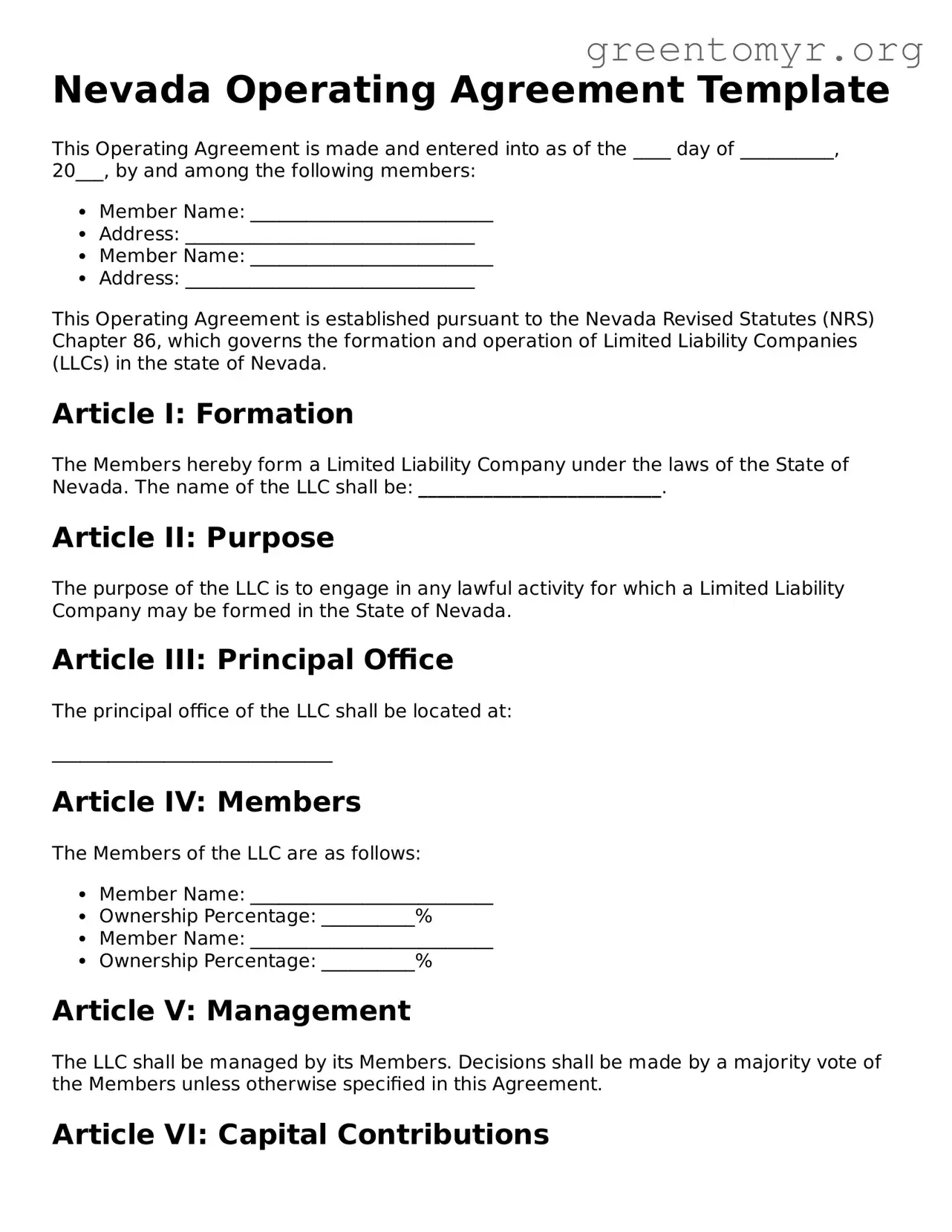
The Nevada Operating Agreement form is a crucial document for businesses operating as limited liability companies (LLCs) in the state. This form outlines the internal rules and regulations governing the LLC, ensuring that all members understand their rights and responsibilities. Key aspects include the management structure, decision-making processes, and profit distribution among members. Additionally, the agreement addresses the procedures for adding or removing members, as well as the steps to take in the event of dissolution. By establishing clear guidelines, the Operating Agreement helps prevent disputes and provides a framework for resolving conflicts should they arise. Overall, this document serves as a foundational tool for the smooth operation of an LLC in Nevada.
Nevada Operating Agreement Template
This Operating Agreement is made and entered into as of the ____ day of __________, 20___, by and among the following members:
This Operating Agreement is established pursuant to the Nevada Revised Statutes (NRS) Chapter 86, which governs the formation and operation of Limited Liability Companies (LLCs) in the state of Nevada.
Article I: Formation
The Members hereby form a Limited Liability Company under the laws of the State of Nevada. The name of the LLC shall be: __________________________.
Article II: Purpose
The purpose of the LLC is to engage in any lawful activity for which a Limited Liability Company may be formed in the State of Nevada.
Article III: Principal Office
The principal office of the LLC shall be located at:
______________________________
Article IV: Members
The Members of the LLC are as follows:
Article V: Management
The LLC shall be managed by its Members. Decisions shall be made by a majority vote of the Members unless otherwise specified in this Agreement.
Article VI: Capital Contributions
Each Member shall contribute capital to the LLC as follows:
Article VII: Distributions
Distributions of profits and losses shall be made to the Members in proportion to their respective ownership percentages.
Article VIII: Indemnification
The LLC shall indemnify its Members to the fullest extent permitted by Nevada law against any losses or damages incurred in connection with the LLC.
Article IX: Amendments
This Operating Agreement may be amended only by a written agreement signed by all Members.
Article X: Governing Law
This Agreement shall be governed by and construed in accordance with the laws of the State of Nevada.
Signatures
IN WITNESS WHEREOF, the Members have executed this Operating Agreement as of the date first above written.
| Fact Name | Description |
|---|---|
| Purpose | The Nevada Operating Agreement outlines the management structure and operating procedures for an LLC in Nevada. |
| Governing Law | The agreement is governed by the Nevada Revised Statutes (NRS) Chapter 86, which pertains to limited liability companies. |
| Member Rights | It defines the rights and responsibilities of the members, ensuring clarity in ownership and decision-making processes. |
| Flexibility | Nevada law allows for significant flexibility in the terms of the Operating Agreement, accommodating various business needs. |
| Tax Implications | The agreement can influence tax treatment, as it outlines profit distribution and member contributions. |
Filling out the Nevada Operating Agreement form is an essential step for anyone looking to establish a limited liability company (LLC) in Nevada. After completing the form, you'll be better prepared to outline the management structure and operational guidelines of your LLC, ensuring clarity and legal compliance.
Once you have completed the form, keep a copy for your records. It's wise to consult with a legal professional to ensure that all provisions meet your specific needs and comply with state laws.
A Nevada Operating Agreement is a legal document that outlines the management structure and operating procedures of a Limited Liability Company (LLC) in Nevada. This agreement serves as a blueprint for how the business will be run, detailing the rights and responsibilities of the members, decision-making processes, and distribution of profits and losses. It is essential for establishing clear expectations and protecting the interests of all parties involved.
While Nevada law does not mandate that LLCs have an Operating Agreement, it is highly recommended. Having this document in place can help prevent misunderstandings and disputes among members. Furthermore, an Operating Agreement can provide clarity on how the business operates, which can be beneficial in legal situations or when seeking financing.
A comprehensive Nevada Operating Agreement should cover several key elements, including:
Including these elements can help ensure that everyone is on the same page regarding the operation of the LLC.
Yes, you can change your Operating Agreement after it has been created. Most agreements will include a section detailing how amendments can be made. Typically, changes require a certain level of agreement among the members, such as a majority or unanimous consent. It’s important to document any changes formally to maintain clarity and legal validity.
You can find Nevada Operating Agreement templates through various online legal services, business formation websites, or legal document providers. Additionally, consulting with a legal professional can help ensure that your Operating Agreement meets your specific needs and complies with state laws. Always review any template carefully to ensure it accurately reflects your business's structure and goals.
When completing the Nevada Operating Agreement form, many individuals overlook important details that can lead to complications down the line. One common mistake is failing to include all members' names and addresses. Each member should be clearly identified to avoid confusion about ownership and responsibilities. Missing this information can create disputes later, especially if the business expands or changes.
Another frequent error is not specifying the management structure of the business. Some individuals may assume that the default structure is sufficient. However, it is crucial to clearly outline whether the business will be managed by members or by appointed managers. This decision impacts how decisions are made and who has authority within the company.
People also often neglect to address the distribution of profits and losses. It is essential to detail how profits will be shared among members. Leaving this section vague can lead to misunderstandings and disagreements when it comes time to distribute earnings. Clearly stating the percentages or amounts can help prevent these issues.
Lastly, failing to include provisions for resolving disputes is a significant oversight. Many individuals do not think about potential conflicts when starting their business. However, having a clear process for resolving disagreements can save time and money in the future. Including mediation or arbitration clauses can help ensure that issues are handled smoothly.
When forming a Limited Liability Company (LLC) in Nevada, the Operating Agreement is a crucial document that outlines the management structure and operational guidelines of the business. However, several other forms and documents are often utilized alongside the Operating Agreement to ensure compliance with state regulations and to facilitate smooth business operations. Below is a list of commonly used documents in conjunction with the Nevada Operating Agreement.
In summary, while the Nevada Operating Agreement is a foundational document for LLCs, it is important to understand the role of other forms and documents. Each of these plays a significant part in ensuring that the business operates within legal parameters and maintains good standing with state authorities. Properly managing these documents can help pave the way for a successful business venture.
The Operating Agreement is an important document for a limited liability company (LLC), but it shares similarities with several other legal documents. Here are five documents that are comparable to the Operating Agreement:
When filling out the Nevada Operating Agreement form, there are important steps to follow. Here’s a list of things you should and shouldn't do:
Take these steps seriously. A well-completed Operating Agreement can help prevent disputes and ensure smooth operations for your business.
Operating agreements are essential documents for limited liability companies (LLCs) in Nevada. However, there are several misconceptions surrounding them. Below is a list of common misunderstandings regarding the Nevada Operating Agreement form.
While it is highly recommended for LLCs to have an operating agreement, Nevada does not legally require all LLCs to create one. However, having this document can help clarify the management structure and operational procedures.
This is not true. Even single-member LLCs can benefit from having an operating agreement. It can help establish clear rules and protections for the owner.
In reality, operating agreements can be amended. Members can update the agreement as needed to reflect changes in management, ownership, or business operations.
There is no official state-provided template for operating agreements. Each LLC can create a customized agreement that fits its specific needs and circumstances.
This is correct. Operating agreements are internal documents and do not need to be submitted to the state of Nevada. However, they should be kept on file for reference.
While an operating agreement can help reinforce the limited liability status of an LLC, it does not guarantee protection of personal assets. Proper business practices must also be followed.
While it is best practice for all members to sign the agreement, it is not strictly necessary for validity. The agreement can still be enforceable even without all signatures, depending on the circumstances.
This is a misconception. Operating agreements serve as a guide for day-to-day operations and decision-making, not just in times of conflict. They help establish clear expectations among members.
When filling out and using the Nevada Operating Agreement form, consider the following key takeaways:
Review the completed form carefully before submission. Accuracy and completeness are crucial for legal validity.