In Nevada, the Power of Attorney for a Child form serves as a crucial legal document that allows parents or guardians to designate another individual to make decisions on behalf of their child. This form is particularly useful in situations where parents may be temporarily unavailable, such as during travel or medical emergencies. By completing this document, parents can grant authority for various responsibilities, including healthcare decisions, educational choices, and general welfare matters. The form typically requires the signatures of both the parent or guardian and the designated agent, ensuring that all parties understand their roles and responsibilities. Additionally, it is important to note that this power can be limited in scope or time, giving parents flexibility in how they choose to delegate authority. Understanding the intricacies of this form can provide peace of mind for parents, knowing that their child's needs will be met even in their absence.
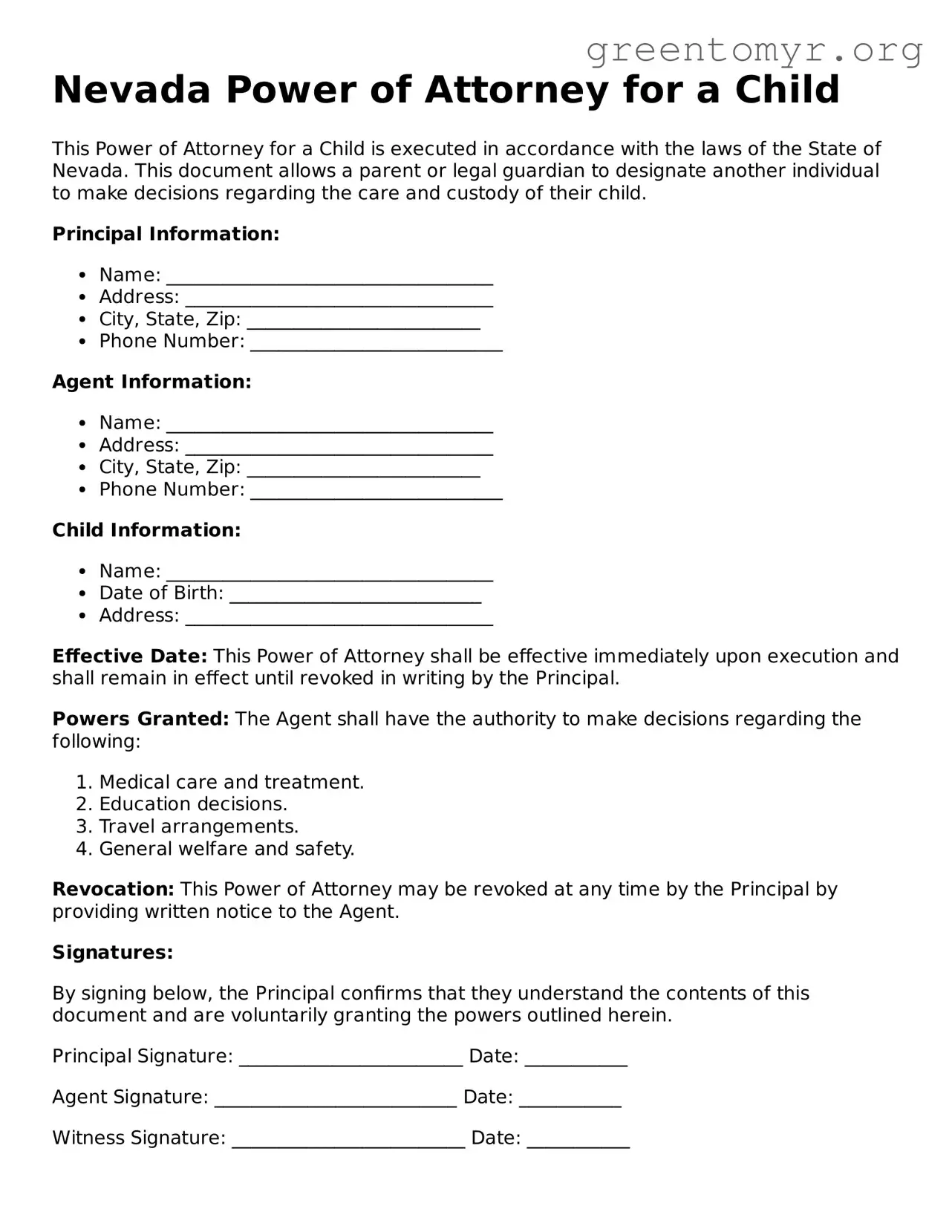
Nevada Power of Attorney for a Child
This Power of Attorney for a Child is executed in accordance with the laws of the State of Nevada. This document allows a parent or legal guardian to designate another individual to make decisions regarding the care and custody of their child.
Principal Information:
Agent Information:
Child Information:
Effective Date: This Power of Attorney shall be effective immediately upon execution and shall remain in effect until revoked in writing by the Principal.
Powers Granted: The Agent shall have the authority to make decisions regarding the following:
Revocation: This Power of Attorney may be revoked at any time by the Principal by providing written notice to the Agent.
Signatures:
By signing below, the Principal confirms that they understand the contents of this document and are voluntarily granting the powers outlined herein.
Principal Signature: ________________________ Date: ___________
Agent Signature: __________________________ Date: ___________
Witness Signature: _________________________ Date: ___________
Witness Signature: _________________________ Date: ___________
This document should be kept in a safe place and a copy should be provided to the Agent and any relevant parties.
| Fact Name | Description |
|---|---|
| Definition | A Power of Attorney for a Child allows a parent or legal guardian to appoint someone else to make decisions on behalf of their child. |
| Governing Law | The Power of Attorney for a Child in Nevada is governed by Nevada Revised Statutes (NRS) Chapter 162. |
| Eligibility | Any parent or legal guardian can create this document, provided they have the legal authority to make decisions for the child. |
| Duration | The Power of Attorney can be temporary or indefinite, depending on the wishes of the parent or guardian. |
| Revocation | The parent or guardian can revoke the Power of Attorney at any time, as long as they follow the proper legal procedures. |
| Limitations | The appointed agent may not have the authority to make certain decisions, such as those related to adoption or marriage. |
| Signature Requirements | The form must be signed by the parent or guardian and may require notarization for added legal validity. |
| Use Cases | This document is often used when parents are traveling, working abroad, or unable to care for their child temporarily. |
| Agent's Responsibilities | The appointed agent is expected to act in the best interests of the child and make decisions accordingly. |
Filling out the Nevada Power of Attorney for a Child form is an important step in ensuring that a trusted individual can make decisions on behalf of your child when necessary. It’s crucial to complete this form accurately to avoid any potential issues in the future. Below are the steps to guide you through the process.
After completing the form, ensure that all parties involved understand their rights and responsibilities. Keeping an open line of communication will help facilitate any decisions that may need to be made in the future.
A Power of Attorney for a Child in Nevada allows a parent or legal guardian to designate another adult to make decisions on behalf of their child. This can include decisions about medical care, education, and other important matters when the parent or guardian is unavailable.
Any responsible adult can be appointed as an agent. This can be a family member, friend, or trusted individual. It is important to choose someone who will act in the best interest of the child.
The Power of Attorney for a Child can be set for a specific duration or remain in effect until revoked by the parent or guardian. If no expiration date is specified, it typically lasts until the child reaches the age of majority, which is 18 years old in Nevada.
Yes, the Power of Attorney must be notarized to be legally valid in Nevada. This ensures that the document is authentic and that the parent or guardian has willingly signed it.
Yes, you can revoke the Power of Attorney at any time. To do this, you should provide written notice to the agent and any relevant parties, such as schools or medical providers. It is advisable to keep a copy of the revocation for your records.
The agent can make a variety of decisions regarding the child's welfare. This includes:
However, the agent cannot make decisions that require parental consent unless specifically authorized in the document.
Yes, Nevada has a specific form for the Power of Attorney for a Child. It is important to use the correct form to ensure that all legal requirements are met. The form can typically be obtained from legal websites or local government offices.
If the child has special needs, the Power of Attorney can still be used. It may be beneficial to include specific instructions in the document regarding the child's unique requirements. This ensures that the agent understands how to best support the child.
Keep the Power of Attorney document in a safe but accessible location. It is advisable to provide copies to the appointed agent, any relevant family members, and institutions that may need to reference it, such as schools or medical facilities.
Filling out the Nevada Power of Attorney for a Child form can be a daunting task. Many people make mistakes that can lead to confusion or even legal issues down the line. Understanding these common errors can help ensure that the document is completed correctly.
One frequent mistake is not providing complete information about the child. It’s crucial to include the child’s full name, date of birth, and any other identifying details. Omitting this information can cause delays or complications when the document is needed.
Another common error is failing to specify the powers granted to the agent. The form should clearly outline what decisions the agent can make on behalf of the child. If this is vague or unclear, it could lead to misunderstandings about what the agent is allowed to do.
People often forget to include the dates of the power of attorney’s validity. It’s important to state when the authority begins and when it ends. Without these dates, the document may be considered invalid after a certain point.
Not signing the form in the presence of a notary public is another mistake that can render the document ineffective. A notary’s signature is often required to verify that the individuals involved are who they claim to be. Skipping this step can lead to challenges in the future.
Many individuals overlook the need for witnesses. Depending on the specific requirements in Nevada, having one or two witnesses sign the form may be necessary. Failing to do so can create problems if the document is ever questioned.
Another mistake is not keeping copies of the completed form. Once the Power of Attorney is filled out and signed, it’s wise to make copies for all parties involved. This ensures that everyone has access to the document when needed.
People sometimes forget to update the Power of Attorney if circumstances change. If the agent’s situation changes or if the child’s needs evolve, it is essential to revise the document accordingly. Neglecting to do this can lead to outdated information being used.
Lastly, many fail to communicate with the child about the Power of Attorney. It’s important for the child to understand who will be making decisions on their behalf and why. This can help prevent confusion or anxiety when the time comes for the document to be used.
By being aware of these common mistakes, individuals can take steps to avoid them. Filling out the Nevada Power of Attorney for a Child form correctly is essential for ensuring that the child’s needs are met and that their best interests are protected.
The Nevada Power of Attorney for a Child form allows a parent or legal guardian to designate another individual to make decisions on behalf of their child. This document is often used in conjunction with other forms to ensure comprehensive legal coverage and clarity regarding the child's welfare. Below is a list of related forms and documents that may be beneficial in similar situations.
Utilizing these documents in conjunction with the Nevada Power of Attorney for a Child form can help ensure that all aspects of a child's care and welfare are addressed. It is advisable to consult with a legal professional to tailor these documents to specific needs and circumstances.
The Power of Attorney for a Child form allows a parent or guardian to designate another person to make decisions on behalf of their child. This document shares similarities with several other legal documents, each serving specific purposes. Below is a list of nine documents that are comparable to the Power of Attorney for a Child form, along with explanations of their similarities.
Understanding these documents can help clarify the various ways in which authority and responsibility for a child's welfare can be managed. Each document serves a unique purpose but shares the fundamental goal of ensuring the best interests of the child are upheld.
When filling out the Nevada Power of Attorney for a Child form, it’s essential to approach the task with care. Here are some important do's and don'ts to consider:
Following these guidelines will help ensure that the Power of Attorney for a Child form is filled out correctly and effectively. Proper attention to detail can make a significant difference in the process.
Understanding the Nevada Power of Attorney for a Child form is essential for parents and guardians. However, several misconceptions can lead to confusion. Here are seven common misconceptions:
This form can be used for various situations, not just emergencies. It allows a parent to delegate authority for everyday decisions when they are unavailable.
Both parents can sign the form if they agree. In cases of joint custody, both parents may need to give their consent.
This authority is not permanent. It can be revoked at any time by the parent who granted it, as long as they are of sound mind.
While notarization is recommended, it is not always required. The form can still be valid without a notary, depending on the situation.
While many adults can be designated, it is wise to choose someone trustworthy and responsible. The chosen individual should have the child's best interests in mind.
This form does not transfer custody. It allows for temporary decision-making authority, but legal custody remains with the parent.
These are two distinct legal arrangements. Guardianship involves a court process and grants broader rights than a Power of Attorney.
Understanding these misconceptions can help parents make informed decisions regarding the care and authority over their children.
When filling out and using the Nevada Power of Attorney for a Child form, there are several important points to consider. Here are four key takeaways:
By keeping these points in mind, parents and guardians can effectively navigate the process of using the Power of Attorney for a Child in Nevada.