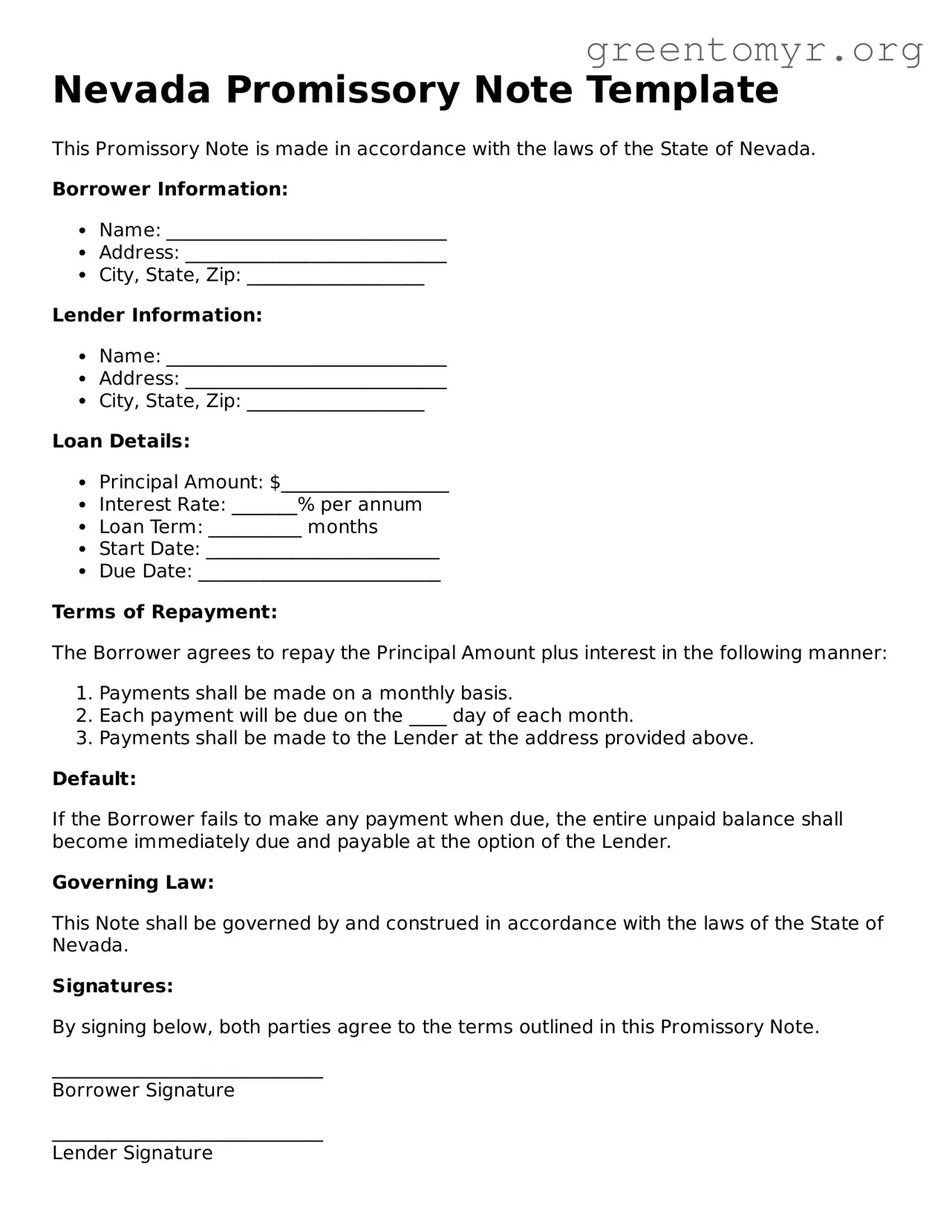
The Nevada Promissory Note form serves as a vital financial instrument, facilitating the borrowing and lending of money between parties. This legally binding document outlines the borrower's promise to repay a specified amount to the lender, detailing essential terms such as the interest rate, payment schedule, and maturity date. It also specifies the consequences of default, ensuring both parties understand their rights and obligations. Additionally, the form may include provisions for prepayment and late fees, offering flexibility and clarity in the repayment process. By adhering to Nevada's legal requirements, this form protects both lenders and borrowers, fostering trust and accountability in financial transactions.
Nevada Promissory Note Template
This Promissory Note is made in accordance with the laws of the State of Nevada.
Borrower Information:
Lender Information:
Loan Details:
Terms of Repayment:
The Borrower agrees to repay the Principal Amount plus interest in the following manner:
Default:
If the Borrower fails to make any payment when due, the entire unpaid balance shall become immediately due and payable at the option of the Lender.
Governing Law:
This Note shall be governed by and construed in accordance with the laws of the State of Nevada.
Signatures:
By signing below, both parties agree to the terms outlined in this Promissory Note.
_____________________________
Borrower Signature
_____________________________
Lender Signature
Date: _________________________
| Fact Name | Description |
|---|---|
| Definition | A Nevada Promissory Note is a written promise to pay a specified amount of money to a lender by a certain date. |
| Governing Law | The promissory note is governed by Nevada Revised Statutes (NRS) Chapter 104. |
| Parties Involved | The note involves two main parties: the borrower (maker) and the lender (payee). |
| Interest Rate | The note may specify an interest rate, which can be fixed or variable. |
| Payment Terms | Payment terms must be clearly outlined, including the due date and any installment amounts. |
| Default Clause | A default clause may be included, detailing the consequences if the borrower fails to pay. |
| Signatures | Both parties must sign the note for it to be legally binding. |
| Notarization | While notarization is not required, it can add an extra layer of authenticity. |
| Transferability | A promissory note can typically be transferred to another party, allowing for sale or assignment. |
| Enforcement | If the borrower defaults, the lender can pursue legal action to enforce the terms of the note. |
After gathering the necessary information, you are ready to complete the Nevada Promissory Note form. This document will outline the terms of the loan agreement between the borrower and the lender. Follow these steps carefully to ensure all required information is accurately provided.
A Nevada Promissory Note is a written agreement in which one party promises to pay a specific amount of money to another party at a predetermined time or on demand. This document serves as a legal record of the debt and outlines the terms of repayment.
Any individual or business in Nevada can use a Promissory Note. It is commonly used in personal loans, business transactions, and real estate financing. Both lenders and borrowers benefit from having a clear, written agreement.
A complete Promissory Note should include the following information:
Yes, a Promissory Note is legally binding in Nevada as long as it meets the necessary legal requirements. Both parties must agree to the terms, and the document should be signed by both the borrower and the lender.
Yes, a Promissory Note can be modified if both parties agree to the changes. It is advisable to document any modifications in writing and have both parties sign the updated agreement to avoid confusion in the future.
If the borrower fails to repay the loan according to the terms outlined in the Promissory Note, the lender has the right to take legal action to recover the owed amount. This may include filing a lawsuit or seeking a judgment against the borrower.
No, you do not necessarily need a lawyer to create a Promissory Note. Many templates are available online that can help you draft a legally sound document. However, consulting with a legal professional can provide additional assurance and guidance.
A Promissory Note is a simpler document that primarily outlines the borrower's promise to repay a loan. A loan agreement, on the other hand, is more comprehensive and may include additional terms and conditions, such as collateral, warranties, and covenants.
Yes, a Promissory Note can be transferred or assigned to another party. This process is known as endorsement. The new holder of the note will then have the right to collect the debt under the same terms outlined in the original agreement.
Filling out a Nevada Promissory Note form can seem straightforward, but many individuals make common mistakes that can lead to complications. One frequent error is failing to include all required information. The form typically requires details such as the names of the borrower and lender, the amount of the loan, and the repayment terms. Omitting any of these critical pieces of information can render the document incomplete.
Another mistake is not specifying the interest rate. While some may assume that the interest rate is understood, it is essential to explicitly state it on the form. This omission can lead to misunderstandings or disputes later on. Clearly defining the interest rate helps both parties understand their obligations and expectations.
People often overlook the importance of signing the document. A Promissory Note is not legally binding unless it is signed by both the borrower and the lender. Without signatures, the note lacks enforceability, which can create significant issues if repayment becomes a problem.
Additionally, failing to date the document is another common oversight. The date of signing establishes the timeline for the loan agreement and repayment schedule. Without a date, it may be unclear when the terms of the agreement take effect, leading to potential confusion.
Some individuals may also neglect to keep copies of the signed Promissory Note. It is crucial for both parties to have a copy for their records. This ensures that each party can refer back to the terms of the agreement if any disputes arise in the future.
Lastly, not considering the legal implications of the Promissory Note can be a significant mistake. While it may seem like a simple agreement, the terms can have lasting consequences. It is advisable to review the document carefully and ensure that all parties understand their rights and responsibilities before signing.
When engaging in a loan agreement, various forms and documents may accompany the Nevada Promissory Note. Each of these documents serves a specific purpose in ensuring clarity and legal protection for both parties involved. Below is a list of commonly used documents that may be relevant in such transactions.
Understanding these documents can help both lenders and borrowers navigate the complexities of loan agreements. It is essential to ensure that all necessary paperwork is completed accurately to protect the interests of all parties involved.
The Promissory Note is a key financial document. Several other documents share similarities with it. Below is a list of those documents, highlighting how they are alike.
Understanding these documents can help clarify financial obligations and rights. Each plays a role in financial transactions, ensuring that both parties are aware of their commitments.
When filling out the Nevada Promissory Note form, it's important to follow certain guidelines to ensure accuracy and legality. Here are five things you should and shouldn't do:
Understanding the Nevada Promissory Note form can be challenging due to several misconceptions. Here are seven common misunderstandings, along with clarifications:
Many people believe that all promissory notes function identically. In reality, the terms can vary significantly based on state laws and individual agreements.
Some think that only banks and financial institutions utilize promissory notes. However, individuals can also create and enforce these documents for personal loans.
While notarization can provide additional legal protection, it is not a requirement for a promissory note to be valid in Nevada.
Another misconception is that promissory notes are not legally binding. In fact, when properly executed, they are enforceable contracts.
Some people assume that every promissory note must include interest. However, it is possible to create a note with no interest, depending on the agreement between the parties.
While written notes are common, verbal agreements can also be considered promissory notes. However, proving the terms of a verbal agreement can be more difficult.
Lastly, many believe that once a promissory note is created, it cannot be transferred. In reality, these notes can often be sold or assigned to another party.
Understanding these misconceptions can help individuals navigate the complexities of promissory notes in Nevada more effectively.
When filling out and using the Nevada Promissory Note form, keep these key takeaways in mind: