The Nevada Quitclaim Deed form serves as a crucial legal instrument for property transfers, allowing individuals to convey their interest in real estate without making any guarantees about the title's validity. This form is particularly useful in situations such as transferring property between family members, settling an estate, or clearing up title issues. It requires the names of the grantor and grantee, a description of the property, and the signature of the grantor, along with any necessary notarization. Unlike other types of deeds, a quitclaim deed does not provide warranties, meaning the grantee receives whatever interest the grantor holds, if any. This aspect makes it vital for parties to understand their rights and the potential risks involved. Additionally, the completed deed must be recorded with the county recorder’s office to ensure public notice of the transfer. Understanding these components is essential for anyone considering using a quitclaim deed in Nevada.
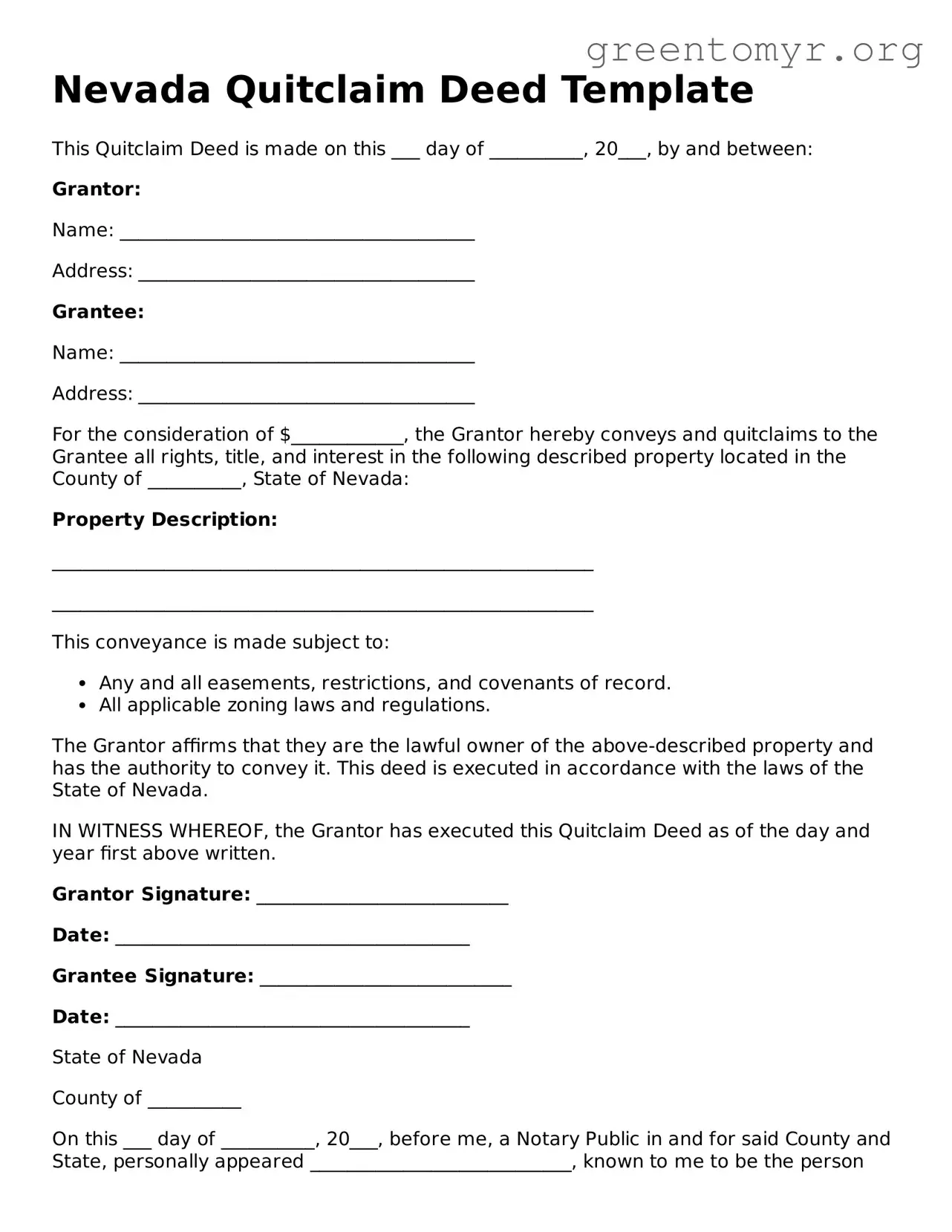
Nevada Quitclaim Deed Template
This Quitclaim Deed is made on this ___ day of __________, 20___, by and between:
Grantor:
Name: ______________________________________
Address: ____________________________________
Grantee:
Name: ______________________________________
Address: ____________________________________
For the consideration of $____________, the Grantor hereby conveys and quitclaims to the Grantee all rights, title, and interest in the following described property located in the County of __________, State of Nevada:
Property Description:
__________________________________________________________
__________________________________________________________
This conveyance is made subject to:
The Grantor affirms that they are the lawful owner of the above-described property and has the authority to convey it. This deed is executed in accordance with the laws of the State of Nevada.
IN WITNESS WHEREOF, the Grantor has executed this Quitclaim Deed as of the day and year first above written.
Grantor Signature: ___________________________
Date: ______________________________________
Grantee Signature: ___________________________
Date: ______________________________________
State of Nevada
County of __________
On this ___ day of __________, 20___, before me, a Notary Public in and for said County and State, personally appeared ____________________________, known to me to be the person whose name is subscribed to the within instrument, and acknowledged that they executed the same.
Notary Public Signature: ______________________
My Commission Expires: ______________________
| Fact Name | Description |
|---|---|
| Definition | A quitclaim deed is a legal document that transfers ownership of real property from one party to another without any warranties regarding the title. |
| Governing Law | The Nevada Revised Statutes (NRS) Chapter 111 governs the use of quitclaim deeds in Nevada. |
| Parties Involved | The parties involved in a quitclaim deed are the grantor (the person transferring the property) and the grantee (the person receiving the property). |
| Consideration | While consideration (payment) is not required, it is often included to ensure the deed's validity. |
| Execution Requirements | The grantor must sign the quitclaim deed in the presence of a notary public for it to be legally binding. |
| Recording | To provide public notice of the transfer, the quitclaim deed should be recorded with the county recorder's office where the property is located. |
| Uses | Quitclaim deeds are commonly used in situations such as transferring property between family members or clearing up title issues. |
| Limitations | Since quitclaim deeds do not guarantee a clear title, they carry risks for the grantee if there are existing liens or claims against the property. |
| Legal Advice | It is advisable to seek legal counsel before executing a quitclaim deed to understand its implications fully. |
Once you have the Nevada Quitclaim Deed form ready, it’s important to fill it out accurately to ensure a smooth transfer of property. Follow these steps carefully to complete the form correctly.
After you have filled out and submitted the Quitclaim Deed, it will be recorded by the county. You will receive a copy for your records, confirming the transfer of property ownership. Keep this document in a safe place for future reference.
A Quitclaim Deed is a legal document used to transfer ownership of real estate from one person to another. In Nevada, this type of deed does not guarantee that the person transferring the property has clear title. Instead, it simply conveys whatever interest the grantor has in the property, if any.
You might use a Quitclaim Deed in several situations, including:
A Nevada Quitclaim Deed typically requires the following information:
Yes, in Nevada, the Quitclaim Deed must be signed in front of a notary public. This step is crucial to ensure the document is legally valid and can be recorded with the county.
To file a Quitclaim Deed in Nevada, follow these steps:
Yes, there are typically fees for filing a Quitclaim Deed with the county recorder's office. These fees can vary by county, so it’s best to check with the local office for the exact amount.
Once a Quitclaim Deed is filed, it cannot be revoked unilaterally. However, if both parties agree, a new deed can be created to reverse the transfer. Legal advice may be necessary in complex situations.
No, a Quitclaim Deed is not the same as a Warranty Deed. A Warranty Deed offers more protection to the grantee, as it guarantees that the grantor holds clear title to the property and has the right to transfer it. In contrast, a Quitclaim Deed provides no such guarantees.
While it is not legally required to have an attorney prepare a Quitclaim Deed, consulting one can be beneficial, especially in complicated situations. An attorney can help ensure that the deed is correctly completed and that your interests are protected.
Filling out a Nevada Quitclaim Deed form can be straightforward, but many people make common mistakes that can lead to complications. One frequent error is failing to provide complete and accurate information about the parties involved. The form requires the names of both the grantor (the person transferring the property) and the grantee (the person receiving the property). Omitting a middle name or using an incorrect spelling can create issues in the future.
Another mistake occurs when individuals do not properly describe the property being transferred. The Quitclaim Deed must include a clear legal description of the property. Relying solely on a street address may not be sufficient. Without a precise legal description, the deed may be deemed invalid, leading to potential disputes over ownership.
Some people overlook the importance of signatures. The Quitclaim Deed must be signed by the grantor in the presence of a notary public. Failing to have the deed notarized can render it unenforceable. Additionally, if the grantor does not sign the document, the transfer of property will not take place, leaving the grantee without any legal rights to the property.
Finally, individuals often forget to record the Quitclaim Deed with the appropriate county recorder’s office. Recording the deed is essential to establish public notice of the property transfer. If the deed is not recorded, the grantee may face challenges in asserting their ownership, especially if the grantor decides to sell the property again or if any legal disputes arise.
When dealing with property transfers in Nevada, the Quitclaim Deed form is often accompanied by several other important documents. Each of these documents serves a specific purpose in the transaction process, ensuring that everything is clear and legally binding. Here’s a list of forms and documents you might encounter.
Understanding these documents can help ensure a smooth property transfer process. Each one plays a crucial role in protecting the interests of both buyers and sellers, making it essential to have them in order.
A Quitclaim Deed is a legal document used to transfer ownership of property. It is important to understand how it relates to other similar documents. Here are six documents that share similarities with a Quitclaim Deed:
Understanding these documents can clarify your options when transferring property. Each serves its unique purpose while sharing common elements with the Quitclaim Deed.
When filling out the Nevada Quitclaim Deed form, it’s important to follow certain guidelines to ensure accuracy and compliance. Here’s a list of what you should and shouldn’t do:
The Nevada Quitclaim Deed is often misunderstood. Here are ten common misconceptions about this legal document:
A quitclaim deed does not guarantee that the person transferring the property has clear title. It merely conveys whatever interest the grantor has, if any.
While quitclaim deeds are frequently used to transfer property between spouses, they can also be used in various situations, such as gifting property or transferring to family members.
Unlike warranty deeds, which provide guarantees about the title, quitclaim deeds offer no such assurances. They simply transfer the interest without any warranties.
While notarization is typically required for a quitclaim deed to be recorded, it is not the only requirement. The deed must also meet specific formatting and content standards.
Quitclaim deeds can be used for real property, but they are not suitable for transferring personal property, such as vehicles or equipment.
Although the form itself may be simple, ensuring that all necessary information is accurate and that the deed is properly executed can take time and careful attention.
Using a quitclaim deed does not eliminate the risks associated with title issues. Title insurance may still be advisable to protect against potential claims.
Quitclaim deeds can also be used to transfer property to a trust or a business entity, not just between individuals.
When properly executed and recorded, quitclaim deeds are legally binding. They create a record of the transfer of interest in the property.
While quitclaim deeds are generally irrevocable, there may be circumstances under which a court could reverse a transfer, particularly if fraud or coercion is involved.
Understanding these misconceptions can help individuals make informed decisions when considering the use of a quitclaim deed in Nevada.
When filling out and using the Nevada Quitclaim Deed form, it is essential to keep the following key takeaways in mind: