When renting a home in Nevada, having a solid understanding of the Residential Lease Agreement form is essential for both landlords and tenants. This document outlines the terms and conditions of the rental arrangement, ensuring that both parties are clear on their rights and responsibilities. Key components include the duration of the lease, the rental amount, and payment due dates. Additionally, it covers security deposits, maintenance responsibilities, and rules regarding pets and smoking. Understanding these aspects can help prevent misunderstandings and disputes down the line. By clearly defining the relationship between landlord and tenant, this agreement serves as a foundational tool for a successful rental experience in the Silver State.
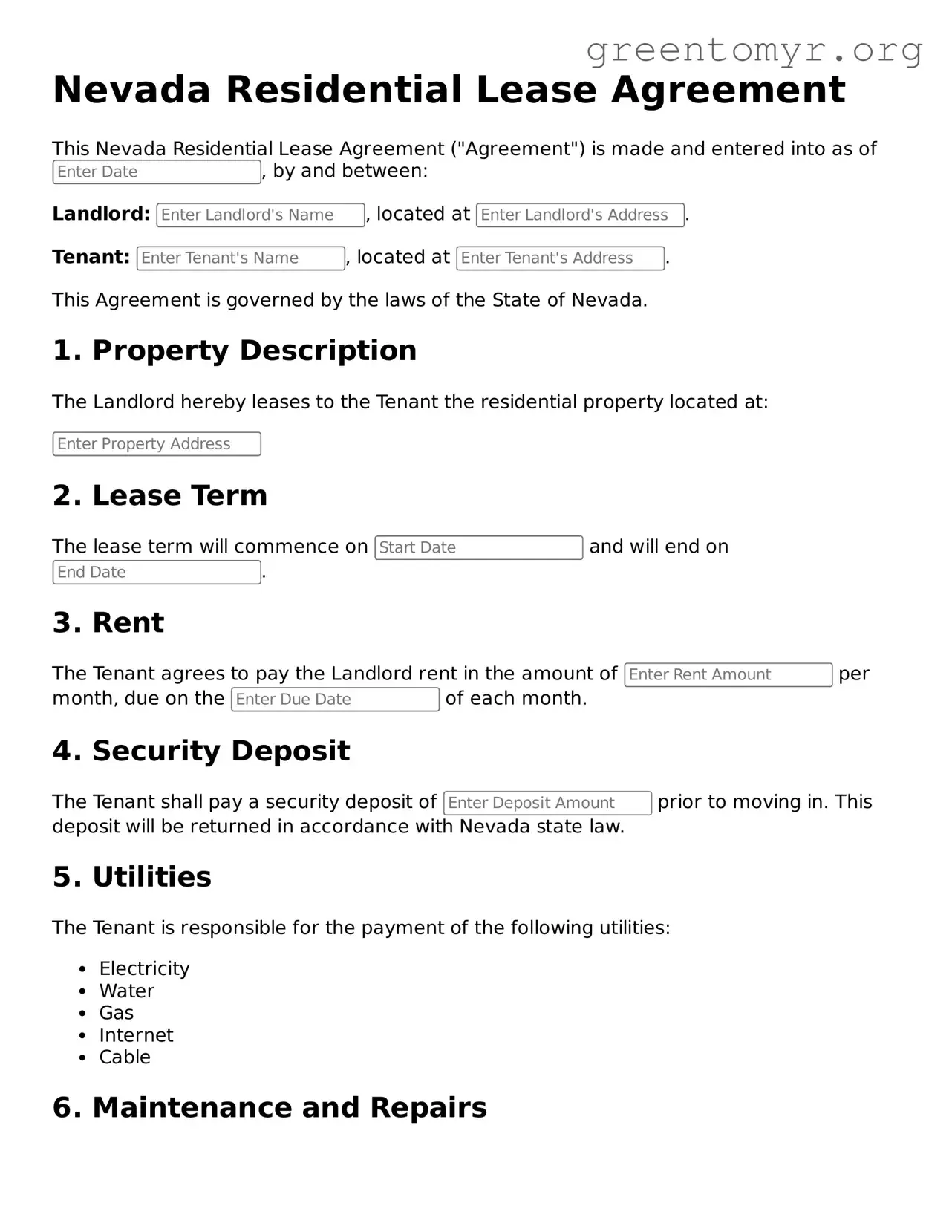
Nevada Residential Lease Agreement
This Nevada Residential Lease Agreement ("Agreement") is made and entered into as of , by and between:
Landlord: , located at .
Tenant: , located at .
This Agreement is governed by the laws of the State of Nevada.
1. Property Description
The Landlord hereby leases to the Tenant the residential property located at:
2. Lease Term
The lease term will commence on and will end on .
3. Rent
The Tenant agrees to pay the Landlord rent in the amount of per month, due on the of each month.
4. Security Deposit
The Tenant shall pay a security deposit of prior to moving in. This deposit will be returned in accordance with Nevada state law.
5. Utilities
The Tenant is responsible for the payment of the following utilities:
6. Maintenance and Repairs
The Tenant agrees to maintain the property in good condition. Any necessary repairs must be reported to the Landlord immediately.
7. Termination
Either party may terminate this Agreement by providing written notice at least days in advance.
8. Governing Law
This Agreement shall be governed by and construed in accordance with the laws of the State of Nevada.
9. Signatures
By signing below, both parties agree to the terms of this Agreement.
Landlord Signature: ________________________ Date: ____________
Tenant Signature: ________________________ Date: ____________
| Fact Name | Details |
|---|---|
| Governing Law | The Nevada Residential Lease Agreement is governed by the Nevada Revised Statutes, particularly Chapter 118A. |
| Parties Involved | The agreement is between a landlord and a tenant, both of whom must be clearly identified. |
| Property Description | The lease must include a detailed description of the rental property, including the address and any specific unit number. |
| Lease Term | The duration of the lease should be specified, whether it is a fixed term or a month-to-month arrangement. |
| Rent Amount | The agreement must clearly state the monthly rent amount and the due date for payment. |
| Security Deposit | The lease should outline the amount of the security deposit and the conditions for its return at the end of the lease. |
| Maintenance Responsibilities | The responsibilities for maintenance and repairs should be clearly defined, indicating who is responsible for what. |
| Utilities | The agreement should specify which utilities are included in the rent and which are the tenant's responsibility. |
| Termination Conditions | The lease must outline the conditions under which either party can terminate the agreement, including notice requirements. |
Filling out the Nevada Residential Lease Agreement form is an important step in establishing a rental relationship. By completing this form accurately, both the landlord and tenant can ensure clarity and mutual understanding regarding the terms of the lease. Below are the steps to guide you through the process of filling out the form.
Once you have completed these steps, review the form for accuracy and completeness. This will help prevent any misunderstandings in the future. After all parties have signed, keep a copy for your records.
A Nevada Residential Lease Agreement is a legally binding document that outlines the terms and conditions under which a tenant rents a residential property from a landlord. This agreement typically includes essential details such as the rental amount, lease duration, security deposit, and responsibilities of both parties. It serves to protect the rights of both the landlord and tenant while ensuring clarity in the rental relationship.
When creating a Nevada Residential Lease Agreement, several critical elements should be included to ensure it is comprehensive and clear:
In Nevada, lease terms can vary widely. Most commonly, residential leases are structured for a duration of 12 months. However, shorter leases, such as month-to-month agreements, are also prevalent. The choice of lease term often depends on the preferences of both the landlord and tenant. Longer leases may provide stability, while shorter leases offer flexibility.
Generally, landlords in Nevada cannot increase rent during the lease term unless the lease agreement explicitly allows for such increases. If the lease is month-to-month, the landlord can typically raise the rent with proper notice, which is usually 30 days. For longer leases, any increase in rent would need to wait until the lease is up for renewal.
In Nevada, tenants have specific rights concerning security deposits. The landlord may collect a security deposit, which cannot exceed three times the monthly rent for unfurnished properties and two times for furnished ones. Upon termination of the lease, the landlord must return the security deposit within 30 days, minus any deductions for damages or unpaid rent. A detailed itemization of any deductions must be provided to the tenant.
The decision to allow pets in a rental property is typically at the discretion of the landlord. If pets are permitted, the lease agreement should specify any associated terms, such as additional pet deposits or monthly pet fees. Tenants should always clarify pet policies before signing the lease to avoid misunderstandings later on.
If a tenant wishes to break the lease early, they may face penalties unless the lease agreement includes a clause that allows for early termination. In Nevada, tenants are generally responsible for paying rent until the end of the lease term or until a new tenant is found. It’s crucial for tenants to communicate with the landlord and understand their obligations to avoid legal complications.
Disputes between landlords and tenants can often be resolved through open communication. If issues arise, it is advisable to address them directly and seek a mutual agreement. Should this approach fail, mediation services are available in Nevada to help facilitate a resolution. If disputes escalate, legal action may be necessary, but this should be considered a last resort. Understanding the terms of the lease agreement can help both parties navigate conflicts more effectively.
Filling out a Nevada Residential Lease Agreement can be a straightforward process, but many individuals make common mistakes that can lead to confusion or disputes later on. One frequent error is failing to provide accurate personal information. This includes not only the names of all tenants but also their contact details. If any information is incorrect or missing, it could complicate communication between the landlord and tenants, potentially leading to misunderstandings.
Another mistake is neglecting to specify the lease term clearly. A lease agreement should outline the duration of the tenancy, whether it is a fixed-term lease or a month-to-month arrangement. If this detail is vague or omitted, it may create uncertainty about when the lease begins and ends, which can lead to disputes over rent payments or eviction notices.
People also often overlook the importance of detailing the security deposit terms. The lease should state the amount of the deposit, the conditions under which it may be withheld, and the timeline for its return after the lease ends. Without this information, tenants might find themselves facing unexpected charges or delays in getting their deposit back, which can lead to frustration and potential legal issues.
Lastly, many individuals forget to include specific rules and regulations regarding the property. This can encompass everything from pet policies to maintenance responsibilities. Clear guidelines help set expectations for both landlords and tenants. When these rules are not clearly articulated, it can result in disagreements and dissatisfaction for both parties.
When entering into a residential lease agreement in Nevada, several other forms and documents may accompany the primary lease. These documents help clarify the terms of the lease, outline responsibilities, and protect the rights of both landlords and tenants. Below is a list of commonly used forms that you might encounter alongside the Nevada Residential Lease Agreement.
Understanding these additional forms can enhance the leasing experience for both landlords and tenants. They provide clarity and help establish a solid foundation for the landlord-tenant relationship, ultimately contributing to a smoother rental process.
When filling out the Nevada Residential Lease Agreement form, it is important to follow certain guidelines to ensure accuracy and compliance. Below are some essential do's and don'ts to consider.
Do:
Don't:
When it comes to the Nevada Residential Lease Agreement form, many misunderstandings can arise. Here are nine common misconceptions and clarifications about them:
Many people think that all lease agreements follow the same format and rules. In reality, lease agreements can vary significantly by state and even by individual landlords.
Some tenants believe that a verbal agreement is sufficient. However, having a written lease is crucial as it provides clear terms and protects both parties.
There is a misconception that security deposits cannot be returned. In Nevada, landlords must return the deposit within a specific timeframe unless there are valid deductions.
Many tenants think landlords can raise rent whenever they want. In Nevada, landlords must provide notice and follow the lease terms regarding rent increases.
Some tenants assume that landlords must handle all repairs. While landlords are responsible for major repairs, tenants may need to address minor issues.
People often believe that lease terms are fixed and cannot be changed. In fact, many terms can be negotiated before signing the lease.
Some tenants think landlords have unrestricted access. In Nevada, landlords must provide notice and have valid reasons to enter the property.
Many believe that landlords can evict tenants without notice. However, there are legal processes and timelines that must be followed in Nevada.
Some people think that all leases must be annual. In reality, leases can be month-to-month or for any duration agreed upon by both parties.
When filling out and using the Nevada Residential Lease Agreement form, it is essential to understand several key aspects to ensure a smooth leasing experience. Here are the important takeaways:
By paying attention to these key points, both landlords and tenants can foster a positive rental experience and reduce the likelihood of conflicts.