Navigating the complexities of estate management can be daunting, especially during a time of loss. In Nevada, the Small Estate Affidavit offers a streamlined approach for individuals dealing with the estates of deceased loved ones. This form simplifies the process of transferring assets when the total value of the estate is below a specified threshold, currently set at $100,000 for personal property. By utilizing this affidavit, heirs can avoid the lengthy and often costly probate process, allowing for a more efficient resolution of the deceased's financial affairs. The affidavit must be completed with accurate information regarding the decedent and their assets, and it requires the signature of the affiant, who is typically an heir or a designated representative. This legal tool not only facilitates the transfer of assets but also ensures that the rights of the heirs are protected, making it an invaluable resource for small estates in Nevada.
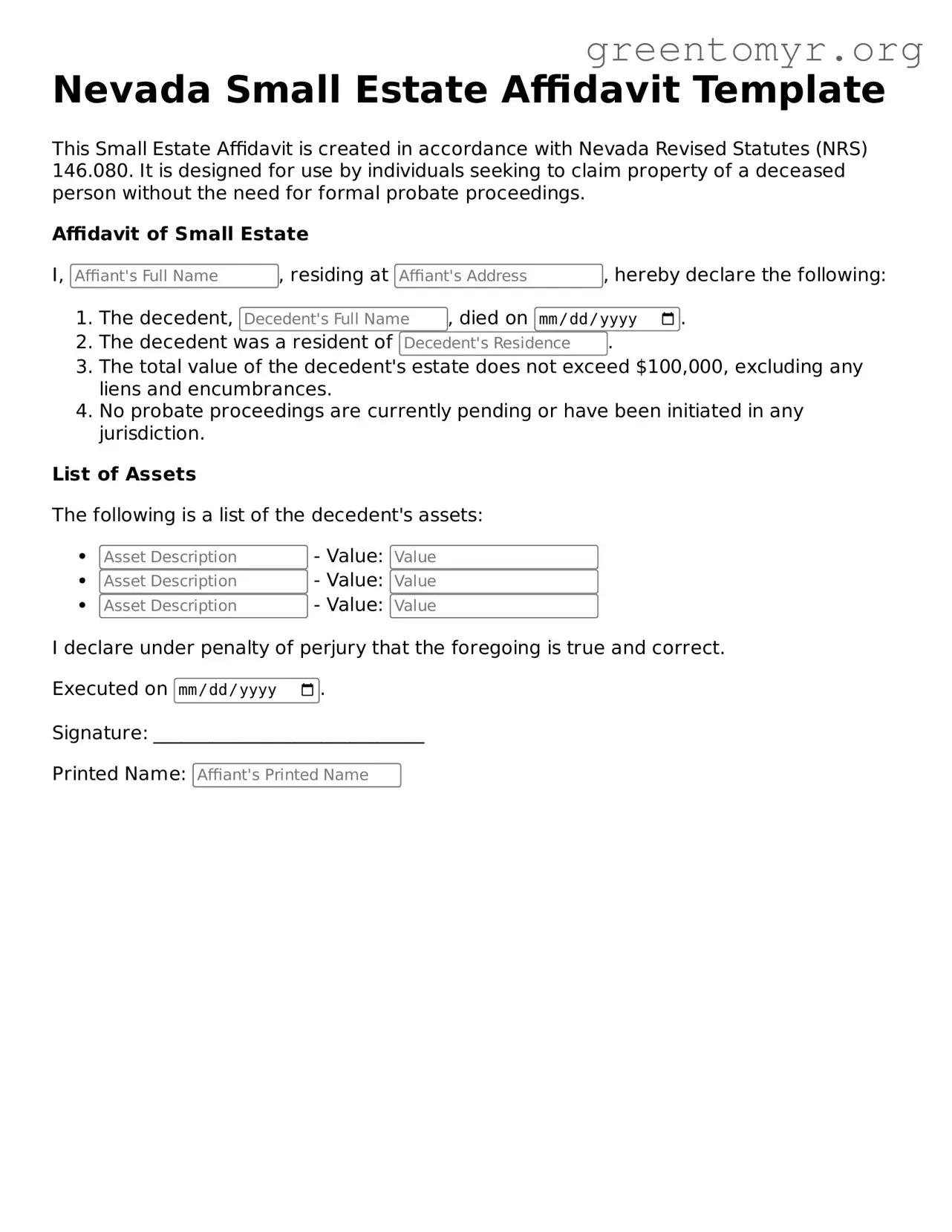
Nevada Small Estate Affidavit Template
This Small Estate Affidavit is created in accordance with Nevada Revised Statutes (NRS) 146.080. It is designed for use by individuals seeking to claim property of a deceased person without the need for formal probate proceedings.
Affidavit of Small Estate
I, , residing at , hereby declare the following:
List of Assets
The following is a list of the decedent's assets:
I declare under penalty of perjury that the foregoing is true and correct.
Executed on .
Signature: _____________________________
Printed Name:
| Fact Name | Details |
|---|---|
| Definition | The Nevada Small Estate Affidavit allows individuals to claim assets of a deceased person without going through formal probate. |
| Eligibility | This form is applicable when the total value of the deceased's assets is $100,000 or less, excluding real estate. |
| Governing Law | The relevant law for the Small Estate Affidavit in Nevada is NRS 146.080. |
| Who Can Use It | Heirs or beneficiaries of the deceased can use this affidavit to collect assets. |
| Required Information | The affidavit must include details about the deceased, the affiant, and the assets being claimed. |
| Filing Process | No court filing is necessary; the affidavit is presented to the financial institutions or asset holders directly. |
| Timeframe | The process can often be completed quickly, sometimes within a few weeks, depending on the institutions involved. |
| Notarization | The affidavit must be signed in front of a notary public to be valid. |
| Limitations | This form cannot be used for estates that include real property; separate procedures apply for those assets. |
| Potential Costs | While the process is generally low-cost, there may be nominal fees for notarization and obtaining copies of documents. |
After gathering the necessary information and documents, you can proceed to fill out the Nevada Small Estate Affidavit form. This process involves providing details about the deceased and their estate, which will be used to facilitate the transfer of assets.
The Nevada Small Estate Affidavit is a legal document that allows individuals to claim assets of a deceased person without going through the formal probate process. This form is typically used when the total value of the estate is below a certain threshold, making it a simpler and faster option for heirs or beneficiaries.
Individuals who are entitled to inherit from the deceased person may use the Small Estate Affidavit. Eligibility generally includes:
It is important to confirm that the total value of the estate does not exceed the state’s threshold for small estates.
As of October 2023, the threshold for a small estate in Nevada is $100,000 in personal property. This includes assets such as bank accounts, vehicles, and personal belongings. Real estate is not included in this calculation.
Assets that can be claimed using the Small Estate Affidavit include:
Real estate cannot be transferred using this affidavit and must go through probate.
To complete the Small Estate Affidavit, follow these steps:
Ensure that all information is accurate and complete to avoid delays.
No, the Small Estate Affidavit does not need to be filed with the court. However, it may need to be presented to financial institutions or other entities holding the deceased's assets to facilitate the transfer.
There are generally no fees associated with completing the Small Estate Affidavit itself. However, there may be fees for notarization or for obtaining copies of the deceased's death certificate, which may be required by institutions holding the assets.
The processing time for a Small Estate Affidavit can vary. Once the affidavit is completed and presented to the relevant institutions, they may take a few days to a few weeks to process the request and transfer the assets. It is advisable to follow up with the institutions directly for specific timelines.
If disputes arise among heirs, it may complicate the process. It is recommended to seek legal advice to resolve conflicts. In some cases, mediation may be necessary to reach an agreement before proceeding with the Small Estate Affidavit.
Yes, you can use the Small Estate Affidavit even if there is a will, as long as the total value of the estate is below the threshold. However, the will must be valid, and you must be an eligible heir or beneficiary as named in the will.
Filling out the Nevada Small Estate Affidavit form can seem straightforward, but many people make common mistakes that can complicate the process. One frequent error is failing to include all required information. The form asks for specific details about the deceased, including their full name and date of death. Omitting any of this information can lead to delays or even rejection of the affidavit.
Another mistake is not properly identifying the heirs. The form requires you to list all beneficiaries entitled to the estate. If someone is left out, it could result in legal disputes down the line. It's essential to double-check your list of heirs to ensure that everyone who has a claim is included.
Many individuals also overlook the need for notarization. The affidavit must be signed in front of a notary public to be valid. Neglecting this step can invalidate the entire document. Make sure to have the affidavit notarized before submitting it to the appropriate court or agency.
Inaccurate valuations of the estate's assets are another common pitfall. The form requires you to provide an estimate of the total value of the estate. Underestimating or overestimating these values can create issues. Take the time to assess the worth of all assets accurately, as this will help avoid complications later.
Additionally, people often misinterpret the requirements for debts and liabilities. The affidavit should include any outstanding debts of the deceased. Failing to disclose these can lead to legal repercussions. Be thorough in listing all known debts to ensure compliance with state laws.
Lastly, many individuals do not keep copies of the completed affidavit. After submission, it is crucial to retain a copy for your records. This can be helpful for future reference or if any questions arise about the estate. Always make sure to keep a personal copy to safeguard against any potential issues.
When dealing with the transfer of assets in a small estate in Nevada, several forms and documents can complement the Small Estate Affidavit. These documents help streamline the process and ensure that all legal requirements are met. Below is a list of commonly used forms that may accompany the Small Estate Affidavit.
By understanding these additional forms and documents, individuals can better navigate the complexities of settling a small estate in Nevada. Each document plays a specific role in ensuring that the estate is administered smoothly and in accordance with the law.
The Small Estate Affidavit form serves a specific purpose in estate management, allowing individuals to claim assets of a deceased person without going through the full probate process. Several other documents share similarities with the Small Estate Affidavit in terms of function or intent. Here are five such documents:
When filling out the Nevada Small Estate Affidavit form, it's important to approach the process with care. Here are some helpful dos and don'ts to guide you.
By following these guidelines, you can help ensure a smoother process when dealing with the Small Estate Affidavit in Nevada.
Many people have misunderstandings about the Nevada Small Estate Affidavit form. Here are six common misconceptions:
Understanding these points can help clarify the purpose and limitations of the Small Estate Affidavit in Nevada.
The Nevada Small Estate Affidavit is a useful tool for individuals handling the estate of a deceased person. Here are some key takeaways to consider when filling out and using this form:
Understanding these points can help streamline the process of managing a small estate in Nevada.