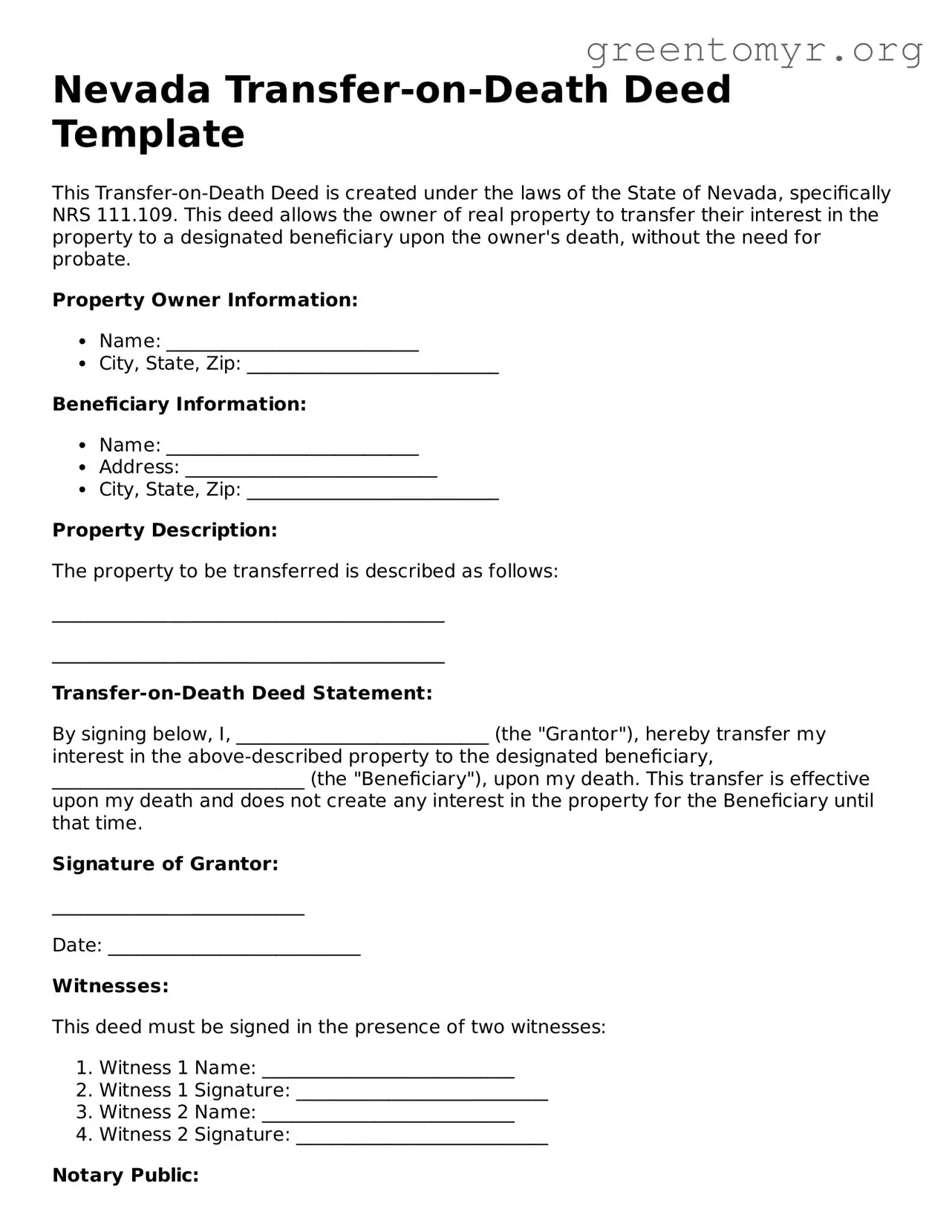
The Nevada Transfer-on-Death Deed form is a valuable legal tool that allows property owners to designate beneficiaries who will inherit real estate upon their death, bypassing the often lengthy probate process. This form is particularly beneficial for individuals looking to ensure a smooth transition of property ownership without the need for court involvement. By completing the deed, property owners can retain full control of their property during their lifetime, while clearly outlining their wishes for the future. The form must be properly executed and recorded with the county recorder’s office to be valid. It is important to note that the deed can be revoked or altered at any time prior to the owner's death, providing flexibility in estate planning. Understanding the requirements and implications of the Transfer-on-Death Deed is essential for anyone considering this option for estate management in Nevada.
Nevada Transfer-on-Death Deed Template
This Transfer-on-Death Deed is created under the laws of the State of Nevada, specifically NRS 111.109. This deed allows the owner of real property to transfer their interest in the property to a designated beneficiary upon the owner's death, without the need for probate.
Property Owner Information:
Beneficiary Information:
Property Description:
The property to be transferred is described as follows:
__________________________________________
__________________________________________
Transfer-on-Death Deed Statement:
By signing below, I, ___________________________ (the "Grantor"), hereby transfer my interest in the above-described property to the designated beneficiary, ___________________________ (the "Beneficiary"), upon my death. This transfer is effective upon my death and does not create any interest in the property for the Beneficiary until that time.
Signature of Grantor:
___________________________
Date: ___________________________
Witnesses:
This deed must be signed in the presence of two witnesses:
Notary Public:
State of Nevada
County of ___________________________
Subscribed and sworn before me on this _____ day of ____________, 20__.
_____________________________
Notary Public Signature
My commission expires: ________________
| Fact Name | Details |
|---|---|
| Definition | A Transfer-on-Death Deed allows property owners to transfer their real estate to beneficiaries upon their death without going through probate. |
| Governing Law | The Nevada Transfer-on-Death Deed is governed by Nevada Revised Statutes (NRS) 111.1091 to 111.1096. |
| Eligibility | Any individual who owns real property in Nevada can create a Transfer-on-Death Deed. |
| Revocation | The deed can be revoked at any time by the property owner, provided the revocation is properly executed and recorded. |
| Beneficiary Designation | Property owners can name one or more beneficiaries in the deed. |
| Recording Requirement | The Transfer-on-Death Deed must be recorded with the county recorder's office in the county where the property is located. |
| Effect on Property Taxes | The deed does not affect property taxes until the property is transferred to the beneficiaries. |
| Impact on Creditors | Creditors may still claim against the estate of the deceased owner before the property is transferred to beneficiaries. |
| Legal Assistance | While it is possible to complete the deed without legal help, consulting an attorney is advisable to ensure all legal requirements are met. |
| Limitations | The deed cannot be used for transferring property that is part of a trust or for properties subject to a mortgage, unless the lender agrees. |
Once you have the Nevada Transfer-on-Death Deed form ready, it's time to fill it out accurately. This form allows you to designate a beneficiary for your property, ensuring a smooth transfer upon your passing. Follow these steps carefully to complete the form.
A Transfer-on-Death Deed (TOD Deed) is a legal document that allows property owners in Nevada to designate a beneficiary who will automatically receive the property upon the owner's death. This deed enables the transfer of real estate without the need for probate, simplifying the process for heirs. The property remains under the owner's control during their lifetime, and they can revoke or change the beneficiary at any time before their death.
Creating a Transfer-on-Death Deed involves several steps:
It is advisable to consult with a legal professional to ensure that all requirements are met and that the deed is properly executed.
Yes, property owners can change or revoke a Transfer-on-Death Deed at any time before their death. To do this, the owner must create a new deed that either designates a different beneficiary or explicitly states that the previous deed is revoked. Like the original deed, any changes must be signed, notarized, and recorded with the county recorder’s office to be legally effective.
If the designated beneficiary passes away before the property owner, the Transfer-on-Death Deed becomes ineffective unless there are alternate beneficiaries named. If no alternate beneficiary is specified, the property will typically go through probate and be distributed according to the owner’s will or, if there is no will, according to state intestacy laws. It is wise to consider naming alternate beneficiaries to avoid complications.
Filling out a Transfer-on-Death Deed (TODD) form in Nevada can be a straightforward process, but several common mistakes can complicate matters. Understanding these pitfalls can help individuals ensure that their property transfers smoothly upon their passing.
One frequent error is failing to include all required information. The TODD form requires specific details, such as the names of the property owners and the beneficiaries. Omitting any of this information can render the deed invalid. It is crucial to double-check that all fields are complete before submission.
Another mistake involves inaccurate property descriptions. The deed must clearly identify the property being transferred. Vague or incorrect descriptions can lead to disputes or confusion among beneficiaries. It is advisable to use legal descriptions from previous deeds or property tax documents to ensure accuracy.
Many individuals also overlook the importance of signatures and notarization. The deed must be signed by the property owner in front of a notary public. Failing to have the deed properly notarized can invalidate the document. Ensuring that all signatures are in place and that the notary's seal is affixed is essential.
Another common issue arises from not recording the deed with the county recorder's office. A TODD is not effective until it is recorded. Individuals often assume that filling out the form is sufficient, but without recording, the transfer does not take effect. Timely recording is necessary to ensure the deed is legally recognized.
People sometimes make the mistake of not updating the deed after significant life events. Changes such as marriage, divorce, or the death of a beneficiary necessitate a review and possible revision of the TODD. Failing to update the deed can lead to unintended consequences regarding property distribution.
Another oversight involves not considering tax implications. While a TODD can help avoid probate, it does not exempt beneficiaries from potential tax liabilities. Consulting with a tax professional before finalizing the deed can provide clarity on any financial responsibilities that may arise.
Finally, individuals may underestimate the importance of communicating intentions with beneficiaries. It is beneficial to discuss the TODD with those named in the deed. Clear communication can prevent misunderstandings and ensure that all parties are aware of the property transfer plans.
When considering the Nevada Transfer-on-Death Deed, it is essential to understand that several other forms and documents may accompany it. These documents help ensure a smooth transfer of property and provide clarity regarding the intentions of the property owner. Below is a list of commonly used forms related to this deed.
Understanding these accompanying documents is crucial for ensuring that property transfers proceed without complications. Each document plays a vital role in the overall process, contributing to a clear and organized transition of ownership.
When filling out the Nevada Transfer-on-Death Deed form, it's essential to follow specific guidelines to ensure accuracy and compliance. Here’s a helpful list of things to do and avoid.
Many people have misunderstandings about the Nevada Transfer-on-Death Deed (TODD) form. Here are some common misconceptions:
This is not true. The deed only transfers the property when the owner passes away. Until that time, the owner retains full control over the property.
While the TODD can simplify the transfer process and may help avoid probate for the property it covers, it does not eliminate the need for probate for other assets or debts the deceased may have.
This is incorrect. The owner can revoke or change the TODD at any time before their death, as long as they follow the proper legal procedures.
In reality, anyone can use a TODD to designate a beneficiary for their property, regardless of their marital status.
When considering a Transfer-on-Death Deed in Nevada, there are several important aspects to keep in mind. This deed allows property owners to designate beneficiaries who will receive their property upon their death, without going through probate. Here are some key takeaways to ensure a smooth process:
Understanding these points can help ensure that the Transfer-on-Death Deed serves its intended purpose effectively and efficiently.