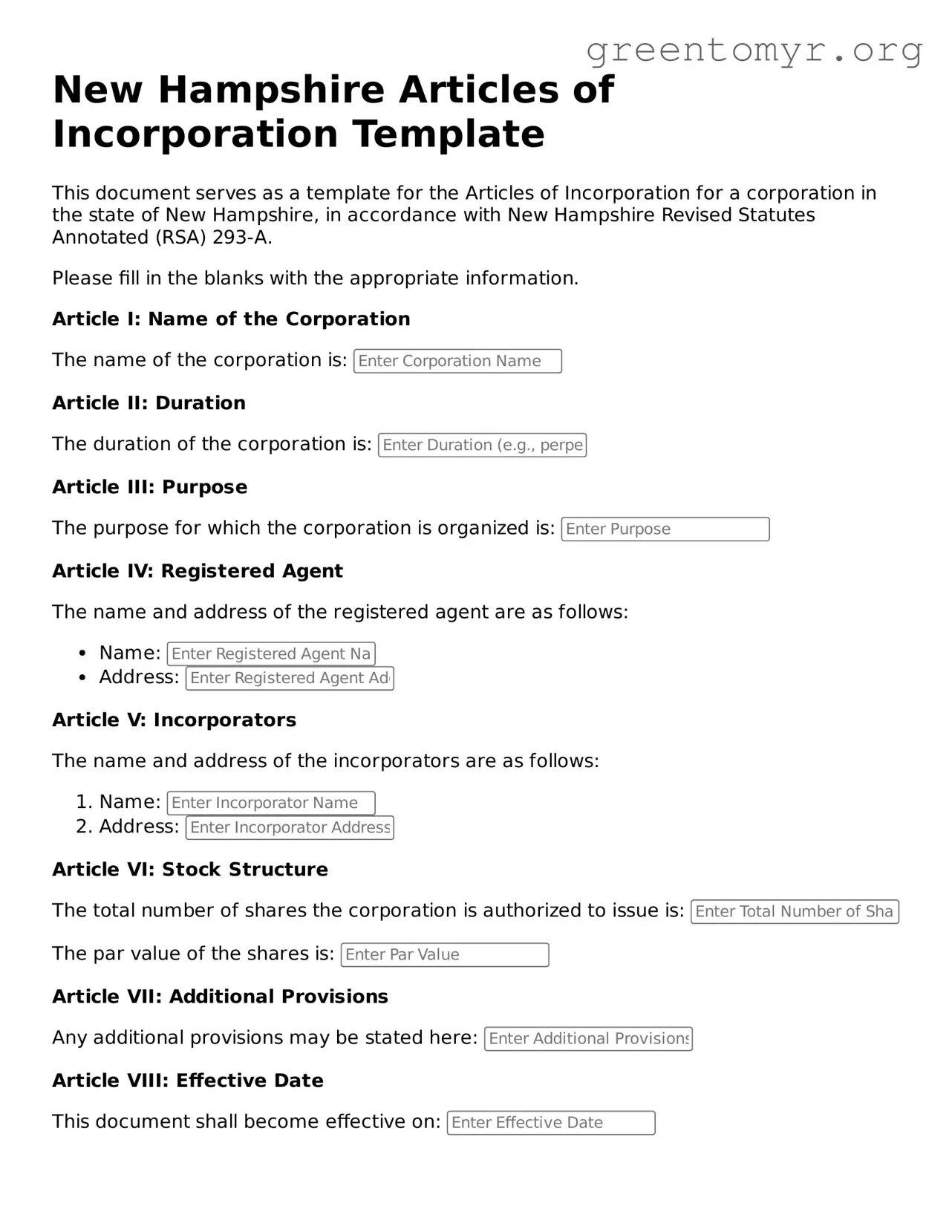
Incorporating a business in New Hampshire is an essential step for entrepreneurs seeking to establish a legal entity. The Articles of Incorporation form plays a pivotal role in this process, serving as the foundational document that outlines key information about the corporation. This form requires the inclusion of crucial details such as the corporation's name, which must be unique and comply with state regulations. Additionally, it specifies the purpose of the corporation, the duration of its existence, and the address of its principal office. The form also mandates the identification of the registered agent, who will act as the point of contact for legal matters. Furthermore, it necessitates the listing of the incorporators, who are responsible for filing the document and initiating the corporation's formation. Understanding these components is vital for ensuring compliance with New Hampshire's legal requirements and setting the stage for a successful business venture.
New Hampshire Articles of Incorporation Template
This document serves as a template for the Articles of Incorporation for a corporation in the state of New Hampshire, in accordance with New Hampshire Revised Statutes Annotated (RSA) 293-A.
Please fill in the blanks with the appropriate information.
Article I: Name of the Corporation
The name of the corporation is:
Article II: Duration
The duration of the corporation is:
Article III: Purpose
The purpose for which the corporation is organized is:
Article IV: Registered Agent
The name and address of the registered agent are as follows:
Article V: Incorporators
The name and address of the incorporators are as follows:
Article VI: Stock Structure
The total number of shares the corporation is authorized to issue is:
The par value of the shares is:
Article VII: Additional Provisions
Any additional provisions may be stated here:
Article VIII: Effective Date
This document shall become effective on:
By signing below, the incorporators affirm that the information provided in these Articles of Incorporation is accurate and complete.
Incorporator Signature:
Date:
Submit this document to the New Hampshire Secretary of State's office for processing.
| Fact Name | Detail |
|---|---|
| Governing Law | The New Hampshire Articles of Incorporation are governed by RSA 293-A, the New Hampshire Business Corporation Act. |
| Purpose | This form is used to legally establish a corporation in New Hampshire. |
| Filing Requirement | The Articles of Incorporation must be filed with the New Hampshire Secretary of State. |
| Information Required | Key information includes the corporation's name, duration, and registered agent. |
| Corporate Name | The name must include a corporate designator, such as "Corporation," "Incorporated," or "Limited." |
| Registered Agent | A registered agent must be designated to receive legal documents on behalf of the corporation. |
| Initial Directors | The form may require the names and addresses of the initial directors of the corporation. |
| Filing Fee | A filing fee is required when submitting the Articles of Incorporation, the amount of which can vary. |
| Effective Date | The corporation may specify an effective date for the Articles of Incorporation, which can be the date of filing or a future date. |
| Amendments | Changes to the Articles of Incorporation can be made through a formal amendment process as outlined in RSA 293-A. |
After gathering the necessary information, you can proceed to fill out the New Hampshire Articles of Incorporation form. This document is essential for officially establishing your corporation in the state. Ensure that all required details are accurate and complete to facilitate a smooth filing process.
Once you have completed the form, review it carefully for accuracy. After verification, submit the Articles of Incorporation to the New Hampshire Secretary of State along with the required filing fee. This step is crucial for the legal recognition of your corporation.
The Articles of Incorporation form is a legal document required to establish a corporation in New Hampshire. This document outlines key information about the corporation, such as its name, purpose, and structure. Filing this form with the New Hampshire Secretary of State is a crucial step in the incorporation process.
When filling out the Articles of Incorporation form, you will typically need to provide the following information:
To file the Articles of Incorporation, you must complete the form and submit it to the New Hampshire Secretary of State's office. This can be done either by mail or online, depending on your preference. If filing by mail, ensure that you include the appropriate filing fee and any required supporting documents. Online filing may streamline the process and provide immediate confirmation.
The filing fee for the Articles of Incorporation in New Hampshire varies based on the type of corporation being formed. As of the latest information, the fee is generally around $100 for a standard corporation. However, additional fees may apply for expedited processing or other services. It is advisable to check the New Hampshire Secretary of State's website for the most current fee schedule.
The processing time for the Articles of Incorporation can vary. Typically, it may take anywhere from a few days to a couple of weeks. If you opt for expedited processing, the turnaround time may be significantly reduced. Always check with the Secretary of State's office for the most accurate estimates based on current workload and processing times.
Once the Articles of Incorporation are filed and approved, the corporation becomes a legal entity. You will receive a certificate of incorporation, which serves as proof of your corporation's existence. After this, it is essential to comply with ongoing requirements, such as obtaining necessary licenses, filing annual reports, and maintaining corporate records.
Yes, amendments to the Articles of Incorporation can be made after the initial filing. If changes are needed—such as altering the corporation's name, purpose, or share structure—an amendment form must be completed and submitted to the Secretary of State. There may be additional fees associated with this process, so it is wise to review the requirements before proceeding.
While it is possible to complete the Articles of Incorporation form on your own, seeking legal assistance can be beneficial. An attorney can help ensure that all information is accurate and compliant with state laws. They can also provide guidance on the best corporate structure for your business needs and assist with any complex issues that may arise during the incorporation process.
Filling out the New Hampshire Articles of Incorporation form can be a straightforward process, but many people stumble over common mistakes. One frequent error is providing incomplete information. Each section of the form requires specific details. Omitting even a single piece of information can delay the processing of your application. Make sure to double-check that every required field is filled out accurately.
Another common mistake is choosing an inappropriate name for the corporation. The name must be unique and not too similar to existing businesses in New Hampshire. Additionally, it must include a corporate designation, such as “Inc.” or “Corporation.” Failing to comply with these naming conventions can result in rejection of the application. Take the time to research and ensure your chosen name meets all requirements.
People also often overlook the importance of the registered agent. The registered agent is responsible for receiving legal documents on behalf of the corporation. Some individuals mistakenly list themselves without understanding the responsibilities involved. It’s crucial to choose someone who is reliable and available during business hours. This choice can significantly impact your corporation’s legal standing.
Lastly, many applicants forget to include the necessary fees when submitting the Articles of Incorporation. Each submission requires a specific payment, and failing to include this can lead to delays or outright rejection. Check the current fee schedule before submitting your application to ensure you include the correct amount. Being thorough in these areas will help streamline the process and set your corporation up for success.
When filing the New Hampshire Articles of Incorporation, several other forms and documents may be required to ensure compliance with state regulations. Each of these documents serves a specific purpose in the incorporation process.
These documents are essential for the smooth operation of a newly formed corporation. Ensure all necessary paperwork is completed accurately and submitted promptly to avoid any delays in the incorporation process.
When filling out the New Hampshire Articles of Incorporation form, it's essential to adhere to certain guidelines to ensure a smooth process. Here are seven important dos and don'ts to consider:
When it comes to the New Hampshire Articles of Incorporation, several misconceptions can lead to confusion for those looking to start a business. Understanding these myths can help ensure a smoother incorporation process. Here are eight common misconceptions:
By clearing up these misconceptions, individuals can approach the incorporation process with greater confidence and understanding. Knowledge is key to making informed decisions about starting a business.
When filling out and using the New Hampshire Articles of Incorporation form, there are several important points to keep in mind: