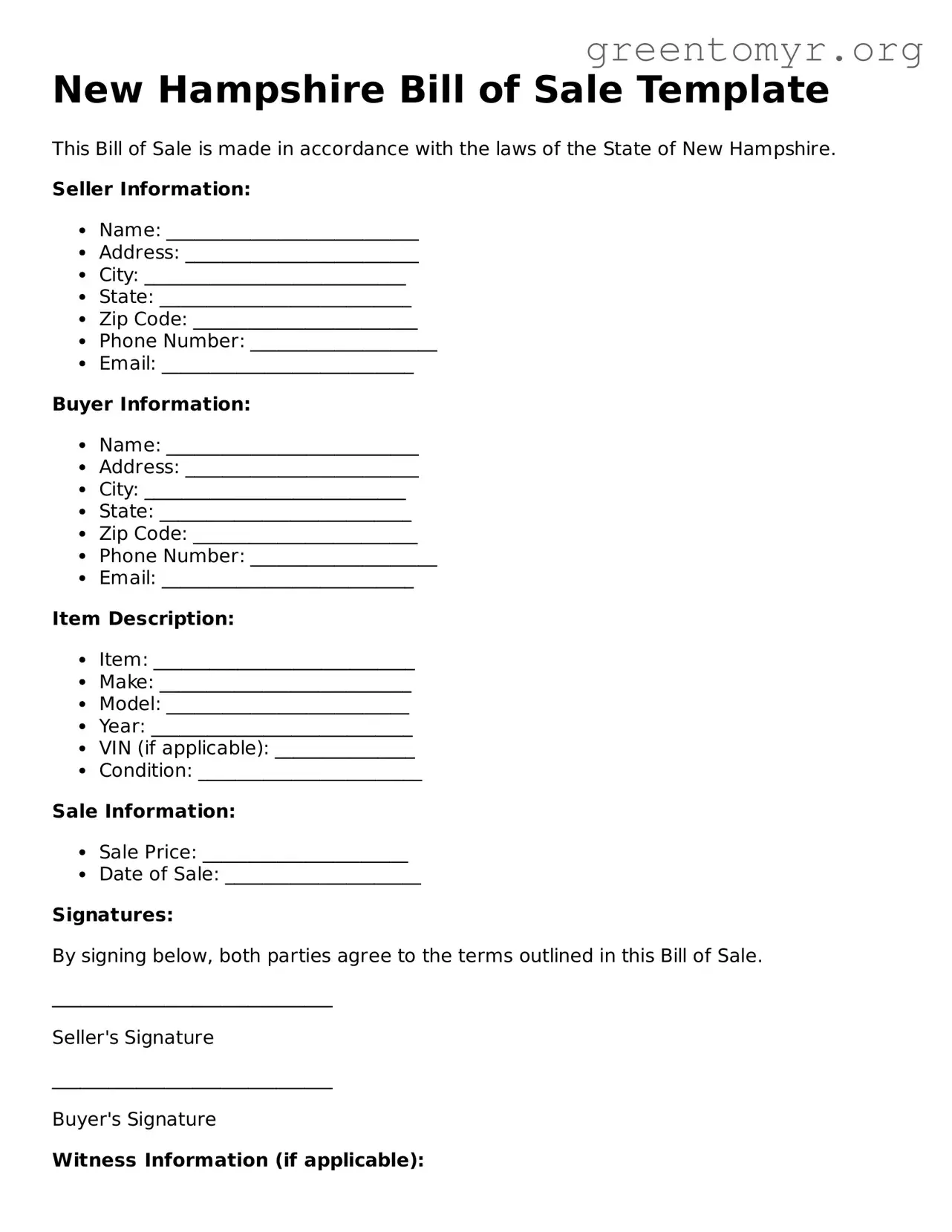
The New Hampshire Bill of Sale form serves as a crucial document in the transfer of ownership for various types of personal property, including vehicles, boats, and other tangible items. This form provides essential information about the transaction, such as the names and addresses of both the seller and the buyer, a detailed description of the item being sold, and the agreed-upon purchase price. Additionally, the form may include important terms regarding warranties or representations about the item, which can protect both parties involved in the sale. By documenting the exchange, the Bill of Sale helps establish a clear record of the transaction, which can be beneficial in case of disputes or for future reference. In New Hampshire, while the Bill of Sale is not always required for every transaction, having one can facilitate a smoother transfer process and provide peace of mind to both the buyer and seller.
New Hampshire Bill of Sale Template
This Bill of Sale is made in accordance with the laws of the State of New Hampshire.
Seller Information:
Buyer Information:
Item Description:
Sale Information:
Signatures:
By signing below, both parties agree to the terms outlined in this Bill of Sale.
______________________________
Seller's Signature
______________________________
Buyer's Signature
Witness Information (if applicable):
| Fact Name | Details |
|---|---|
| Purpose | The New Hampshire Bill of Sale form serves as a legal document that records the transfer of ownership of personal property from one party to another. |
| Governing Law | This form is governed by New Hampshire state law, specifically RSA 477:1, which outlines the requirements for the sale of personal property. |
| Types of Property | The Bill of Sale can be used for various types of personal property, including vehicles, boats, and equipment. |
| Notarization | While notarization is not required for all Bill of Sale forms in New Hampshire, it is recommended for added legal protection and verification. |
| Buyer and Seller Information | The form must include the full names and addresses of both the buyer and the seller to establish clear ownership transfer. |
| Date of Transaction | The date of the sale should be clearly stated to establish when the ownership transfer took place. |
| Consideration | The form should specify the purchase price or other consideration exchanged for the property, which is crucial for legal documentation. |
Filling out the New Hampshire Bill of Sale form is an important step in the process of transferring ownership of a vehicle or personal property. After completing the form, ensure that both parties retain a copy for their records. This document serves as proof of the transaction and can be useful for future reference.
A New Hampshire Bill of Sale form is a legal document that serves as proof of the transfer of ownership of personal property from one party to another. It details the transaction, including the description of the item, the sale price, and the names and addresses of both the buyer and seller. This document is essential for various types of sales, including vehicles, boats, and other personal items.
While a Bill of Sale is not legally required for every transaction in New Hampshire, it is highly recommended. For vehicle sales, for example, a Bill of Sale is necessary to register the vehicle in the buyer's name. Additionally, having a Bill of Sale can help protect both parties in case of disputes regarding the sale.
A comprehensive Bill of Sale should include the following information:
Yes, you can create your own Bill of Sale. It’s important to ensure that it includes all necessary information to make it legally binding. There are also templates available online that can simplify the process. However, if you have any doubts, consulting with a legal professional can provide additional peace of mind.
In New Hampshire, notarization is not required for a Bill of Sale to be valid. However, having it notarized can add an extra layer of security and authenticity, especially for high-value items or vehicles. It can also help in case of future disputes.
After the transaction is complete, both the buyer and seller should keep a copy of the Bill of Sale for their records. It’s advisable to store it in a safe place, as it may be needed for future reference, especially when registering the item or if any disputes arise.
Filling out a New Hampshire Bill of Sale form can seem straightforward, but many people make common mistakes that can lead to complications later. One of the most frequent errors is failing to include all necessary information. Essential details such as the names and addresses of both the buyer and seller must be clearly stated. Omitting any of this information can result in a document that is not legally binding.
Another mistake often encountered is incorrect vehicle identification. For those selling a vehicle, it's crucial to provide the correct Vehicle Identification Number (VIN). A typo in the VIN can create confusion and disputes about ownership. Always double-check this number against the vehicle's registration to ensure accuracy.
People sometimes neglect to include the purchase price. This figure should be explicitly stated in the Bill of Sale. Leaving it blank or writing an ambiguous amount can lead to misunderstandings or issues with taxes later on. Clarity is essential in this regard.
Many individuals also forget to date the document. The date of the sale is a critical piece of information. Without it, the Bill of Sale may lack the necessary context, especially if disputes arise in the future. Always make sure to include the date clearly.
Another common oversight is not having the document signed by both parties. A Bill of Sale is only effective if both the buyer and seller agree to its terms. Without signatures, the document may not hold up in a legal context. Make sure both parties sign and date the form.
Some people fail to provide a description of the item being sold. Whether it’s a vehicle, a piece of equipment, or personal property, a detailed description helps to avoid disputes. Include make, model, year, and any other relevant details to ensure clarity.
It’s also important to overlook the need for witnesses or notarization in certain cases. While not always required, having a witness or getting the document notarized can add an extra layer of protection. This can be particularly important for high-value items.
Lastly, many individuals do not keep a copy of the completed Bill of Sale for their records. After the form is filled out and signed, both parties should retain a copy. This serves as proof of the transaction and can be crucial if any issues arise later. Always prioritize keeping a record of important documents.
When completing a transaction in New Hampshire, especially for vehicles or personal property, a Bill of Sale is essential. However, several other forms and documents may also be needed to ensure everything is in order. Here’s a list of commonly used documents that complement the Bill of Sale.
Having these documents ready can streamline the buying or selling process and help avoid any complications. It’s always a good idea to double-check what is needed for your specific transaction to ensure everything goes smoothly.
The Bill of Sale form serves as a crucial document in various transactions. Several other documents share similarities with it in terms of purpose and function. Below is a list of six documents that are comparable to the Bill of Sale:
When completing the New Hampshire Bill of Sale form, it is essential to approach the task with care. This document serves as a critical record of a transaction, and accuracy is vital. Below are some important guidelines to consider.
Things You Should Do:
Things You Shouldn't Do:
By following these guidelines, individuals can help ensure a smooth transaction and minimize potential issues in the future.
The New Hampshire Bill of Sale form is often misunderstood. Here are six common misconceptions:
Many people believe that a Bill of Sale is only required for the sale of vehicles. In reality, this document can be used for various transactions, including the sale of personal property, boats, and even animals.
Some assume that notarization is mandatory for a Bill of Sale to be valid. However, in New Hampshire, notarization is not required unless the transaction involves a vehicle title transfer.
There is a misconception that a Bill of Sale guarantees the quality or condition of the item sold. In fact, a Bill of Sale is simply a receipt that documents the transaction and does not provide any warranties unless explicitly stated.
Some people think that only one copy of the Bill of Sale is necessary. It is advisable for both the buyer and seller to retain their own copies for their records, ensuring that both parties have proof of the transaction.
There is a belief that a Bill of Sale is not legally binding. In truth, this document is a legally recognized agreement that can be enforced in court if necessary, provided it includes the required information.
Many think that a Bill of Sale is only applicable for private transactions. However, businesses also use this document for sales to customers, making it relevant in both private and commercial contexts.
When filling out and using the New Hampshire Bill of Sale form, it’s important to keep several key points in mind. This document serves as a legal record of the sale of personal property, ensuring both parties are protected. Here are some essential takeaways:
By following these guidelines, you can ensure that the Bill of Sale is completed accurately and serves its intended purpose effectively.