Content Navigation

When it comes to transferring property ownership in New Hampshire, the Deed form plays a crucial role in ensuring that the process is both clear and legally binding. This document serves as the official record of the transfer, detailing essential information such as the names of the parties involved, the legal description of the property, and any specific terms or conditions that apply to the transaction. Understanding the nuances of the New Hampshire Deed form is vital for both buyers and sellers, as it not only protects their rights but also helps prevent future disputes. Additionally, the form must be properly executed and recorded with the appropriate local authority to be valid. Familiarity with the various types of deeds—such as warranty deeds and quitclaim deeds—can further aid individuals in selecting the right option for their unique circumstances. Whether you’re a first-time homebuyer or an experienced investor, grasping the key elements of the Deed form will empower you to navigate property transactions with confidence.

New Hampshire Deed Example

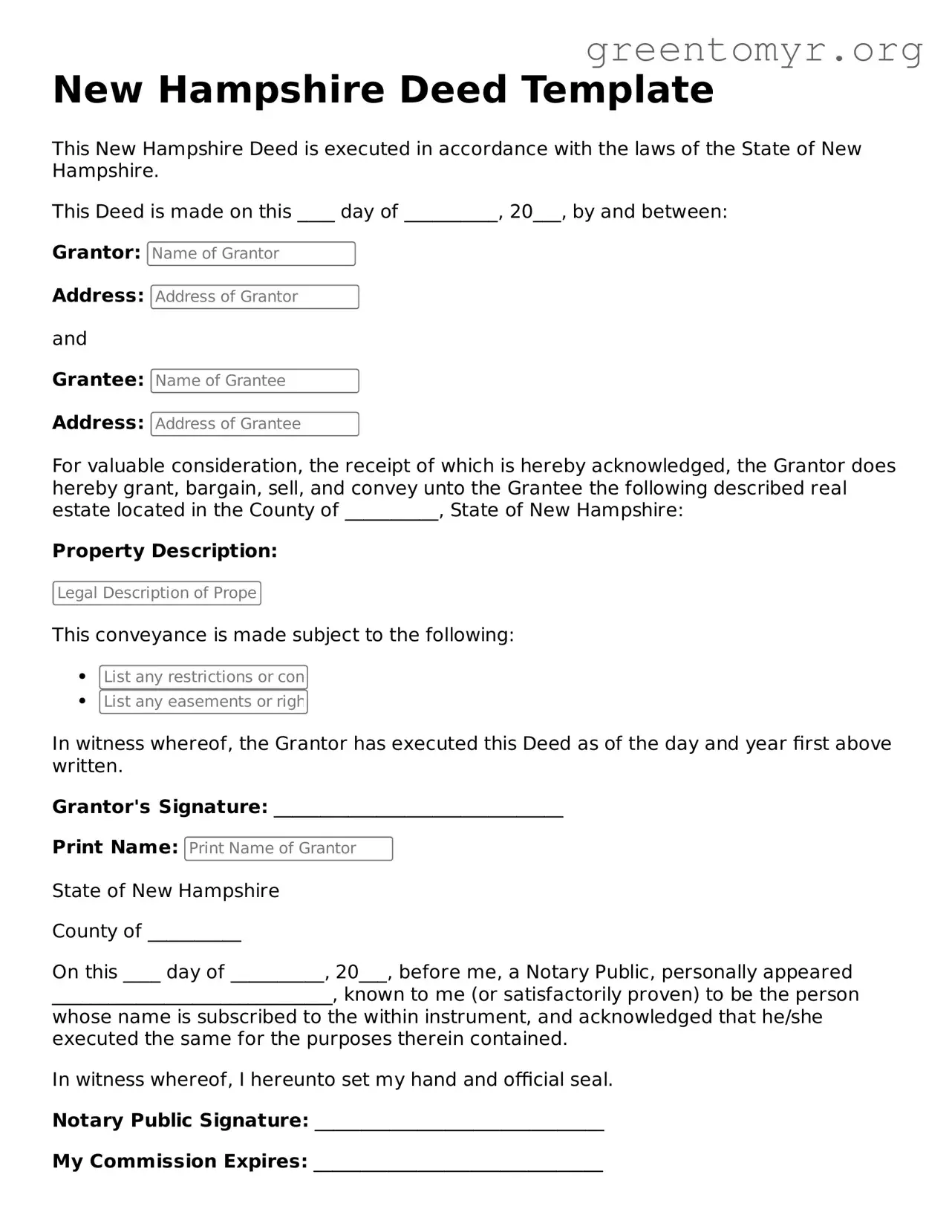
New Hampshire Deed Template

This New Hampshire Deed is executed in accordance with the laws of the State of New Hampshire.

This Deed is made on this ____ day of __________, 20___, by and between:

Grantor:

Address:

and

Grantee:

Address:

For valuable consideration, the receipt of which is hereby acknowledged, the Grantor does hereby grant, bargain, sell, and convey unto the Grantee the following described real estate located in the County of __________, State of New Hampshire:

Property Description:

This conveyance is made subject to the following:

In witness whereof, the Grantor has executed this Deed as of the day and year first above written.

Grantor's Signature: _______________________________

Print Name:

State of New Hampshire

County of __________

On this ____ day of __________, 20___, before me, a Notary Public, personally appeared ______________________________, known to me (or satisfactorily proven) to be the person whose name is subscribed to the within instrument, and acknowledged that he/she executed the same for the purposes therein contained.

In witness whereof, I hereunto set my hand and official seal.

Notary Public Signature: _______________________________

My Commission Expires: _______________________________

PDF Form Features

Fact Name Details
Governing Law The New Hampshire Deed form is governed by the New Hampshire Revised Statutes Annotated, specifically RSA 477.
Types of Deeds New Hampshire recognizes several types of deeds, including Warranty Deeds, Quitclaim Deeds, and Special Warranty Deeds.
Recording Requirements To be valid, the deed must be recorded at the county registry of deeds where the property is located.
Signature Requirement The deed must be signed by the grantor (the seller) and acknowledged before a notary public or other authorized official.

Guide to Using New Hampshire Deed

After obtaining the New Hampshire Deed form, you will need to complete it accurately to ensure proper transfer of property ownership. Following the completion of the form, it will need to be signed, notarized, and filed with the appropriate local authority.

  1. Begin by entering the date of the deed at the top of the form.
  2. Fill in the names of the grantor (the person transferring the property) and the grantee (the person receiving the property). Make sure to include their full legal names.
  3. Provide the address of the property being transferred. This should include the street address, city, and state.
  4. Include a legal description of the property. This can often be found in previous deeds or property tax records.
  5. Indicate the consideration, which is the amount paid for the property. If the transfer is a gift, you can write "gift" or "no consideration."
  6. Specify any encumbrances or restrictions on the property, if applicable.
  7. Sign the deed in the presence of a notary public. Both the grantor and any witnesses should sign as required.
  8. Have the notary public complete their section, including their signature and seal.
  9. Make copies of the completed deed for your records before filing.
  10. Submit the original deed to the local registry of deeds for recording.

Get Answers on New Hampshire Deed

What is a New Hampshire Deed form?

A New Hampshire Deed form is a legal document used to transfer ownership of real estate from one party to another. It outlines the details of the property being transferred, the parties involved, and any terms related to the transfer. This document is essential for establishing clear ownership rights.

What types of deeds are available in New Hampshire?

New Hampshire recognizes several types of deeds, including:

  1. Warranty Deed: This type guarantees that the seller holds clear title to the property and has the right to sell it.
  2. Quitclaim Deed: This deed transfers whatever interest the seller has in the property without any warranties. It is often used between family members or in divorce settlements.
  3. Special Warranty Deed: This deed only guarantees the title against defects that occurred during the seller's ownership.

Do I need a lawyer to prepare a New Hampshire Deed?

While it is not legally required to have a lawyer prepare a deed in New Hampshire, it is highly recommended. A legal professional can ensure that the document is correctly filled out and meets all state requirements. This can help avoid potential disputes or issues in the future.

How do I fill out a New Hampshire Deed form?

To fill out a New Hampshire Deed form, follow these steps:

  • Identify the parties involved: Clearly state the names of the grantor (seller) and grantee (buyer).
  • Describe the property: Include the property’s address and legal description.
  • Specify the consideration: Mention the payment or value exchanged for the property.
  • Sign and date the deed: Both parties must sign the document in front of a notary public.

Where do I file a New Hampshire Deed?

After the deed is completed and signed, it must be filed with the local Registry of Deeds in the county where the property is located. This filing makes the transfer of ownership a matter of public record. It’s important to check if there are any filing fees associated with this process.

What is the role of a notary public in the deed process?

A notary public plays a crucial role in the deed process by verifying the identities of the parties involved and witnessing the signing of the deed. Their signature and seal provide an additional layer of authenticity to the document, which is often required for the deed to be legally valid.

Are there any taxes associated with transferring a deed in New Hampshire?

Yes, there may be transfer taxes associated with transferring a deed in New Hampshire. The state imposes a real estate transfer tax based on the sale price of the property. Both the buyer and seller may be responsible for paying this tax, depending on the terms negotiated in the sale agreement.

Can I revoke a deed in New Hampshire?

Revoking a deed in New Hampshire is possible but can be complex. Generally, if a deed has been executed and recorded, it cannot be unilaterally revoked. To change ownership, a new deed must be created and recorded. Consulting with a legal professional is advisable to navigate this process effectively.

Common mistakes

Completing a New Hampshire Deed form can be straightforward, but several common mistakes can lead to complications. One frequent error is failing to include all necessary parties. When transferring property, both the grantor (the person selling or giving the property) and the grantee (the person receiving the property) must be clearly identified. Omitting either party can render the deed invalid.

Another mistake involves incorrect property descriptions. The deed must accurately describe the property being transferred. This includes the physical address and any relevant lot or parcel numbers. Vague or incomplete descriptions can cause confusion and disputes in the future.

Signatures are crucial in a deed. A common oversight is not obtaining the required signatures. All grantors must sign the deed, and in some cases, witnesses may also be needed. Failing to secure the proper signatures can lead to challenges regarding the deed's validity.

People often overlook the need for notarization. In New Hampshire, a deed must be notarized to be legally binding. Without a notary's signature and seal, the document may not be accepted by the registry of deeds.

Another area of concern is the date of execution. Many individuals forget to include the date when the deed was signed. This date is important for establishing the timeline of the property transfer and can affect various legal rights.

Property taxes can complicate matters if not addressed. Some individuals fail to check for any outstanding property taxes before transferring ownership. Unpaid taxes can lead to liens against the property, which may transfer to the new owner.

Additionally, individuals sometimes neglect to record the deed promptly. After the deed is signed and notarized, it should be filed with the local registry of deeds. Delaying this step can create problems, especially if disputes arise regarding property ownership.

Inaccurate information about the property’s legal status can also lead to issues. Some individuals may not verify if there are any restrictions or easements affecting the property. This oversight can result in future disputes or limitations on how the property can be used.

Lastly, misunderstanding the implications of the deed type can lead to significant consequences. Different types of deeds, such as warranty deeds and quitclaim deeds, offer varying levels of protection. Failing to choose the appropriate deed type can affect the rights of both the grantor and the grantee.

Documents used along the form

When preparing to transfer property in New Hampshire, several important documents often accompany the Deed form. Each of these documents plays a crucial role in ensuring a smooth transaction and protecting the interests of all parties involved. Below is a list of common forms and documents used alongside the New Hampshire Deed form.

  • Property Disclosure Statement: This document provides potential buyers with essential information about the property's condition, including any known defects or issues. It's designed to promote transparency in the sale.
  • Purchase and Sale Agreement: This contract outlines the terms and conditions of the sale, including the purchase price, closing date, and any contingencies. It is a critical document that formalizes the agreement between the buyer and seller.
  • Title Search Report: Conducted by a title company, this report verifies the property's ownership history and identifies any liens or claims against it. Ensuring clear title is vital for a successful transaction.
  • Affidavit of Title: This sworn statement, typically signed by the seller, confirms their ownership of the property and discloses any legal issues that may affect the title. It serves as a safeguard for the buyer.
  • Closing Statement: Also known as a HUD-1 or settlement statement, this document details all financial aspects of the transaction, including closing costs and adjustments. Both parties review this document before finalizing the sale.
  • Mortgage Documents: If the buyer is financing the purchase, various mortgage documents will be necessary. These may include the loan application, promissory note, and mortgage agreement.
  • Power of Attorney: In cases where a party cannot be present at closing, a power of attorney allows someone else to act on their behalf. This document must be properly executed to be valid.
  • IRS Form 1099-S: This form is used to report the sale of real estate to the IRS. It ensures compliance with tax regulations and is typically filed by the closing agent.
  • Homeowners Association (HOA) Documents: If the property is part of an HOA, relevant documents such as bylaws, rules, and regulations may be required. These inform the buyer about community guidelines and fees.

Understanding these documents can significantly streamline the property transfer process in New Hampshire. Each form serves a specific purpose, ensuring that both buyers and sellers are protected and informed throughout the transaction. Be sure to consult with a qualified professional to ensure that all necessary documents are completed accurately and timely.

Similar forms

The Deed form serves as a foundational document in real estate transactions and legal agreements. Several other documents share similarities with the Deed form in their purpose and function. Here are eight such documents:

  • Title Insurance Policy: Like a Deed, this document provides proof of ownership and protects against potential claims or disputes over property ownership.
  • Bill of Sale: This document transfers ownership of personal property, similar to how a Deed transfers ownership of real property.
  • Lease Agreement: A Lease outlines the terms of renting property, establishing rights and responsibilities, akin to the rights conveyed in a Deed.
  • Mortgage Agreement: This document secures a loan with the property as collateral, paralleling the way a Deed establishes ownership rights.
  • Quitclaim Deed: This type of Deed transfers ownership without warranties, similar to a standard Deed but with less protection for the buyer.
  • Trust Agreement: A Trust can hold property on behalf of beneficiaries, similar to how a Deed conveys property interests.
  • Power of Attorney: This document allows one person to act on behalf of another in legal matters, including property transactions, much like the authority granted in a Deed.
  • Settlement Statement: Often used in real estate transactions, this document summarizes the financial details of a sale, providing context for the transfer of ownership indicated in a Deed.

Dos and Don'ts

When filling out the New Hampshire Deed form, attention to detail is crucial. Here are some important dos and don'ts to ensure the process goes smoothly.

  • Do provide accurate property descriptions. Ensure that the legal description of the property is precise and matches public records.
  • Do include the names of all grantors and grantees. All parties involved must be clearly identified to avoid future disputes.
  • Do sign the deed in the presence of a notary. This step is essential for the deed to be valid and enforceable.
  • Do check for any liens or encumbrances on the property. Understanding any existing claims can prevent complications during the transfer.
  • Don't leave any sections blank. Every part of the form should be filled out completely to avoid delays in processing.
  • Don't use outdated forms. Always ensure you are using the most current version of the deed form to comply with legal requirements.

Misconceptions

Understanding the New Hampshire Deed form is essential for anyone involved in real estate transactions in the state. However, several misconceptions can lead to confusion. Here are ten common misconceptions explained:

  1. All deeds are the same. Many people believe that all deed forms are interchangeable. In reality, different types of deeds serve specific purposes and offer varying levels of protection.
  2. A deed must be notarized to be valid. While notarization is often required, some deeds can be valid without it, depending on the circumstances and local laws.
  3. Once a deed is recorded, it cannot be changed. This is not entirely true. While the original deed cannot be altered, a new deed can be created to correct or modify the terms.
  4. Only lawyers can prepare a deed. Although it is advisable to consult a lawyer, individuals can prepare their own deeds if they understand the requirements and format.
  5. Deeds are only necessary for property sales. Deeds are also used for transfers of ownership, gifts, and inheritance, not just sales.
  6. All property transfers require a new deed. Some property transfers, such as those between spouses, may not require a new deed, depending on the situation.
  7. Property taxes are unaffected by the type of deed. The type of deed can influence tax implications, especially regarding exemptions or liabilities.
  8. Once a deed is signed, it is final. While signing a deed indicates intent, there are circumstances under which a deed can be contested or revoked.
  9. Deeds do not require a legal description of the property. A legal description is essential for identifying the property accurately; without it, the deed may be invalid.
  10. All deeds must be filed with the county clerk. While most deeds should be recorded, certain transactions may not require this step, depending on local laws.

By understanding these misconceptions, individuals can navigate the process of property transactions in New Hampshire with greater confidence and clarity.

Key takeaways

When filling out and using the New Hampshire Deed form, it’s important to keep several key points in mind. Here are ten essential takeaways to ensure a smooth process:

  1. Understand the Purpose: A deed is a legal document that transfers ownership of real property from one party to another.
  2. Choose the Correct Type: There are different types of deeds, such as warranty deeds and quitclaim deeds. Select the one that best fits your situation.
  3. Identify the Parties: Clearly state the names and addresses of both the grantor (seller) and grantee (buyer) in the deed.
  4. Describe the Property: Provide a detailed description of the property being transferred, including the address and any relevant parcel identification numbers.
  5. Include Consideration: Mention the amount paid for the property, even if it is a nominal amount, to validate the transaction.
  6. Signatures Required: Ensure that the grantor signs the deed. Depending on the type of deed, notarization may also be necessary.
  7. Witnesses May Be Needed: Some deeds in New Hampshire require witnesses to the signing. Check the specific requirements for your deed type.
  8. File with the Registry: After completing the deed, file it with the appropriate county registry of deeds to make the transfer official.
  9. Keep Copies: Always retain copies of the signed deed for your records and future reference.
  10. Consult a Professional: If unsure about any part of the process, consider seeking assistance from a real estate attorney or professional.

By following these key takeaways, you can navigate the process of filling out and using the New Hampshire Deed form with greater confidence and clarity.