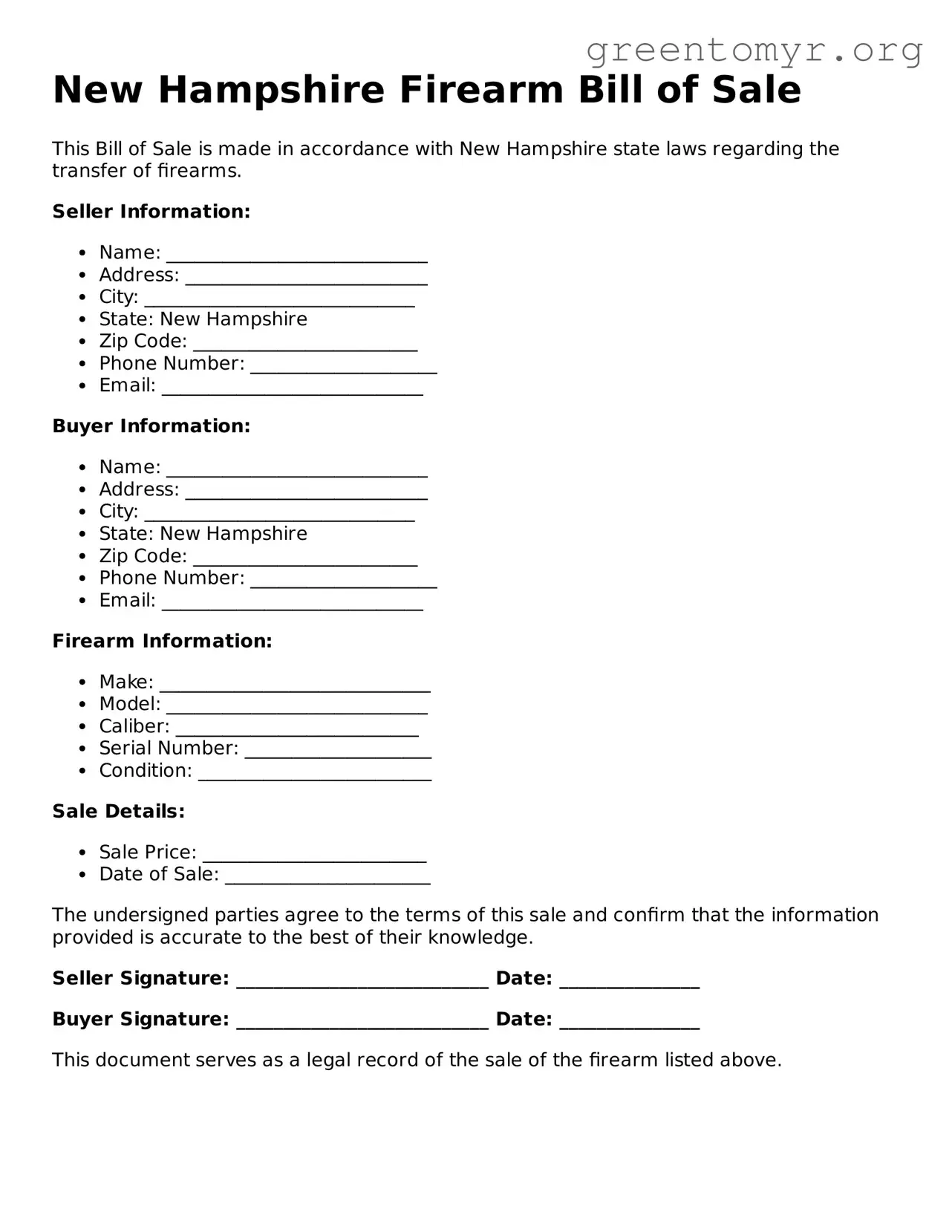
The New Hampshire Firearm Bill of Sale form serves as an essential document for individuals engaged in the private sale or transfer of firearms within the state. This form outlines key details such as the names and addresses of both the seller and the buyer, ensuring that both parties are clearly identified in the transaction. Additionally, it includes information about the firearm itself, including its make, model, and serial number, which helps establish the specific item being sold. By providing a space for signatures, the form confirms that both parties agree to the terms of the sale, thereby creating a record of the transaction. This documentation is particularly important in New Hampshire, where private sales do not require a background check, making the Bill of Sale an important tool for accountability and transparency. Understanding the nuances of this form can help individuals navigate the process of buying or selling firearms while adhering to state laws.
New Hampshire Firearm Bill of Sale
This Bill of Sale is made in accordance with New Hampshire state laws regarding the transfer of firearms.
Seller Information:
Buyer Information:
Firearm Information:
Sale Details:
The undersigned parties agree to the terms of this sale and confirm that the information provided is accurate to the best of their knowledge.
Seller Signature: ___________________________ Date: _______________
Buyer Signature: ___________________________ Date: _______________
This document serves as a legal record of the sale of the firearm listed above.
| Fact Name | Description |
|---|---|
| Purpose | The New Hampshire Firearm Bill of Sale form is used to document the sale or transfer of a firearm between individuals. |
| Governing Law | This form is governed by New Hampshire RSA 159:6, which outlines the regulations regarding the sale of firearms. |
| Parties Involved | The form requires information from both the seller and the buyer, ensuring both parties are clearly identified. |
| Firearm Details | Specific details about the firearm, such as make, model, and serial number, must be included to ensure clarity in the transaction. |
| Consideration | The form should state the amount of money or other consideration exchanged for the firearm. |
| Signatures | Both the buyer and seller must sign the form to validate the transaction and indicate agreement to its terms. |
| Notarization | While notarization is not required, having the document notarized can add an extra layer of protection and authenticity. |
| Record Keeping | It is advisable for both parties to keep a copy of the signed bill of sale for their records, as it serves as proof of the transaction. |
| Legal Age | Both parties must be of legal age to own a firearm, which is 18 years old in New Hampshire. |
After obtaining the New Hampshire Firearm Bill of Sale form, you will need to complete it accurately to ensure a smooth transaction. This process involves providing essential information about the buyer, seller, and the firearm being sold. Follow the steps below to fill out the form correctly.
A Firearm Bill of Sale is a document that records the transfer of ownership of a firearm from one person to another. This form helps protect both the buyer and the seller by providing proof of the transaction and details about the firearm involved.
No, a Firearm Bill of Sale is not legally required in New Hampshire for private sales. However, it is highly recommended to have one to ensure clarity and to provide a record of the transaction.
The Firearm Bill of Sale should include:
Yes, you can create your own Firearm Bill of Sale. Just make sure to include all necessary information and have both parties sign the document. There are also templates available online that you can use for convenience.
No, notarization is not required for a Firearm Bill of Sale in New Hampshire. However, having it notarized can add an extra layer of authenticity and may be helpful if any disputes arise in the future.
If you are giving a firearm as a gift, it is still a good idea to complete a Firearm Bill of Sale. This document can serve as proof of the transfer and help avoid any misunderstandings later on.
If you lose the Firearm Bill of Sale, you can create a new one. Make sure to include all the original details to the best of your ability. Both parties should sign the new document to confirm the transaction.
Yes, in New Hampshire, you must be at least 18 years old to purchase a firearm from a private seller. For purchases from licensed dealers, the age requirement is also 18, but additional federal regulations may apply.
If you suspect that a firearm is stolen, do not proceed with the sale. Report your concerns to local law enforcement. They can help verify the firearm's status and ensure that you are not involved in any illegal transactions.
Filling out the New Hampshire Firearm Bill of Sale form can seem straightforward, but many individuals encounter pitfalls that can lead to complications. One common mistake is failing to provide complete information about the firearm being sold. This includes not listing the make, model, caliber, and serial number. Omitting any of these details can create confusion and may even render the document ineffective.
Another frequent error involves the seller's and buyer's information. It is essential to include accurate names, addresses, and contact details. Inaccuracies or missing information can complicate future transactions or legal matters. For instance, if a buyer later needs to prove ownership, incomplete details may hinder their ability to do so.
Many people also neglect to check the date on the form. A dated bill of sale is crucial for establishing when the transaction took place. If the date is missing or incorrect, it can lead to disputes regarding ownership or the legality of the sale.
Signatures are another area where mistakes commonly occur. Both parties must sign the form to validate the transaction. Some individuals might forget to sign or assume that only one signature is needed. This oversight can invalidate the document and create issues down the line.
In addition to signatures, witnesses may be required in certain situations. Failing to include a witness signature when necessary can weaken the document's legal standing. It is wise to check local regulations to determine if a witness is required for the transaction.
Another mistake is not providing the appropriate consideration or payment details. The bill of sale should clearly state the amount paid for the firearm. Without this information, it can be challenging to establish the legitimacy of the transaction, which may raise questions later.
Some individuals may also overlook the importance of keeping a copy of the completed bill of sale. Both the buyer and seller should retain a copy for their records. Without this documentation, proving ownership or the terms of the sale could become problematic.
Additionally, people sometimes fail to verify the buyer's eligibility to purchase a firearm. Ensuring that the buyer is legally allowed to own a firearm is not only responsible but also protects the seller from potential legal issues. A brief background check can save a lot of trouble in the long run.
Lastly, many individuals do not read the entire form before signing. Skimming through the document can lead to misunderstandings or missed sections that require attention. Taking the time to read and understand each part of the form ensures that all information is accurate and complete.
The New Hampshire Firearm Bill of Sale form is an essential document for the legal transfer of firearm ownership. Alongside this form, several other documents may be necessary to ensure compliance with state laws and to protect the interests of both the buyer and the seller. Below is a list of commonly used forms and documents that often accompany the Firearm Bill of Sale.
Having these documents prepared and organized can facilitate a smooth transaction and help prevent potential legal issues. It is crucial to ensure that all parties involved understand their rights and responsibilities during the sale process.
The Firearm Bill of Sale form serves as an important document in the transfer of firearm ownership. Several other documents share similarities with this form, primarily in their purpose of documenting the transfer of ownership for various types of property. Here are four such documents:
When filling out the New Hampshire Firearm Bill of Sale form, it's important to follow specific guidelines to ensure the process goes smoothly. Here are four key do's and don'ts:
The New Hampshire Firearm Bill of Sale form is often misunderstood. Below are ten common misconceptions about this form, along with clarifications to help clarify the facts.
While it is a good practice to use a Bill of Sale, New Hampshire does not require a formal Bill of Sale for private sales between individuals.
The form does not guarantee that the seller has the legal right to sell the firearm. Buyers should conduct their own due diligence.
Notarization is not required for a Bill of Sale in New Hampshire, although it may add an extra layer of security for both parties.
The Bill of Sale can be used for any type of firearm, including rifles and shotguns.
There is no requirement to file the Bill of Sale with any state agency. It is a private agreement between the buyer and seller.
While the form documents the transaction, it does not shield either party from potential legal issues that may arise from the firearm itself.
The Bill of Sale is advisable for any transaction, regardless of the price, to ensure clarity and record-keeping.
A Bill of Sale does not replace the need for a background check, which is required for sales through licensed dealers.
Including a Social Security number is not necessary and may raise privacy concerns for the buyer.
While it serves as a record of the transaction, the enforceability of the Bill of Sale can depend on various factors, including state laws.
Understanding these misconceptions can help individuals navigate firearm transactions more effectively in New Hampshire. Always consider consulting with a legal professional for specific advice tailored to individual circumstances.
When filling out and using the New Hampshire Firearm Bill of Sale form, keep these key takeaways in mind: