When it comes to managing your financial and legal affairs, having a reliable plan in place is crucial. In New Hampshire, the General Power of Attorney form serves as a powerful tool that allows you to appoint someone you trust to act on your behalf. This document can cover a wide range of responsibilities, from handling bank transactions to making healthcare decisions, depending on how you choose to structure it. By granting authority through this form, you can ensure that your interests are represented even when you’re unable to make decisions for yourself. It’s essential to understand the specific powers you’re granting and the implications of those decisions. Whether you’re preparing for a temporary absence or planning for the future, the General Power of Attorney can provide peace of mind and clarity in uncertain times.
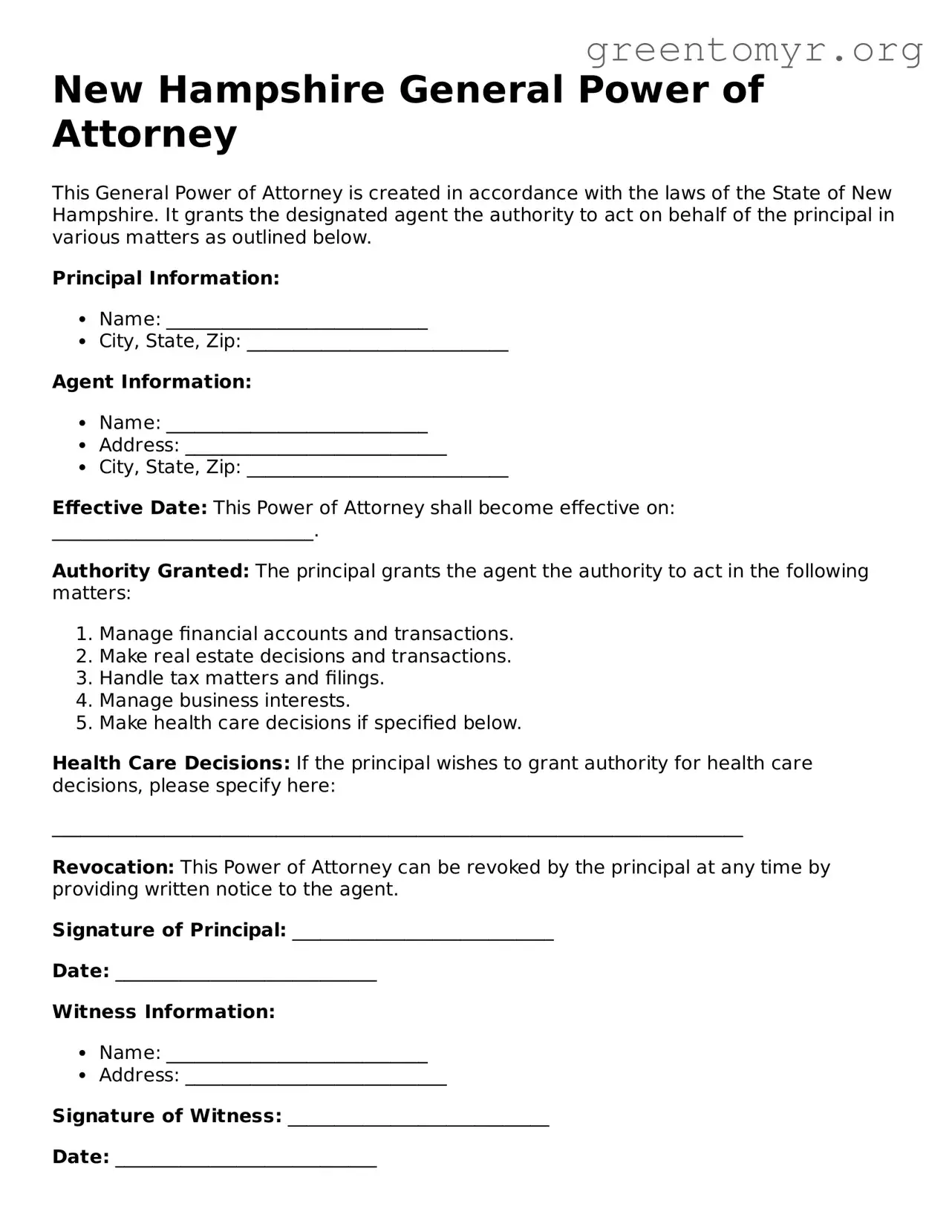
New Hampshire General Power of Attorney
This General Power of Attorney is created in accordance with the laws of the State of New Hampshire. It grants the designated agent the authority to act on behalf of the principal in various matters as outlined below.
Principal Information:
Agent Information:
Effective Date: This Power of Attorney shall become effective on: ____________________________.
Authority Granted: The principal grants the agent the authority to act in the following matters:
Health Care Decisions: If the principal wishes to grant authority for health care decisions, please specify here:
__________________________________________________________________________
Revocation: This Power of Attorney can be revoked by the principal at any time by providing written notice to the agent.
Signature of Principal: ____________________________
Date: ____________________________
Witness Information:
Signature of Witness: ____________________________
Date: ____________________________
| Fact Name | Details |
|---|---|
| Definition | A General Power of Attorney in New Hampshire allows an individual to grant another person the authority to act on their behalf in various financial and legal matters. |
| Governing Law | The General Power of Attorney is governed by New Hampshire Revised Statutes Annotated (RSA) 464-B. |
| Durability | This form can be made durable, meaning it remains effective even if the principal becomes incapacitated, provided it is explicitly stated in the document. |
| Signing Requirements | The principal must sign the document in the presence of a notary public or two witnesses to ensure its validity. |
| Revocation | The principal can revoke the General Power of Attorney at any time, as long as they are mentally competent to do so. |
| Limitations | While a General Power of Attorney grants broad authority, it cannot be used to make health care decisions unless specifically stated in a separate health care power of attorney. |
Filling out the New Hampshire General Power of Attorney form is a straightforward process. Once completed, this form allows you to designate someone to act on your behalf in financial or legal matters. Ensure that you have all necessary information and documents ready before starting.
After completing the form, it is important to communicate with your agent about the responsibilities they will assume. This ensures clarity and understanding between both parties.
A General Power of Attorney (GPOA) in New Hampshire is a legal document that allows one person, known as the principal, to appoint another person, called the agent or attorney-in-fact, to make decisions on their behalf. This authority can cover a wide range of financial and legal matters, such as managing bank accounts, paying bills, and handling real estate transactions. The GPOA becomes effective immediately upon signing, unless specified otherwise.
Individuals who want to ensure their financial and legal matters are managed according to their wishes should consider creating a GPOA. This is particularly important for:
Yes, you can limit the powers granted in a General Power of Attorney. While a general power of attorney provides broad authority, you have the option to specify which powers the agent can exercise. For example, you might allow your agent to manage your finances but prohibit them from selling your property. Clearly outlining these limitations in the document is crucial for ensuring your wishes are followed.
Revoking a General Power of Attorney is a straightforward process. To do so, you must create a written revocation document stating your intent to cancel the GPOA. It is advisable to notify your agent of the revocation and to inform any institutions or individuals who were aware of the original power of attorney. This helps prevent any confusion or unauthorized actions by the agent.
In New Hampshire, a General Power of Attorney typically becomes invalid if the principal becomes incapacitated, unless it is specifically designated as a Durable Power of Attorney. A Durable Power of Attorney remains effective even if the principal is no longer able to make decisions for themselves. If you want your GPOA to continue in the event of incapacity, it’s essential to specify that it is durable in the document.
While it is not legally required to have a lawyer draft a General Power of Attorney, consulting with one is highly recommended. A lawyer can help ensure that the document meets all legal requirements and accurately reflects your wishes. Additionally, they can provide guidance on the implications of granting power to an agent, helping you make informed decisions.
Filling out a General Power of Attorney (POA) form in New Hampshire can seem straightforward, but many individuals make common mistakes that can lead to complications down the line. Understanding these pitfalls can help ensure that the document serves its intended purpose effectively.
One frequent error is not specifying the powers granted. A General Power of Attorney can encompass a wide range of authority, from managing finances to making healthcare decisions. When individuals fail to clearly outline which powers they are granting, they may inadvertently limit the agent's ability to act in their best interest. It is crucial to be explicit about the powers being conferred to avoid confusion later.
Another mistake involves neglecting to date the document. A Power of Attorney should always include the date it was signed. Without this, there may be questions about its validity, especially if the document is presented at a later time. A dated form helps establish a clear timeline and can prevent disputes regarding its effectiveness.
Some people also overlook the importance of not having witnesses or notarization. In New Hampshire, while a POA does not always require notarization, having it notarized or witnessed can add an extra layer of legitimacy. This can be particularly important if the document is ever challenged. Taking the time to ensure proper witnessing or notarization can save significant trouble in the future.
Additionally, individuals often forget to review the document for accuracy before signing. Typos or incorrect information can lead to misunderstandings. It is essential to double-check names, dates, and the specifics of the powers granted. An error in this critical document can have serious implications for the agent's authority.
Another common oversight is failing to discuss the decision with the agent. It is vital to communicate with the person designated as the agent. They should fully understand their responsibilities and the extent of their authority. This conversation can help prevent misunderstandings and ensure that the agent is willing and prepared to take on this important role.
Lastly, many individuals make the mistake of not keeping a copy of the completed form. Once the POA is signed, it is essential to retain a copy for personal records and to provide copies to the agent and any relevant institutions. Without access to the document, it can be challenging for the agent to act on behalf of the principal when needed.
By being aware of these common mistakes, individuals can take the necessary steps to ensure that their General Power of Attorney is completed accurately and serves its intended purpose. A little attention to detail can make a significant difference in the effectiveness of this important legal document.
A General Power of Attorney (POA) in New Hampshire allows one person to grant another the authority to act on their behalf in various matters. When preparing a POA, it is often useful to consider additional forms and documents that can complement this arrangement. Below are some commonly used documents that may be relevant.
These documents help clarify roles and responsibilities, ensuring that the principal's wishes are honored in various situations. It's important to consider which documents best fit your needs when establishing a power of attorney.
Filling out a General Power of Attorney (POA) form in New Hampshire can be straightforward if you keep a few important guidelines in mind. Here are nine things you should and shouldn't do during the process:
When it comes to the New Hampshire General Power of Attorney (POA) form, many people hold misconceptions that can lead to confusion. Understanding the facts is essential for making informed decisions. Here’s a list of common misconceptions about the General Power of Attorney form in New Hampshire:
By clearing up these misconceptions, individuals can better understand the importance and functionality of a General Power of Attorney in New Hampshire. Always consult with a knowledgeable professional when considering legal documents to ensure that your needs are met.
Filling out and using the New Hampshire General Power of Attorney form can be straightforward if you keep a few key points in mind. Here are some important takeaways to consider:
By following these guidelines, you can effectively utilize the New Hampshire General Power of Attorney form to ensure your interests are protected.