Content Navigation

In New Hampshire, families who choose to homeschool their children must submit a Homeschool Letter of Intent to their local school district. This essential document serves as a formal notification of the family's decision to educate their child outside of the traditional school system. The form requires basic information, including the names and ages of the children being homeschooled, as well as the educational approach the family plans to use. Parents must also outline their curriculum, demonstrating a commitment to providing a comprehensive education that meets state standards. Additionally, the form may ask for details about the educational resources and support the family intends to utilize. By completing and submitting this letter, parents not only comply with state regulations but also affirm their dedication to fostering a learning environment tailored to their child's unique needs.

New Hampshire Homeschool Letter of Intent Example

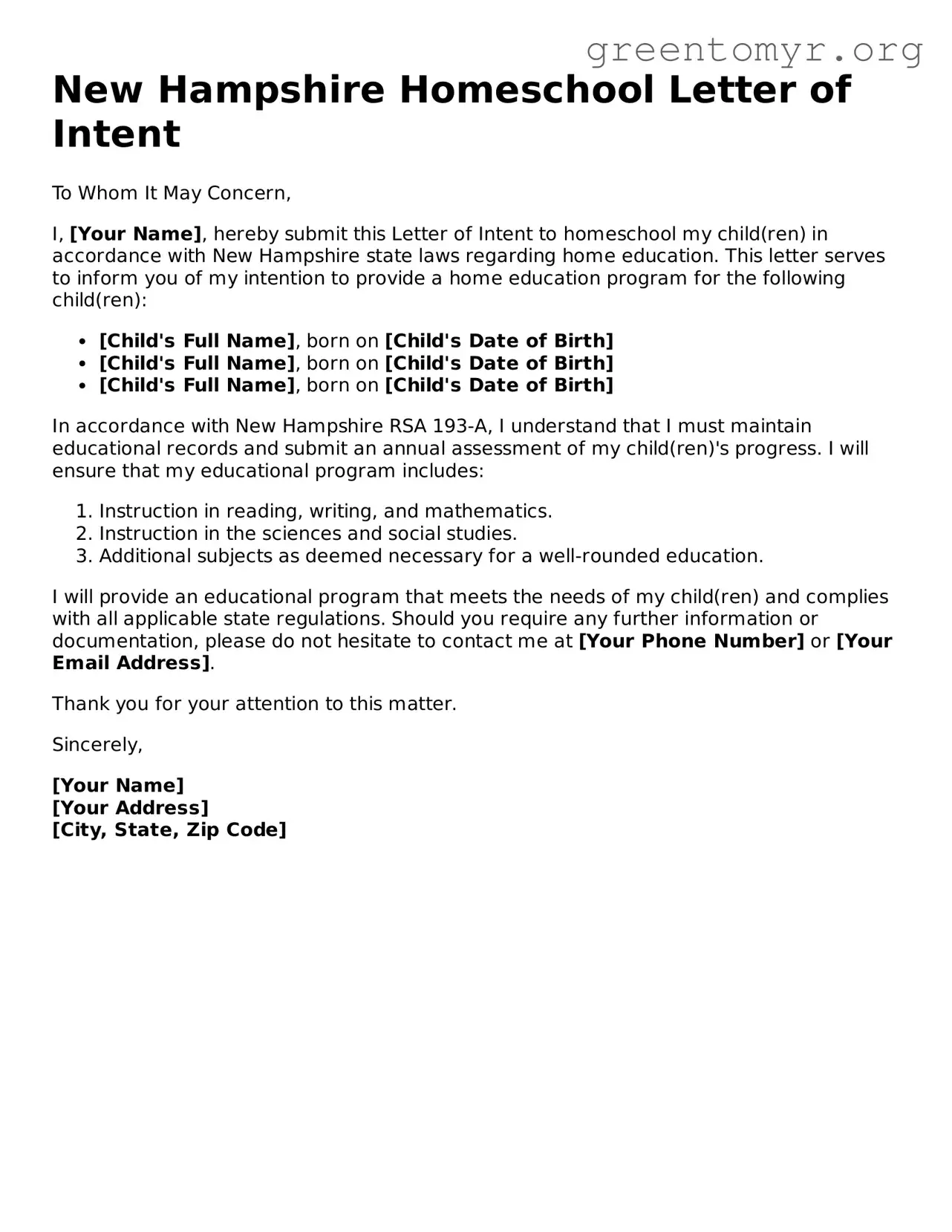
New Hampshire Homeschool Letter of Intent

To Whom It May Concern,

I, [Your Name], hereby submit this Letter of Intent to homeschool my child(ren) in accordance with New Hampshire state laws regarding home education. This letter serves to inform you of my intention to provide a home education program for the following child(ren):

  • [Child's Full Name], born on [Child's Date of Birth]
  • [Child's Full Name], born on [Child's Date of Birth]
  • [Child's Full Name], born on [Child's Date of Birth]

In accordance with New Hampshire RSA 193-A, I understand that I must maintain educational records and submit an annual assessment of my child(ren)'s progress. I will ensure that my educational program includes:

  1. Instruction in reading, writing, and mathematics.
  2. Instruction in the sciences and social studies.
  3. Additional subjects as deemed necessary for a well-rounded education.

I will provide an educational program that meets the needs of my child(ren) and complies with all applicable state regulations. Should you require any further information or documentation, please do not hesitate to contact me at [Your Phone Number] or [Your Email Address].

Thank you for your attention to this matter.

Sincerely,

[Your Name]
[Your Address]
[City, State, Zip Code]

PDF Form Features

Fact Name Details
Governing Law The New Hampshire Homeschool Letter of Intent is governed by RSA 193-A, which outlines the requirements for homeschooling in the state.
Submission Requirement Parents or guardians must submit the Letter of Intent to their local school district at the beginning of each homeschooling year.
Content of the Form The form requires basic information, including the child's name, age, and educational plans for the year.
Deadline The Letter of Intent must be submitted by September 1st of each year or within five days of beginning homeschooling if starting after that date.

Guide to Using New Hampshire Homeschool Letter of Intent

After obtaining the New Hampshire Homeschool Letter of Intent form, you will need to provide specific information about your homeschooling plans. This form serves as a notification to the local school district about your intent to homeschool your child. Following the completion of the form, you should submit it to the appropriate school district office.

  1. Begin by entering your name as the parent or guardian.
  2. Provide your complete address, including city and zip code.
  3. List the names and ages of all children who will be homeschooled.
  4. Indicate the educational year for which you are submitting the letter of intent.
  5. Include a brief description of the educational curriculum or plan you intend to use.
  6. Sign and date the form to certify that the information provided is accurate.
  7. Make a copy of the completed form for your records.
  8. Submit the original form to your local school district office.

Get Answers on New Hampshire Homeschool Letter of Intent

What is the New Hampshire Homeschool Letter of Intent form?

The New Hampshire Homeschool Letter of Intent form is a document that parents or guardians must submit to their local school district to formally notify them of their intent to homeschool their children. This form is a crucial first step in complying with state regulations regarding homeschooling.

Who needs to submit the Letter of Intent?

Any parent or guardian who plans to homeschool a child in New Hampshire must submit the Letter of Intent. This includes families with children of compulsory school age, typically between the ages of 6 and 18.

When should the Letter of Intent be submitted?

The Letter of Intent should be submitted at the beginning of the homeschooling year. It is advisable to submit it at least two weeks before the start of the school year to ensure compliance with local regulations.

What information is required on the Letter of Intent?

The Letter of Intent typically requires the following information:

  • The name and address of the parent or guardian
  • The name and age of the child being homeschooled
  • The educational plan or curriculum that will be used
  • The signature of the parent or guardian

Is there a specific format for the Letter of Intent?

While there is no mandated format for the Letter of Intent, it should clearly include all required information. Many families choose to use a template to ensure that they cover all necessary points.

What happens after submitting the Letter of Intent?

Once the Letter of Intent is submitted, the local school district will acknowledge receipt. They may not respond further unless there are questions or concerns about the homeschooling plan. Parents should keep a copy for their records.

Are there any consequences for not submitting the Letter of Intent?

Failure to submit the Letter of Intent can lead to legal consequences. The state may consider the child truant, which could result in fines or other penalties. It is essential to comply with this requirement to avoid complications.

Can the Letter of Intent be revoked?

Yes, parents can revoke the Letter of Intent if they decide to discontinue homeschooling. A written notice should be provided to the local school district to formally inform them of the decision.

Where can I obtain the Letter of Intent form?

The Letter of Intent form can usually be obtained from the local school district's website or office. Additionally, many homeschooling organizations provide templates and guidance for completing the form.

Common mistakes

Filling out the New Hampshire Homeschool Letter of Intent form can be a straightforward process, but mistakes often occur. One common error is failing to include all required information. The form asks for specific details such as the names of the students and their ages. Omitting any of this information can lead to delays or complications in the homeschooling process.

Another frequent mistake is not signing the form. A signature is essential as it indicates that the parent or guardian is officially submitting the intent to homeschool. Without a signature, the form is considered incomplete, and the homeschooling plan may not be recognized by the state.

Some individuals overlook the importance of providing accurate contact information. This includes a current address and phone number. If the state needs to reach out for any reason, having incorrect or outdated contact information can result in missed communications and potential issues with the homeschooling process.

Additionally, people sometimes fail to submit the form within the designated timeframe. New Hampshire requires that the Letter of Intent be filed within a certain period before starting the homeschooling year. Missing this deadline can create unnecessary hurdles and stress for families eager to begin their homeschooling journey.

Another mistake involves misunderstanding the requirements for educational plans. While the form itself may be simple, the educational plan must align with state guidelines. Not providing a clear outline of the educational approach can lead to confusion and may require additional clarification from the state.

Some parents also mistakenly assume that they do not need to keep records once the form is submitted. In reality, maintaining detailed records of educational progress and attendance is crucial for compliance with state regulations. Failing to do so can lead to complications if the state requests documentation.

Moreover, individuals sometimes neglect to check for updates or changes in the homeschooling laws. Regulations can evolve, and staying informed is vital for ensuring compliance. Relying on outdated information can lead to unintentional violations of state requirements.

Another common oversight is not communicating with local school officials. While the form is submitted to the state, informing local school authorities can help foster a positive relationship and ensure that everyone is on the same page regarding the homeschooling process.

Finally, some families may rush through the form without reviewing it thoroughly. Taking the time to read through the completed form before submission can help catch any errors or omissions. A careful review can save time and prevent potential setbacks in the homeschooling journey.

Documents used along the form

When families decide to homeschool in New Hampshire, they often need to complete a variety of forms and documents in addition to the Homeschool Letter of Intent. Each of these documents serves a specific purpose and helps ensure compliance with state regulations. Below is a list of common forms and documents that may be used alongside the Homeschool Letter of Intent.

  • Individualized Home Education Plan (IHEP): This document outlines the educational goals, subjects to be taught, and methods of assessment for the student. It provides a roadmap for the homeschooling experience.
  • Attendance Records: Keeping track of days and hours of instruction is important. Attendance records help demonstrate that the student is receiving the required amount of educational time.
  • Progress Reports: These reports summarize the student’s academic achievements and areas needing improvement. They can be used to evaluate the effectiveness of the educational plan.
  • Curriculum Documentation: This includes materials and resources being used for instruction. It can be helpful for both parents and evaluators to understand the educational framework in place.
  • Standardized Test Results: If applicable, families may choose to administer standardized tests to assess the student’s progress. Results can provide insight into the student's academic standing.
  • Portfolio of Student Work: A collection of completed assignments, projects, and assessments can showcase the student’s learning journey and achievements over time.
  • Notice of Intent to Withdraw (if applicable): If the student is transitioning from public or private school to homeschooling, this document formally notifies the school of the intent to withdraw.
  • Evaluation Reports: Some families opt for an annual evaluation by a qualified evaluator to assess the student’s progress and compliance with educational standards.

By preparing these documents, families can better navigate the homeschooling process in New Hampshire. Each form plays a crucial role in ensuring that educational standards are met while providing a tailored learning experience for students.

Similar forms

  • Letter of Intent to Homeschool: This document serves as a formal notification to the school district that parents intend to educate their children at home. It typically includes basic information about the child and the educational plan.
  • Notice of Intent to Establish a Private School: Similar to the homeschool letter, this notice informs the state or local education authority of a parent’s decision to create a private educational institution. It outlines the school's purpose and structure.
  • Withdrawal Letter from Public School: When parents decide to homeschool, they often submit a withdrawal letter to the public school. This document formally removes the child from the school’s enrollment, ensuring that the school is aware of the change.
  • Educational Plan or Curriculum Outline: This document details the educational approach and subjects that will be covered during homeschooling. It is similar to the Letter of Intent in that it outlines the parents' intentions regarding their child's education.
  • Annual Assessment Report: Many states require homeschoolers to submit an annual assessment of the child's progress. This report is akin to the Letter of Intent as it reflects the educational journey and compliance with state regulations.
  • Notification of Intent to Participate in Extracurricular Activities: Some states allow homeschooled children to participate in public school activities. This notification serves to inform the school district of the child’s interest, similar to how the Letter of Intent communicates educational intentions.
  • Application for Educational Services: This document is submitted to request access to educational resources or services available to homeschooled children. It mirrors the Letter of Intent by indicating the family's educational choices.
  • Statement of Philosophy of Education: This document outlines the parents' educational beliefs and methods. Like the Letter of Intent, it communicates the family's approach to education and their commitment to homeschooling.
  • Record of Educational Hours: Some states require documentation of the hours spent on educational activities. This record is similar to the Letter of Intent in that it helps demonstrate compliance with homeschooling regulations.

Dos and Don'ts

When filling out the New Hampshire Homeschool Letter of Intent form, it's important to follow certain guidelines to ensure that the process goes smoothly. Here are six things to keep in mind:

  • Do provide accurate information about your child, including their name and age.
  • Do include your contact information so that the school district can reach you if necessary.
  • Do specify the educational plan you intend to follow for your homeschool curriculum.
  • Don't leave any sections of the form blank; incomplete forms can lead to delays.
  • Don't forget to sign and date the form before submission.
  • Don't submit the form late; adhere to any deadlines set by your local school district.

By adhering to these guidelines, you can help ensure that your homeschooling journey starts on the right foot.

Misconceptions

Homeschooling in New Hampshire can be a rewarding experience, but there are several misconceptions about the Homeschool Letter of Intent form that can create confusion for families. Here are ten common misunderstandings:

  1. It is mandatory to submit a Letter of Intent every year. Many believe that they must submit a new Letter of Intent annually. In fact, once you submit your initial Letter of Intent, you do not need to resubmit it unless you change your educational plan or move to a different district.
  2. Submitting the form guarantees approval from the school district. While the form is a notification, it does not require approval. The school district is simply informed of your intent to homeschool.
  3. The Letter of Intent must be submitted by a specific date. There is no strict deadline for submitting the Letter of Intent. However, it is advisable to do so before beginning your homeschooling journey to ensure compliance with state regulations.
  4. Homeschooling families must follow a specific curriculum. Some think that the state mandates a certain curriculum. In reality, families have the freedom to choose their educational materials and methods, allowing for a personalized approach.
  5. Parents must have teaching credentials to homeschool. This is a common misconception. New Hampshire does not require parents to have formal teaching credentials to educate their children at home.
  6. Homeschooling is only for certain types of students. Many assume that homeschooling is only suitable for students with special needs or those who struggle in traditional schools. In truth, homeschooling can benefit a wide range of learners, including those who thrive in a more flexible environment.
  7. There are strict regulations regarding the number of hours spent on homeschooling. Some believe that there are specific hourly requirements for homeschooling. New Hampshire does not impose a set number of hours; instead, it focuses on educational outcomes.
  8. Parents cannot take breaks during the homeschooling year. Many think that once they start homeschooling, they must continue without interruption. However, families can take breaks as needed, allowing for a more relaxed and enjoyable learning experience.
  9. Homeschooling is a lonely experience for both parents and children. This misconception can deter families from considering homeschooling. In reality, many homeschooling families engage with co-ops, support groups, and community activities, fostering a sense of connection.
  10. Once you start homeschooling, you can never return to public school. Some fear that choosing to homeschool means they cannot go back to public school. However, students can transition back to public education at any time, provided they meet the school’s admission requirements.

Understanding these misconceptions can empower families to make informed decisions about homeschooling in New Hampshire. It is essential to approach this educational choice with clarity and confidence.

Key takeaways

Filling out the New Hampshire Homeschool Letter of Intent form is an important step for families choosing to homeschool their children. Here are some key takeaways to keep in mind:

  • Understand the Purpose: The Letter of Intent serves as a formal notification to the local school district that you intend to homeschool your child.
  • Include Required Information: The form typically requires details such as the child's name, age, and the educational program you plan to follow.
  • Submit on Time: Ensure that you submit the Letter of Intent within the required timeframe set by your local school district to avoid any issues.
  • Keep a Copy: Always keep a copy of the submitted form for your records. This can be useful for future reference.
  • Be Aware of Local Regulations: Different districts may have specific guidelines regarding homeschooling. Familiarize yourself with these to ensure compliance.
  • Communicate with the District: If you have questions or need clarification about the process, don’t hesitate to reach out to your local school district.
  • Plan Your Curriculum: After submitting the form, take time to plan your educational curriculum. This will help you stay organized and focused.
  • Stay Informed: Keep up-to-date with any changes in homeschooling laws or regulations in New Hampshire, as these can affect your homeschooling journey.

By following these guidelines, you can navigate the process of submitting the Homeschool Letter of Intent with confidence. Remember, this step is just the beginning of an exciting educational adventure for you and your child.