Creating a Last Will and Testament is an essential step in ensuring that your wishes are honored after your passing. In New Hampshire, this legal document serves as a guide for how your assets will be distributed, who will care for your dependents, and who will manage your estate. The form typically includes key components such as the appointment of an executor, who will be responsible for carrying out your wishes, and specific instructions regarding the distribution of your property. Additionally, you can designate guardians for minor children, ensuring they are cared for by someone you trust. It's also important to note that the will must be signed and witnessed to be valid. By taking the time to complete this form, you can provide clarity and peace of mind for your loved ones during a difficult time.
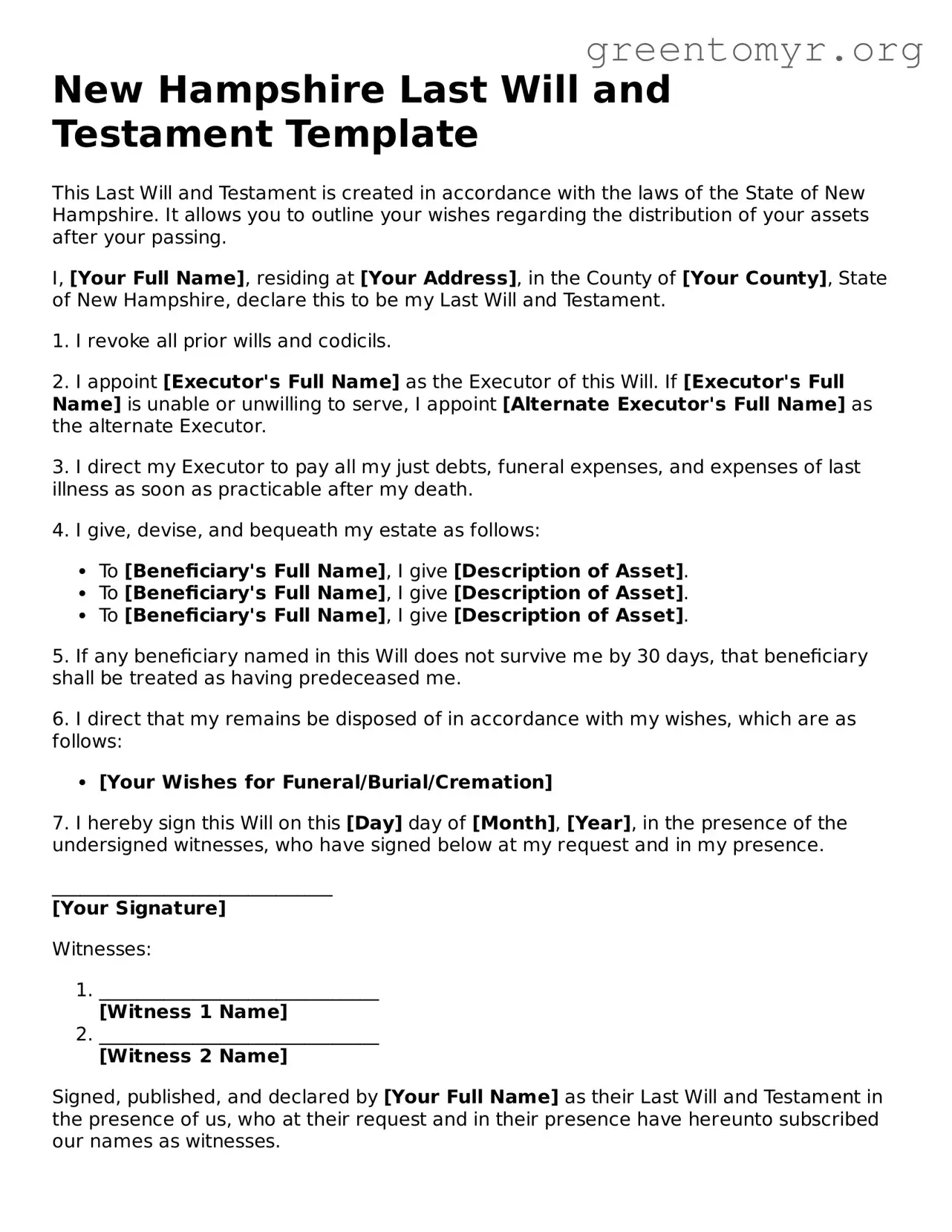
New Hampshire Last Will and Testament Template
This Last Will and Testament is created in accordance with the laws of the State of New Hampshire. It allows you to outline your wishes regarding the distribution of your assets after your passing.
I, [Your Full Name], residing at [Your Address], in the County of [Your County], State of New Hampshire, declare this to be my Last Will and Testament.
1. I revoke all prior wills and codicils.
2. I appoint [Executor's Full Name] as the Executor of this Will. If [Executor's Full Name] is unable or unwilling to serve, I appoint [Alternate Executor's Full Name] as the alternate Executor.
3. I direct my Executor to pay all my just debts, funeral expenses, and expenses of last illness as soon as practicable after my death.
4. I give, devise, and bequeath my estate as follows:
5. If any beneficiary named in this Will does not survive me by 30 days, that beneficiary shall be treated as having predeceased me.
6. I direct that my remains be disposed of in accordance with my wishes, which are as follows:
7. I hereby sign this Will on this [Day] day of [Month], [Year], in the presence of the undersigned witnesses, who have signed below at my request and in my presence.
______________________________
[Your Signature]
Witnesses:
Signed, published, and declared by [Your Full Name] as their Last Will and Testament in the presence of us, who at their request and in their presence have hereunto subscribed our names as witnesses.
| Fact Name | Details |
|---|---|
| Governing Law | The New Hampshire Last Will and Testament is governed by New Hampshire Revised Statutes Annotated, Chapter 551. |
| Requirements for Validity | The testator must be at least 18 years old and of sound mind to create a valid will in New Hampshire. |
| Witness Requirement | Two witnesses are required to sign the will for it to be valid. They must be present at the same time as the testator. |
| Self-Proving Will | A will can be made self-proving by including an affidavit signed by the witnesses at the time of signing. |
| Revocation of Will | A Last Will and Testament can be revoked by the testator at any time, provided that the revocation is executed in accordance with state law. |
After you have gathered the necessary information, you are ready to fill out the New Hampshire Last Will and Testament form. This form allows you to specify how you want your assets distributed after your passing. Follow these steps carefully to ensure that your will is completed correctly.
Once you have completed the form, keep it in a safe place and inform your executor and loved ones where to find it. This ensures that your wishes are known and can be carried out as you intended.
A Last Will and Testament is a legal document that outlines how a person's assets and affairs should be handled after their death. This document allows individuals to specify who will inherit their property, appoint guardians for minor children, and name an executor to manage the estate. Having a will in place ensures that your wishes are honored and can help avoid disputes among family members.
In New Hampshire, any person who is at least 18 years old and of sound mind can create a Last Will and Testament. Being of sound mind means that the individual understands the nature of the document and the implications of their decisions. It's important to ensure that the will reflects your true intentions.
No, you do not necessarily need a lawyer to create a Last Will and Testament in New Hampshire. While legal assistance can be beneficial, especially for complex estates, many people choose to prepare their own wills using forms or templates. However, it is crucial to follow the state's requirements to ensure that your will is valid.
To ensure that your Last Will and Testament is valid in New Hampshire, you must meet the following requirements:
Meeting these criteria helps to avoid challenges to the will's validity after your passing.
Yes, you can change your Last Will and Testament at any time while you are alive and of sound mind. This is done through a process called a codicil, which is an amendment to the original will, or by creating a completely new will that revokes the previous one. It’s important to clearly state your intentions to avoid confusion among your heirs.
If you pass away without a Last Will and Testament, you are considered to have died "intestate." In this case, New Hampshire's intestacy laws will determine how your assets are distributed. Typically, your property will go to your closest relatives, such as your spouse or children. However, this may not align with your wishes, making it essential to have a will in place.
Yes, you can include specific gifts in your Last Will and Testament. This allows you to designate particular items or amounts of money to specific individuals. For example, you might want to leave a family heirloom to a child or a sum of money to a friend. Clearly outlining these gifts in your will helps ensure that your wishes are followed.
After your death, the executor named in your will is responsible for executing its terms. This includes gathering your assets, paying any debts or taxes, and distributing your property according to your wishes. The executor will typically file the will with the probate court to begin the legal process of settling your estate. Having a clear and valid will can make this process smoother for your loved ones.
Filling out a Last Will and Testament form in New Hampshire is a crucial step in ensuring that your wishes are honored after your passing. However, many individuals make common mistakes that can lead to confusion or even invalidate the will. Understanding these pitfalls can help you navigate the process more effectively.
One frequent error is failing to clearly identify the testator. It is essential to include your full legal name and address. Omitting this information can create ambiguity about who the will belongs to, potentially leading to disputes among heirs.
Another mistake is not specifying the beneficiaries correctly. When naming individuals or organizations, be precise. Using nicknames or vague terms can result in misunderstandings. Always use full names and, if possible, include their relationship to you.
Many people overlook the importance of designating an executor. This person will be responsible for carrying out your wishes. If you do not appoint someone, the court may appoint an administrator, which may not align with your intentions.
Additionally, failing to sign the will in the presence of witnesses is a common misstep. New Hampshire law requires that the will be signed by the testator and witnessed by at least two individuals. If this step is neglected, the will may not be considered valid.
Not dating the will can also lead to complications. Including a date helps establish the most current version of your wishes. Without it, disputes may arise if multiple versions of the will exist.
Some individuals forget to review and update their will regularly. Life changes, such as marriage, divorce, or the birth of children, can affect your wishes. Regularly revisiting your will ensures it reflects your current circumstances.
Lastly, not keeping the will in a safe yet accessible place can create issues for your loved ones. It’s advisable to inform your executor and family members about where the will is stored. This transparency can ease the process of executing your wishes when the time comes.
A Last Will and Testament is an essential document for anyone looking to outline their wishes regarding their estate after passing. In New Hampshire, several other forms and documents often accompany a will to ensure that all aspects of a person's wishes are clearly defined and legally binding. Below is a list of these important documents.
Each of these documents plays a crucial role in estate planning. By considering them alongside a Last Will and Testament, individuals can create a comprehensive plan that reflects their wishes and protects their loved ones.
The Last Will and Testament is a crucial legal document that outlines how a person's assets will be distributed after their death. It shares similarities with several other legal documents. Below is a list of seven documents that are comparable to a Last Will and Testament, along with explanations of their similarities.
When filling out the New Hampshire Last Will and Testament form, it is essential to approach the task with care and attention to detail. This document plays a crucial role in determining how your assets will be distributed after your passing. Here are some important dos and don'ts to consider:
By following these guidelines, you can help ensure that your Last Will and Testament reflects your wishes accurately and is legally valid. This can provide peace of mind for both you and your loved ones.
When it comes to creating a Last Will and Testament in New Hampshire, several misconceptions can lead to confusion. Understanding these common myths can help ensure that your wishes are accurately reflected in your will.
This is incorrect. New Hampshire does recognize handwritten wills, also known as holographic wills, as long as they are signed by the testator and clearly express their intentions.
While having an attorney can be helpful, it is not a requirement. Individuals can create their own will as long as they follow the legal guidelines set by the state.
This is not true. Wills can be modified or revoked at any time as long as the testator is of sound mind and follows the proper legal procedures.
Oral wills, or nuncupative wills, are generally not recognized in New Hampshire. A written document is required to ensure that your wishes are legally binding.
This is a misconception. Some assets, like those held in a trust or joint accounts, may not need to be included in the will since they have designated beneficiaries.
When filling out and using the New Hampshire Last Will and Testament form, it is important to keep several key points in mind. These takeaways can help ensure that your will is valid and effectively communicates your wishes.
Following these guidelines can help ensure that your Last Will and Testament accurately reflects your wishes and is legally enforceable in New Hampshire.