In the realm of healthcare decisions, the New Hampshire Living Will form serves as a crucial tool for individuals wishing to communicate their preferences regarding medical treatment in the event they become unable to express their wishes. This legal document allows individuals to outline their desires concerning life-sustaining treatments, such as resuscitation efforts and artificial nutrition, thereby providing clarity to family members and healthcare providers during difficult times. Importantly, the Living Will form is designed to ensure that a person’s values and choices are respected, even when they cannot speak for themselves. By completing this form, individuals can specify the types of medical interventions they wish to receive or decline, thus alleviating the burden on loved ones who may otherwise have to make these challenging decisions in moments of crisis. Additionally, understanding the requirements and implications of the Living Will in New Hampshire is essential, as it not only involves filling out the form but also ensuring that it is properly witnessed and compliant with state laws. This proactive approach empowers individuals to take control of their healthcare destiny and fosters meaningful conversations about end-of-life care among families.
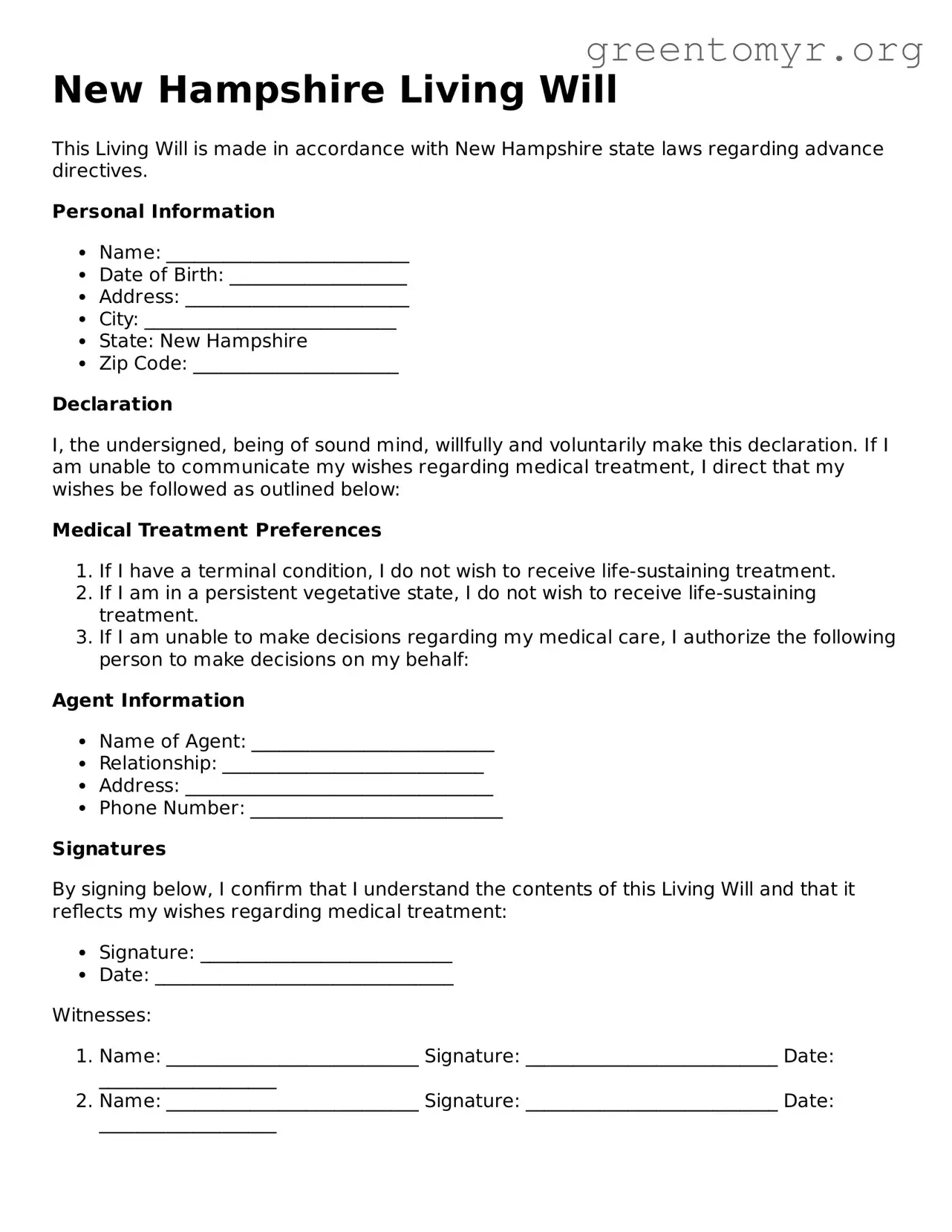
New Hampshire Living Will
This Living Will is made in accordance with New Hampshire state laws regarding advance directives.
Personal Information
Declaration
I, the undersigned, being of sound mind, willfully and voluntarily make this declaration. If I am unable to communicate my wishes regarding medical treatment, I direct that my wishes be followed as outlined below:
Medical Treatment Preferences
Agent Information
Signatures
By signing below, I confirm that I understand the contents of this Living Will and that it reflects my wishes regarding medical treatment:
Witnesses:
| Fact Name | Description |
|---|---|
| Governing Law | The New Hampshire Living Will is governed by New Hampshire Revised Statutes Annotated (RSA) 137-J. |
| Purpose | A Living Will allows individuals to express their wishes regarding medical treatment in case they become unable to communicate those wishes. |
| Eligibility | Any adult who is of sound mind can create a Living Will in New Hampshire. |
| Signature Requirement | The document must be signed by the individual creating the Living Will in the presence of two witnesses. |
| Witness Requirements | Witnesses must be at least 18 years old and cannot be related to the individual or entitled to any portion of their estate. |
| Revocation | A Living Will can be revoked at any time by the individual, either verbally or in writing. |
| Healthcare Proxy | While a Living Will outlines treatment preferences, individuals can also appoint a healthcare proxy to make decisions on their behalf. |
| Storage | It is advisable to keep the Living Will in an easily accessible place and to share copies with family and healthcare providers. |
| Legal Advice | Consulting an attorney is recommended to ensure that the Living Will meets all legal requirements and accurately reflects the individual's wishes. |
Filling out the New Hampshire Living Will form is an important step in ensuring your healthcare wishes are respected. Once you complete the form, it will need to be signed and witnessed to be legally valid. Here are the steps to guide you through the process.
A Living Will is a legal document that allows individuals to outline their preferences for medical treatment in case they become unable to communicate their wishes due to illness or injury. In New Hampshire, this document specifically addresses end-of-life care decisions, helping healthcare providers and family members understand the individual's desires regarding life-sustaining treatments.
Anyone who is at least 18 years old and is capable of making their own healthcare decisions should consider creating a Living Will. This document is especially important for individuals with serious health conditions, those undergoing major surgeries, or anyone who wants to ensure their healthcare preferences are respected in critical situations. It is a proactive step in planning for the future.
Creating a Living Will in New Hampshire involves several steps:
Once completed, it is advisable to share copies with your healthcare providers and family members to ensure they are aware of your wishes.
Yes, you can change or revoke your Living Will at any time as long as you are mentally competent. To make changes, you can either create a new Living Will or modify the existing one. If you choose to revoke your Living Will, it is important to inform your healthcare providers and family members to avoid any confusion regarding your wishes. Written revocation is the most effective method, but you can also verbally express your desire to revoke it.
Filling out a Living Will in New Hampshire is a significant step in ensuring that your healthcare wishes are respected. However, many individuals make common mistakes that can lead to confusion or unintended consequences. One prevalent error is failing to clearly state preferences regarding life-sustaining treatments. It is essential to be explicit about what you do or do not want, as vague language can result in misinterpretations by healthcare providers.
Another frequent mistake is neglecting to sign the document in front of the required witnesses. New Hampshire law mandates that a Living Will must be signed by the individual and witnessed by at least two people. If this step is overlooked, the document may not be considered valid, leaving your wishes unfulfilled in critical moments.
People often forget to review and update their Living Will as circumstances change. Life events such as a serious illness, a change in personal beliefs, or new family dynamics can all impact your healthcare preferences. Regularly revisiting the document ensures it reflects your current desires.
Additionally, some individuals mistakenly assume that a Living Will is the same as a durable power of attorney for healthcare. While both documents serve important roles, they are distinct. A Living Will outlines your treatment preferences, whereas a durable power of attorney designates someone to make healthcare decisions on your behalf if you are unable to do so.
Another common error involves not discussing the Living Will with family members or the designated healthcare proxy. Open conversations about your wishes can prevent confusion and conflict during stressful times. It is vital that those involved understand your preferences to honor them appropriately.
People sometimes overlook the importance of using clear and straightforward language in their Living Will. Legal jargon or complex phrasing can lead to misunderstandings. It is best to articulate your wishes in simple terms to ensure clarity.
Some individuals fail to consider the implications of their choices fully. For example, opting for "no resuscitation" may seem straightforward, but it is crucial to understand the full scope of what that entails. Consulting with a healthcare professional can provide valuable insights into the consequences of various decisions.
Another mistake is not providing copies of the Living Will to relevant parties. Simply having the document stored away does not ensure that it will be available when needed. Distributing copies to your healthcare proxy, family members, and your physician can facilitate adherence to your wishes.
Lastly, people sometimes forget to check the legal requirements specific to New Hampshire. Each state has its own laws governing Living Wills, and what may be acceptable in one state may not be valid in another. Familiarizing yourself with New Hampshire's regulations is essential for creating a legally binding document.
When preparing a New Hampshire Living Will, it is essential to consider several other documents that can complement this important directive. Each of these forms serves a unique purpose and can help ensure that your healthcare wishes are honored in various situations. Below is a list of commonly used documents that you might find beneficial.
Understanding these documents and how they work together can empower you to make informed decisions about your healthcare. By taking the time to prepare these forms, you can ensure that your wishes are respected and that your loved ones are not left to make difficult choices without guidance.
A Living Will is an important document that outlines your wishes regarding medical treatment in situations where you may not be able to communicate your preferences. It is similar to several other legal documents that also address health care decisions. Here are four documents that share similarities with a Living Will:
Understanding these documents can help you make informed decisions about your health care preferences and ensure that your wishes are honored when it matters most.
When filling out the New Hampshire Living Will form, it's important to be mindful of certain dos and don'ts to ensure your wishes are clearly communicated. Here’s a helpful list to guide you:
By following these guidelines, you can help ensure that your Living Will accurately reflects your preferences and is legally valid.
When it comes to the New Hampshire Living Will form, there are several misconceptions that can lead to confusion. Here are eight common misunderstandings:
Understanding these misconceptions can help individuals make informed decisions about their healthcare preferences and ensure their wishes are respected.
When filling out and using the New Hampshire Living Will form, keep the following key takeaways in mind: