In New Hampshire, the Medical Power of Attorney form serves as a vital tool for individuals looking to ensure their healthcare wishes are honored when they can no longer communicate those wishes themselves. This document allows you to appoint a trusted person, often referred to as your agent, to make medical decisions on your behalf. It covers a range of important aspects, including the authority granted to your agent, the types of medical treatments you may wish to accept or refuse, and any specific instructions regarding your care. Understanding this form is essential, as it not only empowers you to choose someone who knows your values and preferences but also provides peace of mind that your healthcare choices will be respected. Whether you are planning for future health uncertainties or simply want to clarify your medical preferences, the Medical Power of Attorney form is a crucial element of responsible health planning in New Hampshire.
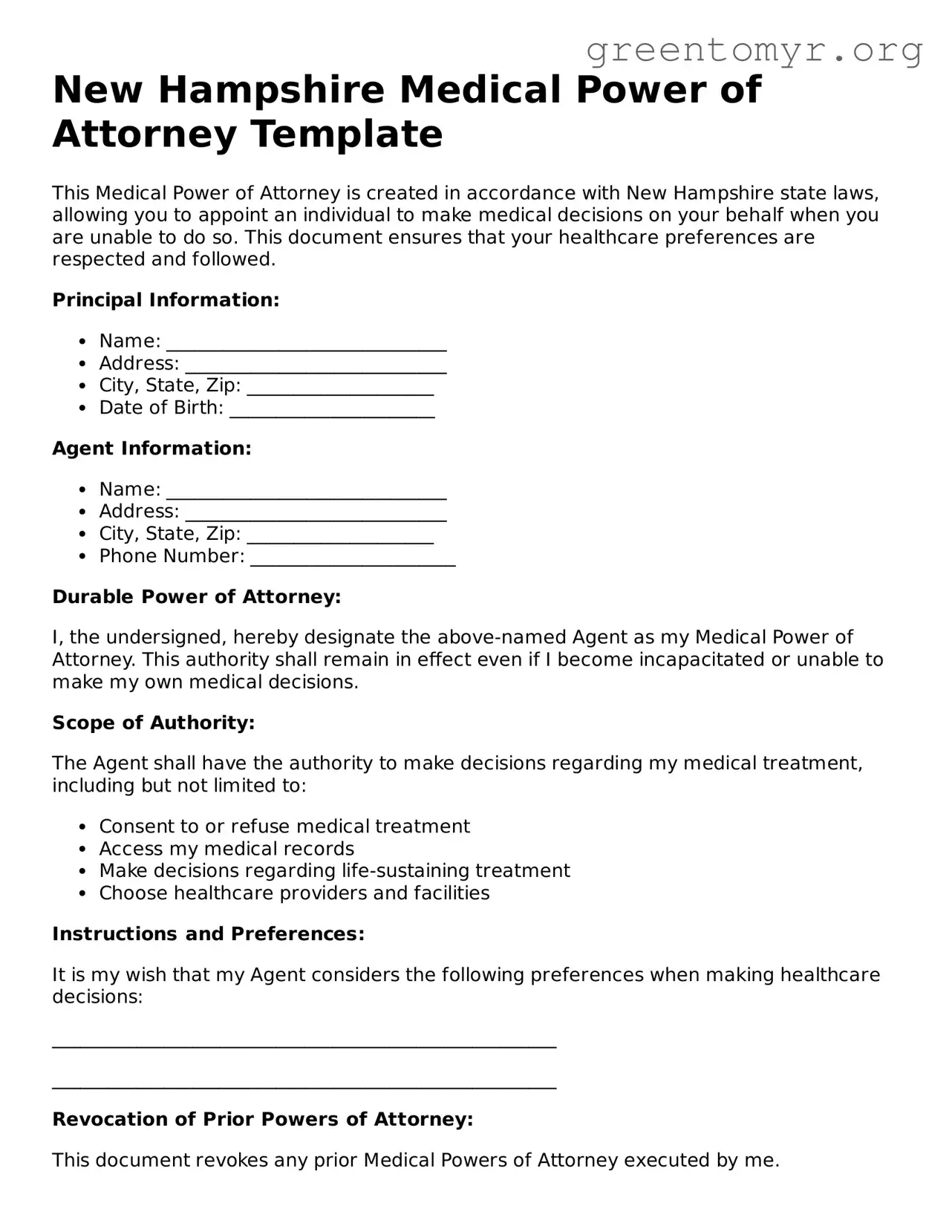
New Hampshire Medical Power of Attorney Template
This Medical Power of Attorney is created in accordance with New Hampshire state laws, allowing you to appoint an individual to make medical decisions on your behalf when you are unable to do so. This document ensures that your healthcare preferences are respected and followed.
Principal Information:
Agent Information:
Durable Power of Attorney:
I, the undersigned, hereby designate the above-named Agent as my Medical Power of Attorney. This authority shall remain in effect even if I become incapacitated or unable to make my own medical decisions.
Scope of Authority:
The Agent shall have the authority to make decisions regarding my medical treatment, including but not limited to:
Instructions and Preferences:
It is my wish that my Agent considers the following preferences when making healthcare decisions:
______________________________________________________
______________________________________________________
Revocation of Prior Powers of Attorney:
This document revokes any prior Medical Powers of Attorney executed by me.
Signatures:
By signing below, I affirm that I am of sound mind and that I understand the implications of this document.
Principal Signature: ___________________________ Date: _______________
Agent Signature: _____________________________ Date: _______________
Witnesses:
Notary Public:
State of New Hampshire
County of ____________________________
Subscribed and sworn to before me this _____ day of ____________, 20__.
Notary Public Signature: ______________________________
My Commission Expires: _____________________________
| Fact Name | Details |
|---|---|
| Definition | A Medical Power of Attorney allows a person to appoint someone else to make medical decisions on their behalf if they are unable to do so. |
| Governing Law | The form is governed by New Hampshire Revised Statutes Annotated, Chapter 137-J. |
| Eligibility | Any adult resident of New Hampshire can create a Medical Power of Attorney. |
| Signature Requirement | The form must be signed by the principal and witnessed by two adults who are not related to the principal. |
| Revocation | A Medical Power of Attorney can be revoked at any time by the principal, as long as they are competent. |
| Durability | This document remains effective even if the principal becomes incapacitated. |
| Limitations | It does not grant authority for decisions regarding mental health treatment unless specified. |
After obtaining the New Hampshire Medical Power of Attorney form, you will need to fill it out carefully. This document allows you to designate someone to make healthcare decisions on your behalf if you become unable to do so. Follow the steps below to complete the form accurately.
Once completed, ensure that copies are provided to your agent and any relevant healthcare providers. This helps ensure your wishes are known and can be honored when necessary.
A Medical Power of Attorney (MPOA) is a legal document that allows you to appoint someone you trust to make healthcare decisions on your behalf if you become unable to make those decisions yourself. This person is often referred to as your agent or proxy. The MPOA is particularly important in situations where you may be incapacitated due to illness or injury.
You can choose anyone you trust to be your agent, as long as they are at least 18 years old and capable of making healthcare decisions. Common choices include family members, close friends, or trusted advisors. It’s essential to discuss your wishes with the person you choose, ensuring they are willing to take on this responsibility.
Your agent can make a wide range of healthcare decisions, including:
However, your agent must act in accordance with your wishes and best interests, as outlined in the MPOA document.
No, you do not need a lawyer to create a Medical Power of Attorney in New Hampshire. You can complete the form on your own, as long as you follow the state’s requirements. However, consulting with a legal professional can provide clarity and ensure that your document meets all legal standards and accurately reflects your wishes.
If you decide to revoke or change your MPOA, you can do so at any time as long as you are mentally competent. To revoke the MPOA, you should create a written notice stating your intention to revoke it. Make sure to notify your agent and any healthcare providers involved in your care. If you create a new MPOA, it will automatically replace the previous one.
Generally, a Medical Power of Attorney created in New Hampshire will be recognized in other states, but this can vary. Each state has its own laws regarding MPOAs. It’s advisable to check the specific requirements of the state you are moving to and consider creating a new MPOA that complies with that state’s laws to ensure your wishes are honored.
Filling out a Medical Power of Attorney (MPOA) form in New Hampshire is a critical step in ensuring that your healthcare wishes are respected. However, many people make common mistakes that can lead to confusion or even invalidate the document. One frequent error is failing to specify the agent clearly. It's essential to name a trusted individual who can make medical decisions on your behalf. Without a clear designation, healthcare providers may struggle to determine who has the authority to act.
Another mistake involves neglecting to discuss your wishes with your chosen agent. It’s not enough to simply name someone; that person should understand your values and preferences regarding medical treatment. If your agent is unaware of your desires, they may make decisions that do not align with your intentions.
Some individuals also forget to sign the document in the presence of witnesses or a notary. New Hampshire law requires that the MPOA be properly executed to be valid. Without the necessary signatures, the form may not hold up when it’s needed most.
Additionally, people often overlook the importance of updating their MPOA. Life circumstances change, and so do relationships. If your agent becomes unavailable or if your health care preferences evolve, it’s crucial to revise the document accordingly. Failing to keep it current can lead to complications when decisions need to be made.
Another common oversight is not considering alternate agents. If your primary agent is unable to fulfill their role, having a backup can prevent delays in decision-making. Not naming an alternate can leave healthcare providers in a difficult position during critical moments.
Some individuals may also fail to understand the scope of authority granted to their agent. It’s important to be specific about what decisions your agent can make. Vague language can lead to misunderstandings or disputes about the extent of their powers.
Another mistake is assuming that a Medical Power of Attorney automatically includes a Do Not Resuscitate (DNR) order. These are separate documents, and if you wish to refuse resuscitation, you must explicitly state that in a DNR form.
Lastly, many people neglect to keep copies of the completed MPOA in accessible locations. If the document is needed in an emergency, it should be readily available to healthcare providers and family members. Ensure that copies are distributed to your agent, family, and healthcare providers to avoid unnecessary delays.
When preparing a New Hampshire Medical Power of Attorney, it's important to consider additional documents that can complement your healthcare planning. These forms help ensure that your wishes are clearly communicated and respected in medical situations. Here are some commonly used forms that you may find beneficial:
Having these documents in place can provide peace of mind, knowing that your healthcare preferences are documented and accessible. It’s wise to discuss your choices with your loved ones and healthcare providers to ensure everyone understands your wishes.
The Medical Power of Attorney (MPOA) form is an important document that allows individuals to designate someone they trust to make healthcare decisions on their behalf if they become unable to do so. Several other documents serve similar purposes in different contexts. Here are five documents that share similarities with the MPOA:
Understanding these documents can empower individuals to make informed decisions about their healthcare and financial affairs, ensuring their wishes are respected when they cannot voice them themselves.
When filling out the New Hampshire Medical Power of Attorney form, it is essential to approach the process with care. Below are some important guidelines to follow, as well as common pitfalls to avoid.
By adhering to these guidelines, you can ensure that your Medical Power of Attorney accurately reflects your wishes and provides peace of mind for you and your family.
Understanding the New Hampshire Medical Power of Attorney (MPOA) form is crucial for making informed healthcare decisions. However, several misconceptions often arise. Here are eight common misunderstandings:
By addressing these misconceptions, individuals can better understand the importance of the New Hampshire Medical Power of Attorney and ensure their healthcare preferences are honored.
Filling out and utilizing the New Hampshire Medical Power of Attorney form is an important step in ensuring that your healthcare wishes are respected. Here are some key takeaways to keep in mind:
Taking these steps can provide peace of mind, knowing that your healthcare decisions will be handled according to your wishes when it matters most.