The New Hampshire Motor Vehicle Power of Attorney form serves as a crucial legal document that empowers an individual to act on behalf of another person in matters related to motor vehicles. This form is particularly useful when the vehicle owner cannot be present to handle transactions such as registering a vehicle, transferring ownership, or obtaining necessary titles. By designating an agent through this form, the principal ensures that their interests are represented effectively, even in their absence. The document typically requires specific information, including the names and addresses of both the principal and the agent, as well as details about the vehicle in question. Additionally, it may include the scope of authority granted to the agent, which can range from limited tasks to broader responsibilities. Understanding the nuances of this form can help vehicle owners navigate the complexities of motor vehicle transactions with confidence and ease.
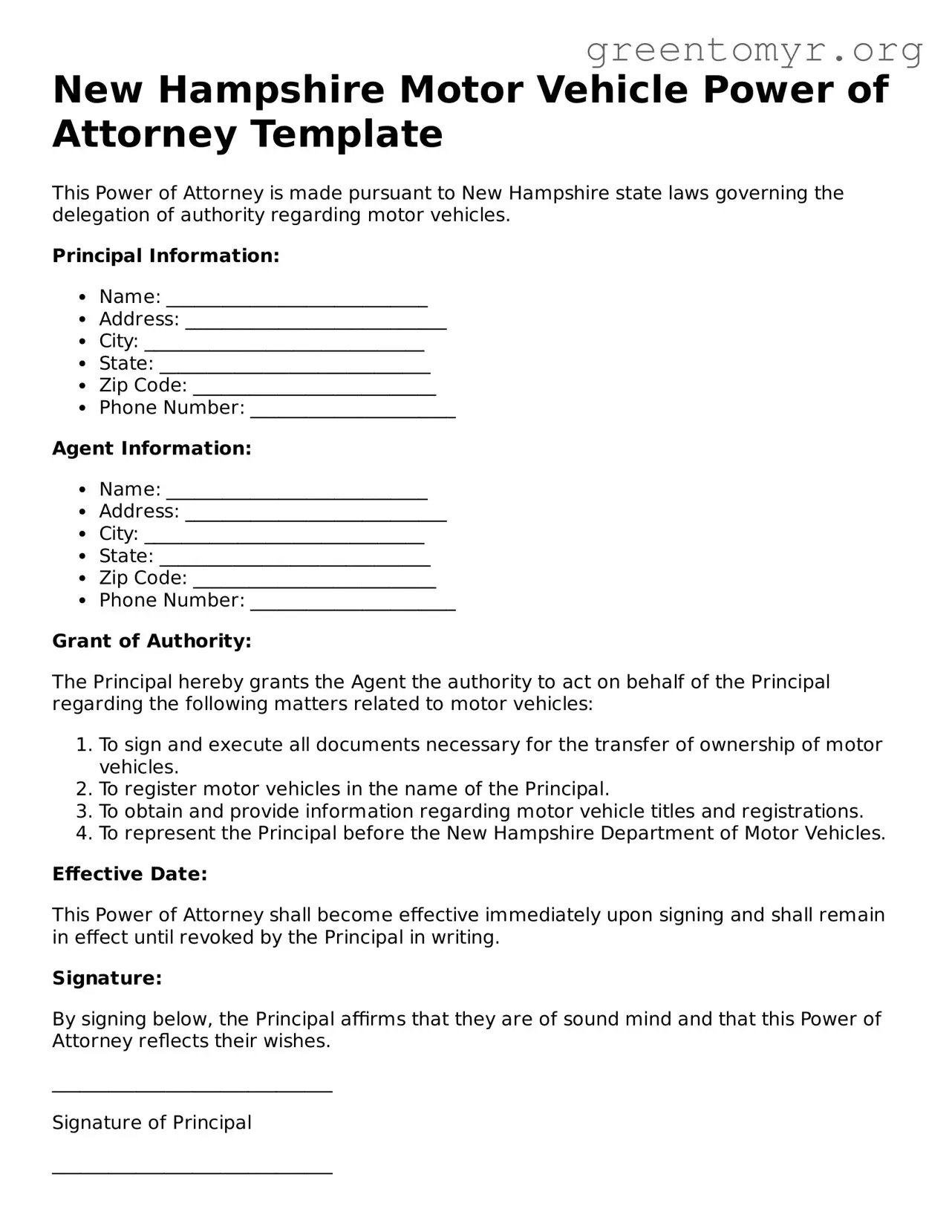
New Hampshire Motor Vehicle Power of Attorney Template
This Power of Attorney is made pursuant to New Hampshire state laws governing the delegation of authority regarding motor vehicles.
Principal Information:
Agent Information:
Grant of Authority:
The Principal hereby grants the Agent the authority to act on behalf of the Principal regarding the following matters related to motor vehicles:
Effective Date:
This Power of Attorney shall become effective immediately upon signing and shall remain in effect until revoked by the Principal in writing.
Signature:
By signing below, the Principal affirms that they are of sound mind and that this Power of Attorney reflects their wishes.
______________________________
Signature of Principal
______________________________
Date
Witness Information:
______________________________
Signature of Witness
______________________________
Date
This document must be signed in the presence of a witness to be valid in New Hampshire.
| Fact Name | Description |
|---|---|
| Purpose | The New Hampshire Motor Vehicle Power of Attorney form allows an individual to designate another person to handle motor vehicle transactions on their behalf. |
| Governing Law | This form is governed by New Hampshire Revised Statutes Annotated (RSA) 261:1. |
| Signatures Required | The form must be signed by the principal (the person granting authority) and may require notarization to be valid. |
| Duration | The authority granted under this form remains effective until revoked or until the specified transaction is completed. |
After obtaining the New Hampshire Motor Vehicle Power of Attorney form, you will need to complete it accurately to ensure it serves its intended purpose. Follow these steps to fill out the form correctly.
Once the form is completed, it can be submitted as needed to facilitate the transfer of authority regarding motor vehicle matters.
The Motor Vehicle Power of Attorney form in New Hampshire is a legal document that allows one person, referred to as the "principal," to designate another person, known as the "agent," to act on their behalf regarding motor vehicle matters. This can include tasks such as transferring ownership, registering vehicles, or signing necessary documents related to motor vehicles. The form provides a convenient way for individuals to delegate authority, especially when they are unable to handle these matters personally due to distance, time constraints, or other reasons.
In New Hampshire, the principal can choose any competent adult as their agent. This could be a family member, friend, or even a professional, such as an attorney or a licensed dealer. It is important for the principal to trust the agent, as they will have the authority to make decisions regarding the principal's motor vehicle transactions. The agent should be someone who is reliable and understands the responsibilities that come with this authority.
Completing the Motor Vehicle Power of Attorney form involves several straightforward steps:
Once completed, the form should be submitted to the appropriate agency, such as the DMV, along with any other necessary documents related to the specific motor vehicle transaction.
Generally, there is no fee specifically for completing the Motor Vehicle Power of Attorney form itself. However, there may be fees associated with other transactions that the agent performs on behalf of the principal, such as title transfers or registration fees at the DMV. It is advisable to check with the DMV for any applicable fees related to the specific services being requested. Additionally, if you seek assistance from a legal professional to complete the form, their services may incur a fee.
Filling out the New Hampshire Motor Vehicle Power of Attorney form can be straightforward, but many individuals make common mistakes that can lead to delays or complications. One prevalent error is failing to provide complete information. Every section of the form must be filled out accurately, including names, addresses, and vehicle details. Omitting even a single piece of information can render the document invalid.
Another mistake occurs when individuals forget to sign the form. A signature is crucial as it signifies consent and authority. Without it, the document holds no legal weight. Moreover, some people may overlook the requirement for a witness or notary signature, which is often necessary to authenticate the Power of Attorney. Always check the specific requirements for your situation.
Many also misinterpret the scope of authority granted in the Power of Attorney. It's essential to clearly define what actions the agent can take on your behalf. Vague language can lead to misunderstandings, and the agent may not have the authority to perform certain tasks related to the vehicle. Be specific about the powers being delegated.
Another common oversight is using outdated forms. Regulations and requirements can change, so it's vital to ensure that you are using the most current version of the form. Using an outdated form may lead to rejection or additional paperwork. Always verify that you have the latest version from the New Hampshire Department of Motor Vehicles.
People often fail to keep a copy of the completed form. After submitting the Power of Attorney, it's wise to retain a copy for your records. This can be helpful in case any disputes arise or if you need to refer back to the document later. Keeping a record ensures you have proof of the authority granted.
Some individuals rush through the process, not taking the time to read the instructions carefully. Each section of the form has specific requirements, and misunderstanding them can lead to errors. Taking the time to read and understand the instructions can save a lot of hassle down the line.
Lastly, many people underestimate the importance of discussing the Power of Attorney with their chosen agent. It is crucial to ensure that the person you are appointing understands their responsibilities and is willing to accept them. This conversation can prevent future conflicts and ensure that your wishes are honored.
When dealing with motor vehicle transactions in New Hampshire, the Motor Vehicle Power of Attorney form is a crucial document. However, it is often accompanied by other forms and documents that help streamline the process. Understanding these additional documents can help you navigate your responsibilities and rights effectively.
By familiarizing yourself with these documents, you can ensure a smoother process when managing your vehicle's legal requirements. Each form plays a vital role in protecting your interests and facilitating transactions. Always consider consulting with a professional if you have questions about any of these documents.
The Motor Vehicle Power of Attorney form allows an individual to designate someone else to act on their behalf regarding vehicle-related matters. This document shares similarities with several other legal forms that empower individuals to delegate authority. Below is a list of eight documents that are akin to the Motor Vehicle Power of Attorney, along with explanations of their similarities.
Understanding these documents can help individuals navigate their options when it comes to delegating authority. Each form serves a specific purpose, yet they all share the fundamental principle of empowering another person to act on one's behalf.
When filling out the New Hampshire Motor Vehicle Power of Attorney form, follow these guidelines to ensure accuracy and compliance.
Understanding the New Hampshire Motor Vehicle Power of Attorney form is essential for anyone looking to manage vehicle-related matters on behalf of another person. However, several misconceptions exist. Here are eight common misunderstandings:
Clearing up these misconceptions can help individuals make informed decisions about using the New Hampshire Motor Vehicle Power of Attorney form.
When filling out and using the New Hampshire Motor Vehicle Power of Attorney form, consider the following key takeaways: