In the competitive landscape of today’s job market, understanding the nuances of employment agreements is essential for both employers and employees. One such agreement that often comes into play is the New Hampshire Non-compete Agreement. This legal document serves to protect a company’s interests by restricting an employee's ability to engage in similar work after leaving the organization. Key elements of this form include the duration of the restriction, the geographic scope, and the specific activities that are prohibited. Each of these components is crucial, as they define the boundaries within which an employee must operate following their departure. By clearly outlining these terms, the agreement aims to balance the employer's need for protection with the employee's right to seek new opportunities. Understanding the implications of signing such an agreement is vital, as it can significantly impact one’s career trajectory and professional relationships. Thus, navigating the complexities of the New Hampshire Non-compete Agreement requires careful consideration and awareness of both parties' rights and responsibilities.
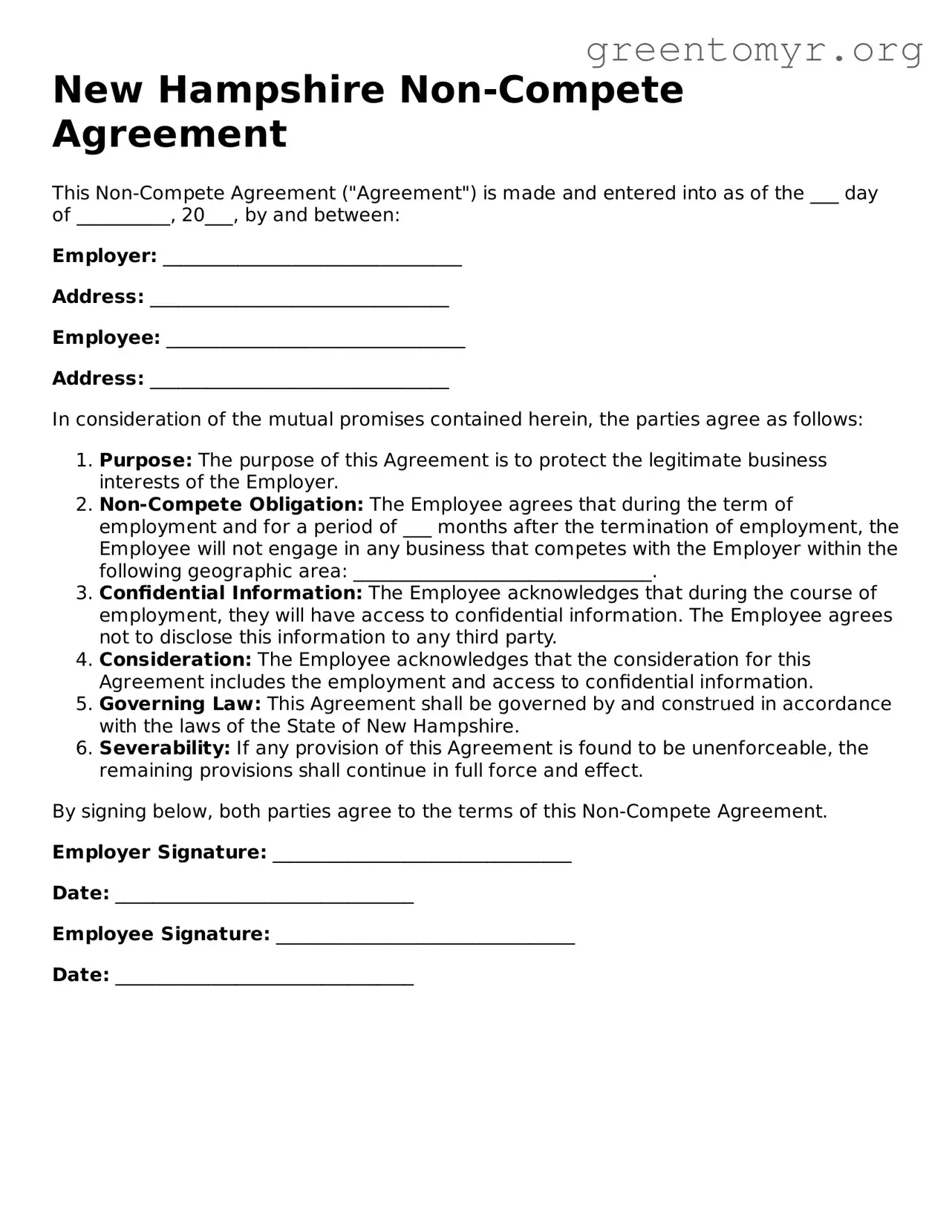
New Hampshire Non-Compete Agreement
This Non-Compete Agreement ("Agreement") is made and entered into as of the ___ day of __________, 20___, by and between:
Employer: ________________________________
Address: ________________________________
Employee: ________________________________
Address: ________________________________
In consideration of the mutual promises contained herein, the parties agree as follows:
By signing below, both parties agree to the terms of this Non-Compete Agreement.
Employer Signature: ________________________________
Date: ________________________________
Employee Signature: ________________________________
Date: ________________________________
| Fact Name | Description |
|---|---|
| Governing Law | The New Hampshire Non-compete Agreement is governed by New Hampshire state law. |
| Enforceability | Non-compete agreements are enforceable in New Hampshire if they are reasonable in duration, geographic scope, and purpose. |
| Duration Limits | Typically, non-compete agreements should not exceed one year unless justified by the nature of the business. |
| Geographic Scope | The geographic area covered by the non-compete must be limited to where the employer operates. |
| Consideration Requirement | A valid non-compete agreement requires consideration, which can be a job offer, training, or other benefits. |
| Public Policy | New Hampshire courts may refuse to enforce non-compete agreements that violate public policy. |
| Reasonableness Test | Courts assess the reasonableness of a non-compete agreement based on its impact on the employee's ability to work. |
| Exceptions | Certain professions, such as doctors and lawyers, may have specific restrictions regarding non-compete agreements. |
| Modification | Employers may modify non-compete agreements, but any changes must be communicated clearly to the employee. |
| Legal Advice | It is advisable for both employers and employees to seek legal advice before entering into a non-compete agreement. |
Once you have the New Hampshire Non-compete Agreement form in hand, you will need to complete it accurately to ensure that all necessary details are included. Following the steps below will guide you through the process of filling out the form correctly.
After completing the form, review it carefully to confirm that all information is accurate and legible. Any errors or omissions could lead to complications later. Once everything is in order, both parties should retain a copy for their records.
A Non-compete Agreement is a legal contract between an employer and an employee. It restricts the employee from working for competitors or starting a competing business for a specified period after leaving the company. In New Hampshire, these agreements must be reasonable in scope and duration to be enforceable.
To be valid, a Non-compete Agreement must meet several criteria:
In New Hampshire, the duration of a Non-compete Agreement can vary. Typically, a period of six months to two years is considered reasonable. However, the specific length should be justified based on the nature of the business and the employee's role.
Yes, Non-compete Agreements can be enforceable in New Hampshire if they meet the legal requirements. Courts will evaluate the agreement based on its reasonableness and the protection of legitimate business interests. If deemed overly restrictive, the court may refuse to enforce it.
Yes, employees can negotiate the terms of a Non-compete Agreement. It is advisable to discuss any concerns regarding the agreement with the employer before signing. Negotiating terms such as duration, geographic area, and scope can lead to a more balanced agreement.
If an employee breaches a Non-compete Agreement, the employer may take legal action. This could result in a lawsuit for damages or an injunction to prevent the employee from working for a competitor. The consequences depend on the specific terms of the agreement and the nature of the breach.
A Non-compete Agreement may be terminated under certain conditions. This could include mutual agreement between the employer and employee or if the employer fails to enforce the agreement within a reasonable time. It is important to review the terms of the agreement for any clauses regarding termination.
If you are presented with a Non-compete Agreement, take the time to read it carefully. Consider consulting with a legal professional to understand the implications fully. Assess how the agreement may impact your future employment opportunities before signing.
New Hampshire Non-compete Agreement forms can be found online through various legal document providers. Ensure that the form you choose complies with New Hampshire laws and is tailored to your specific situation. It is advisable to consult a legal expert for assistance in drafting or reviewing the agreement.
When filling out the New Hampshire Non-compete Agreement form, individuals often make several common mistakes that can lead to complications down the line. One frequent error is failing to clearly identify the parties involved. It is essential to specify both the employer and the employee accurately. Omitting names or using incorrect titles can render the agreement unenforceable.
Another mistake is not defining the scope of the non-compete clause. The agreement should clearly outline the types of activities that are restricted after employment ends. Vague language can lead to misunderstandings and potential legal disputes. It’s important to be specific about what constitutes competition.
Timeframe is another critical aspect that people often overlook. The duration of the non-compete agreement should be reasonable and clearly stated. A common error is setting an excessively long timeframe, which may not hold up in court. New Hampshire law requires that the duration be justifiable based on the nature of the business and the employee’s role.
Geographic limitations are also frequently mishandled. Some individuals fail to specify the geographic area in which the non-compete applies. Without this detail, the agreement may be too broad and therefore unenforceable. It’s vital to define the area in which the restrictions will apply to avoid confusion.
Many people neglect to include consideration in the agreement. Consideration refers to something of value exchanged between the parties. If an employee is asked to sign a non-compete after starting work without any new benefits or compensation, the agreement may be challenged. It’s essential to ensure that the employee receives something in return for agreeing to the terms.
Another common error is not reviewing the agreement with legal counsel. While it may seem straightforward, having a lawyer review the non-compete agreement can prevent future issues. Legal professionals can provide insights on enforceability and help tailor the agreement to fit specific circumstances.
Inadequate explanation of the agreement's terms is also a mistake that can lead to confusion. Employees should fully understand what they are signing. Providing a clear explanation of the implications of the non-compete can help avoid misunderstandings and foster a better working relationship.
Some individuals mistakenly assume that a non-compete agreement is a one-size-fits-all document. Each agreement should be customized to reflect the unique aspects of the business and the employee’s role. Using a generic template can lead to issues down the line.
Lastly, people often forget to keep a copy of the signed agreement. After both parties have signed, it’s crucial to retain a copy for future reference. This ensures that both the employer and employee have access to the terms agreed upon, which can be vital in case of disputes.
By avoiding these common mistakes, individuals can ensure that their New Hampshire Non-compete Agreement is clear, enforceable, and beneficial to both parties involved.
When entering into a Non-compete Agreement in New Hampshire, several other documents may be relevant to ensure clarity and enforceability. Understanding these documents can help both employers and employees navigate their rights and responsibilities effectively.
Being aware of these documents can facilitate a smoother transition into or out of employment. It is essential to understand how they interact with the Non-compete Agreement to protect your interests effectively.
The Non-compete Agreement is a crucial document in the realm of employment and business relationships. It shares similarities with several other legal documents. Here’s a list of eight documents that are comparable to a Non-compete Agreement, along with a brief explanation of how they relate:
When filling out the New Hampshire Non-compete Agreement form, it’s essential to approach the task with care. Here are some important do's and don'ts to keep in mind:
By following these guidelines, you can navigate the process more effectively and protect your interests.
Understanding the New Hampshire Non-compete Agreement can be challenging. Many misconceptions exist that may lead individuals to misunderstand their rights and obligations. Below is a list of common misconceptions, along with clarifications to help provide a clearer picture.
By addressing these misconceptions, individuals can better navigate their rights concerning non-compete agreements in New Hampshire. Understanding the nuances can empower employees to make informed decisions about their careers.
When filling out and using the New Hampshire Non-compete Agreement form, consider the following key takeaways: