Content Navigation

The New Hampshire Non-disclosure Agreement (NDA) form serves as a crucial tool for individuals and businesses seeking to protect sensitive information from unauthorized disclosure. This legally binding contract outlines the terms under which confidential information may be shared between parties while ensuring that such information remains protected. Typically, the NDA specifies the definition of confidential information, the obligations of the receiving party, and the duration of confidentiality. It may also include clauses addressing the consequences of breach and the governing law applicable to the agreement. By establishing clear guidelines, the NDA fosters trust and encourages open communication, allowing parties to collaborate without the fear of compromising their proprietary information. Understanding the components of this form is essential for anyone looking to engage in business relationships or partnerships in New Hampshire, as it safeguards intellectual property and trade secrets effectively.

New Hampshire Non-disclosure Agreement Example

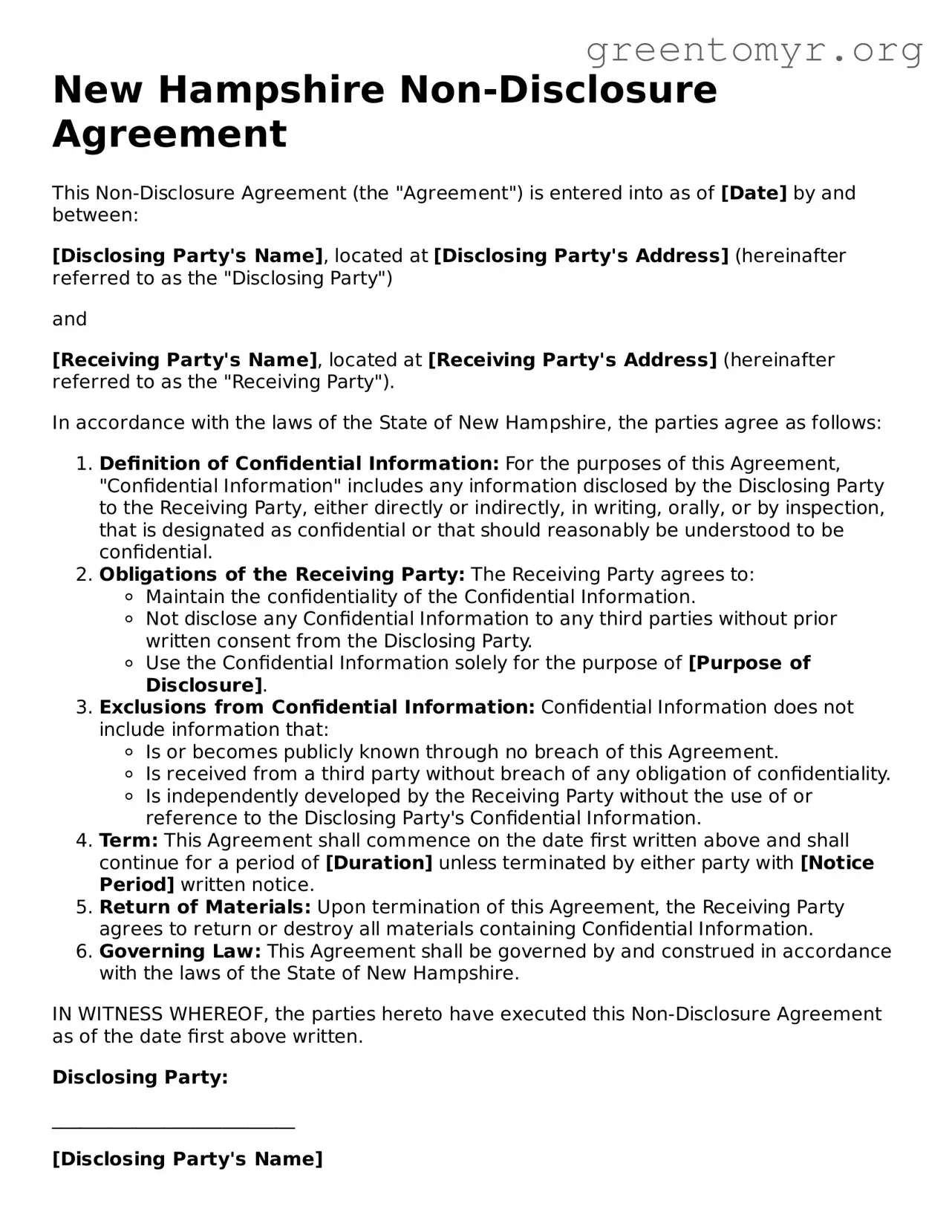
New Hampshire Non-Disclosure Agreement

This Non-Disclosure Agreement (the "Agreement") is entered into as of [Date] by and between:

[Disclosing Party's Name], located at [Disclosing Party's Address] (hereinafter referred to as the "Disclosing Party")

and

[Receiving Party's Name], located at [Receiving Party's Address] (hereinafter referred to as the "Receiving Party").

In accordance with the laws of the State of New Hampshire, the parties agree as follows:

  1. Definition of Confidential Information: For the purposes of this Agreement, "Confidential Information" includes any information disclosed by the Disclosing Party to the Receiving Party, either directly or indirectly, in writing, orally, or by inspection, that is designated as confidential or that should reasonably be understood to be confidential.
  2. Obligations of the Receiving Party: The Receiving Party agrees to:
    • Maintain the confidentiality of the Confidential Information.
    • Not disclose any Confidential Information to any third parties without prior written consent from the Disclosing Party.
    • Use the Confidential Information solely for the purpose of [Purpose of Disclosure].
  3. Exclusions from Confidential Information: Confidential Information does not include information that:
    • Is or becomes publicly known through no breach of this Agreement.
    • Is received from a third party without breach of any obligation of confidentiality.
    • Is independently developed by the Receiving Party without the use of or reference to the Disclosing Party's Confidential Information.
  4. Term: This Agreement shall commence on the date first written above and shall continue for a period of [Duration] unless terminated by either party with [Notice Period] written notice.
  5. Return of Materials: Upon termination of this Agreement, the Receiving Party agrees to return or destroy all materials containing Confidential Information.
  6. Governing Law: This Agreement shall be governed by and construed in accordance with the laws of the State of New Hampshire.

IN WITNESS WHEREOF, the parties hereto have executed this Non-Disclosure Agreement as of the date first above written.

Disclosing Party:

__________________________

[Disclosing Party's Name]

Receiving Party:

__________________________

[Receiving Party's Name]

PDF Form Features

Fact Name Description
Purpose The New Hampshire Non-disclosure Agreement (NDA) is designed to protect confidential information shared between parties.
Governing Law The NDA is governed by New Hampshire state law, which outlines the enforcement and interpretation of the agreement.
Parties Involved The NDA typically involves at least two parties: the disclosing party and the receiving party.
Duration of Confidentiality The agreement specifies the duration for which the information must remain confidential, often ranging from one to five years.
Consequences of Breach Violating the NDA can lead to legal action, including injunctions and monetary damages for the injured party.

Guide to Using New Hampshire Non-disclosure Agreement

Filling out the New Hampshire Non-disclosure Agreement form is straightforward. Once completed, you will have a document that helps protect sensitive information. Follow these steps carefully to ensure everything is filled out correctly.

  1. Begin by entering the date at the top of the form.
  2. Next, fill in the names of the parties involved. This includes the disclosing party and the receiving party.
  3. Provide the address for each party. Make sure to include the city, state, and zip code.
  4. In the section regarding the definition of confidential information, clearly describe what information is considered confidential.
  5. Specify the purpose for which the confidential information will be used. Be concise but clear.
  6. Indicate the duration of the agreement. This is the time period during which the information must remain confidential.
  7. Include any exceptions to confidentiality, if applicable. This could involve information that is already public or independently developed.
  8. Both parties should sign and date the agreement at the bottom of the form.

Once you have completed these steps, review the form to ensure all information is accurate. This will help avoid any issues later on. After that, keep a copy for your records and provide a copy to the other party involved.

Get Answers on New Hampshire Non-disclosure Agreement

What is a Non-disclosure Agreement (NDA)?

A Non-disclosure Agreement (NDA) is a legally binding contract designed to protect confidential information shared between parties. It ensures that sensitive information remains private and is not disclosed to unauthorized individuals or entities. NDAs are commonly used in business settings to safeguard trade secrets, proprietary data, and other confidential materials.

Why would I need a Non-disclosure Agreement in New Hampshire?

In New Hampshire, an NDA can be crucial for various reasons, including:

  • Protecting business ideas and strategies from competitors.
  • Safeguarding sensitive client information.
  • Maintaining confidentiality during negotiations or collaborations.
  • Ensuring compliance with industry regulations regarding data privacy.

Who should sign a Non-disclosure Agreement?

Typically, anyone who will have access to confidential information should sign an NDA. This can include:

  • Employees and contractors.
  • Business partners and investors.
  • Consultants and vendors.

By having these individuals sign an NDA, you can help ensure that your sensitive information is protected.

What information can be protected under an NDA?

An NDA can protect various types of information, such as:

  • Trade secrets, including formulas and processes.
  • Business plans and marketing strategies.
  • Financial data and projections.
  • Client lists and personal information.

It is essential to clearly define what constitutes confidential information in the NDA to avoid misunderstandings.

How long does the confidentiality obligation last?

The duration of the confidentiality obligation is typically specified in the NDA. In New Hampshire, it can vary, but common terms range from one to five years. Some agreements may extend indefinitely, particularly for trade secrets. It’s important to choose a duration that aligns with the nature of the information being protected.

What happens if someone breaches the NDA?

If a party breaches the NDA, the injured party may pursue legal remedies. This can include:

  1. Seeking monetary damages for any losses incurred.
  2. Requesting injunctive relief to prevent further disclosures.
  3. Claiming specific performance, which requires the breaching party to fulfill their obligations under the NDA.

Legal action can be a lengthy and costly process, so having a well-drafted NDA can help prevent breaches from occurring in the first place.

Can an NDA be modified after it is signed?

Yes, an NDA can be modified after it is signed, but both parties must agree to the changes. It’s advisable to document any modifications in writing and have both parties sign the amended agreement. This ensures clarity and helps avoid future disputes regarding the terms of the NDA.

Where can I find a New Hampshire Non-disclosure Agreement form?

You can find a New Hampshire Non-disclosure Agreement form through various sources, including:

  • Online legal document services.
  • Local business associations or chambers of commerce.
  • Legal professionals who specialize in contract law.

When using a template, ensure it is tailored to your specific needs and complies with New Hampshire laws.

Common mistakes

When completing the New Hampshire Non-disclosure Agreement (NDA) form, individuals often encounter several common mistakes that can undermine the document's effectiveness. One frequent error is failing to clearly define the confidential information. Without a precise definition, the scope of confidentiality may become ambiguous, leading to potential disputes later on.

Another mistake involves not identifying the parties involved in the agreement accurately. It is essential to specify who is disclosing the information and who is receiving it. Omitting this detail can result in confusion about the responsibilities and obligations of each party, which may complicate enforcement of the agreement.

Many individuals also overlook the importance of including a term for the duration of confidentiality. An NDA should specify how long the information must remain confidential. Without this timeframe, the agreement may lack clarity, and parties might assume different durations, leading to misunderstandings.

Additionally, some people neglect to consider the consequences of a breach of the NDA. It is crucial to outline the potential repercussions for violating the agreement. This section serves as a deterrent against unauthorized disclosure and provides a clear course of action should a breach occur.

Furthermore, individuals may fail to ensure that the NDA complies with applicable laws. Each state has its own regulations regarding NDAs, and it is vital to align the agreement with New Hampshire’s legal standards. Non-compliance can render the NDA unenforceable, which defeats its purpose.

Lastly, many individuals do not seek legal advice when filling out the NDA form. While it may seem straightforward, the nuances of confidentiality agreements can be complex. Consulting with a legal professional can help ensure that the NDA is comprehensive and tailored to the specific needs of the parties involved.

Documents used along the form

When entering into a Non-disclosure Agreement (NDA) in New Hampshire, several other documents may be relevant to ensure comprehensive protection of confidential information. These documents serve various purposes, from clarifying the terms of the agreement to establishing the legal framework for business relationships. Below is a list of commonly used forms and documents that often accompany an NDA.

  • Mutual Non-disclosure Agreement: This document is used when both parties wish to protect their confidential information. It outlines the obligations of each party, ensuring that both sides are equally bound to maintain confidentiality.
  • Confidentiality Statement: A brief declaration that can accompany the NDA, reinforcing the importance of confidentiality and the expectations surrounding the handling of sensitive information.
  • Letter of Intent: This document expresses the intention of the parties to enter into a business relationship. It often outlines the preliminary terms and can set the stage for further negotiations, including the NDA.
  • Service Agreement: When services are involved, this agreement details the terms under which one party provides services to another. It often includes confidentiality clauses to protect sensitive information shared during the service provision.
  • Employment Agreement: For employees who will have access to confidential information, this document outlines the terms of employment, including duties, compensation, and obligations related to confidentiality.
  • Licensing Agreement: This agreement allows one party to use the intellectual property of another under specified conditions. It often includes confidentiality provisions to protect proprietary information.
  • Partnership Agreement: In cases where two or more parties are forming a partnership, this document outlines the roles, responsibilities, and contributions of each partner, including how confidential information will be handled.
  • Termination Agreement: When a business relationship ends, this document outlines the terms of termination, including how confidential information must be handled post-termination.

These documents can provide additional layers of protection and clarity in business dealings. When used alongside the New Hampshire Non-disclosure Agreement, they help ensure that all parties understand their rights and obligations regarding confidential information.

Similar forms

  • Confidentiality Agreement: This document serves a similar purpose as a Non-disclosure Agreement (NDA) by protecting sensitive information shared between parties. Both documents aim to prevent unauthorized disclosure of proprietary information.
  • Mutual Non-disclosure Agreement: Unlike a one-way NDA, this agreement is designed for situations where both parties will share confidential information. Each party is bound to keep the other's information private.
  • Non-compete Agreement: This document restricts individuals from engaging in business activities that compete with their employer after leaving the company. It protects trade secrets and proprietary information, similar to an NDA.
  • Non-solicitation Agreement: This type of agreement prevents one party from soliciting clients or employees of another party. It helps safeguard business relationships and sensitive information.
  • Trade Secret Agreement: This document specifically focuses on protecting trade secrets. It outlines what constitutes a trade secret and the obligations of parties to maintain confidentiality.
  • Employment Agreement: Often includes confidentiality clauses that protect company information. This agreement establishes the terms of employment while safeguarding proprietary data.
  • Partnership Agreement: In partnerships, this document can include confidentiality provisions to protect sensitive business information shared among partners.
  • License Agreement: When licensing intellectual property, this agreement may contain confidentiality clauses that protect the proprietary information involved in the licensing process.
  • Consulting Agreement: This document outlines the terms between a consultant and a client, often including provisions to protect confidential information shared during the consulting relationship.

Dos and Don'ts

When filling out the New Hampshire Non-disclosure Agreement form, it’s important to follow certain guidelines to ensure the document is completed correctly. Here’s a list of things you should and shouldn’t do:

  • Do read the entire agreement carefully before filling it out.
  • Do provide accurate and complete information about all parties involved.
  • Do specify the purpose of the non-disclosure clearly.
  • Do sign and date the document once you have reviewed it thoroughly.
  • Don't leave any sections blank unless instructed to do so.
  • Don't use vague language when describing confidential information.
  • Don't forget to keep a copy of the signed agreement for your records.

Misconceptions

Non-disclosure agreements (NDAs) are crucial legal documents that help protect sensitive information. However, there are several misconceptions surrounding the New Hampshire Non-disclosure Agreement form. Understanding these misconceptions can help individuals and businesses navigate the complexities of confidentiality agreements more effectively.

  • All NDAs are the same. Many people believe that all non-disclosure agreements have the same terms and conditions. In reality, NDAs can vary significantly based on the specific needs of the parties involved. Each agreement should be tailored to address the unique circumstances of the situation.
  • NDAs are only for businesses. While businesses commonly use NDAs, individuals can also benefit from them. Freelancers, consultants, and even employees may require NDAs to protect their personal or proprietary information.
  • Signing an NDA means you cannot discuss anything. Some individuals think that signing an NDA completely prohibits them from discussing any aspect of their work. However, most NDAs specify the types of information that must remain confidential, allowing for open communication about non-sensitive topics.
  • NDAs are enforceable in all situations. It is a common belief that all NDAs are legally binding. However, certain NDAs may be deemed unenforceable if they are overly broad, vague, or if they violate public policy. Understanding the limitations of an NDA is essential.
  • Once signed, an NDA lasts forever. Many assume that NDAs remain in effect indefinitely. In truth, most NDAs have a specified duration, after which the obligations to maintain confidentiality may no longer apply. This time frame can vary depending on the agreement.
  • Only lawyers can draft NDAs. While legal expertise is beneficial, it is not strictly necessary for drafting an NDA. Many individuals can create a basic NDA using templates or online resources, provided they understand the essential elements that need to be included.

By addressing these misconceptions, individuals and businesses can better appreciate the role of NDAs in protecting sensitive information and ensure they are using these agreements effectively.

Key takeaways

When filling out and using the New Hampshire Non-disclosure Agreement (NDA) form, it is crucial to understand its key components and implications. Here are ten essential takeaways:

  1. Identify the Parties: Clearly state the names and addresses of all parties involved in the agreement.
  2. Define Confidential Information: Specify what constitutes confidential information to avoid ambiguity.
  3. Limit the Scope: Clearly outline the purpose of sharing the confidential information to maintain focus.
  4. Set a Timeframe: Include a specific duration for which the NDA will be in effect, typically ranging from 1 to 5 years.
  5. Include Obligations: Detail the responsibilities of each party regarding the handling of the confidential information.
  6. Address Exceptions: List any circumstances under which the confidential information may be disclosed, such as legal requirements.
  7. Consider Governing Law: Specify that New Hampshire law governs the agreement to ensure local legal compliance.
  8. Include Signatures: Ensure all parties sign and date the NDA to make it legally binding.
  9. Keep Copies: Maintain copies of the signed NDA for all parties involved for future reference.
  10. Review Regularly: Periodically review the NDA to ensure it remains relevant and enforceable.

Understanding these key points will help you effectively navigate the process of creating and using a Non-disclosure Agreement in New Hampshire.