The New Hampshire Notary Acknowledgement form serves as a crucial tool in the realm of legal documentation, ensuring that signatures on important papers are authentic and that the signers are who they claim to be. This form is often utilized in various transactions, including real estate deals, contracts, and affidavits, where the verification of identity and intention is paramount. By executing this form, individuals affirm that they willingly signed a document in the presence of a notary public, who then certifies the act. The process involves the notary confirming the identity of the signers, typically through government-issued identification, and recording pertinent details such as the date and location of the acknowledgment. This not only enhances the credibility of the document but also helps prevent fraud. Understanding the nuances of the New Hampshire Notary Acknowledgement form can empower individuals to navigate legal processes with greater confidence and clarity.
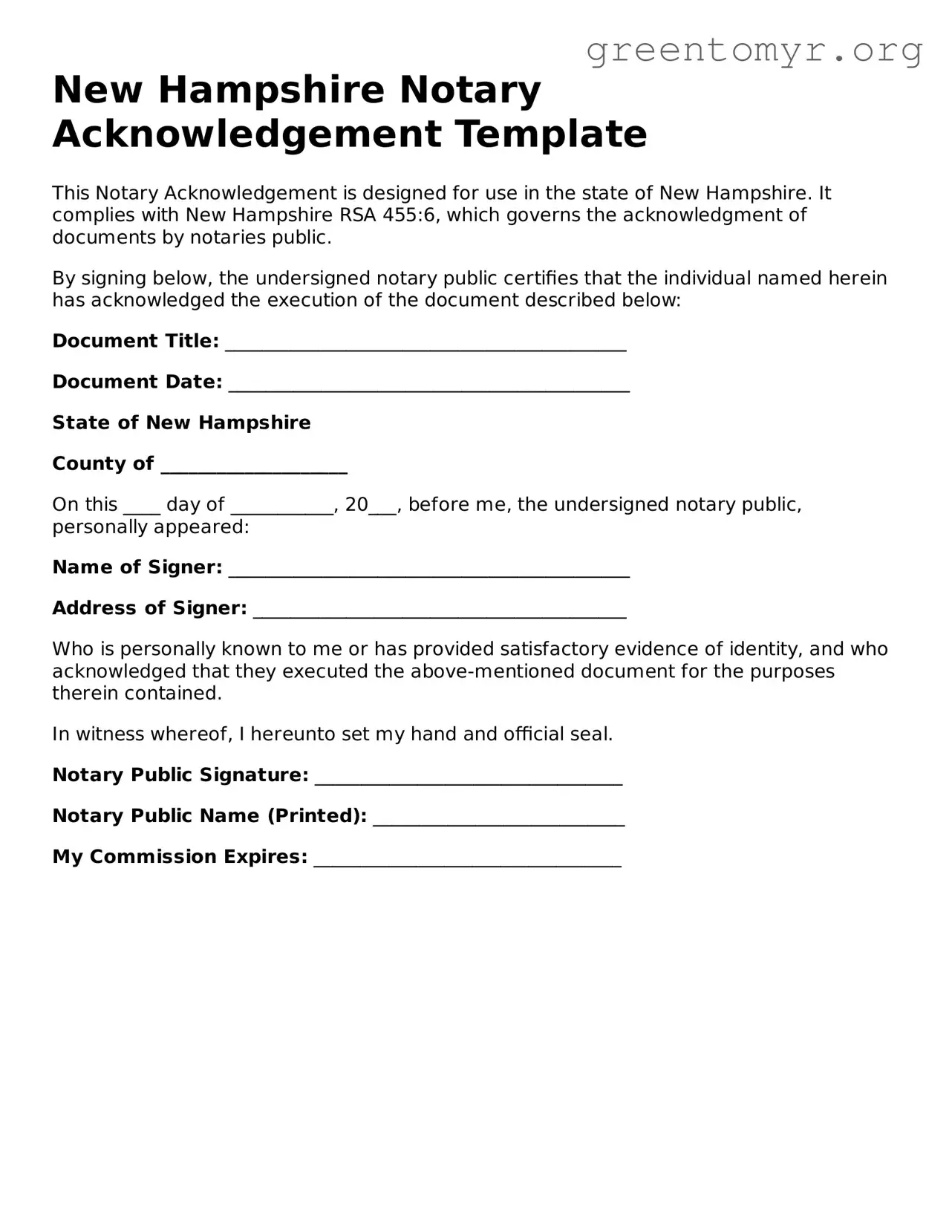
New Hampshire Notary Acknowledgement Template
This Notary Acknowledgement is designed for use in the state of New Hampshire. It complies with New Hampshire RSA 455:6, which governs the acknowledgment of documents by notaries public.
By signing below, the undersigned notary public certifies that the individual named herein has acknowledged the execution of the document described below:
Document Title: ___________________________________________
Document Date: ___________________________________________
State of New Hampshire
County of ____________________
On this ____ day of ___________, 20___, before me, the undersigned notary public, personally appeared:
Name of Signer: ___________________________________________
Address of Signer: ________________________________________
Who is personally known to me or has provided satisfactory evidence of identity, and who acknowledged that they executed the above-mentioned document for the purposes therein contained.
In witness whereof, I hereunto set my hand and official seal.
Notary Public Signature: _________________________________
Notary Public Name (Printed): ___________________________
My Commission Expires: _________________________________
| Fact Name | Details |
|---|---|
| Purpose | The New Hampshire Notary Acknowledgement form is used to verify the identity of the signer and confirm that they signed the document voluntarily. |
| Governing Law | This form is governed by New Hampshire Revised Statutes Annotated (RSA) 455-E. |
| Signature Requirement | The signer must appear in person before the notary public to acknowledge their signature. |
| Notary's Role | The notary public must complete the form by providing their signature, seal, and the date of notarization. |
| Document Types | This form can be used for various documents, including contracts, deeds, and affidavits. |
| Validity | The New Hampshire Notary Acknowledgement remains valid as long as it is properly completed and executed. |
Once you have the New Hampshire Notary Acknowledgement form in hand, it’s time to fill it out accurately. Completing this form correctly ensures that the document you are notarizing is recognized and valid. Follow the steps below to guide you through the process.
The New Hampshire Notary Acknowledgement form is a legal document used to confirm that a person has willingly signed a document in the presence of a notary public. This form serves as proof that the signature is authentic and that the signer is who they claim to be. It is commonly used for various legal documents, such as contracts, deeds, and affidavits.
You will need to use a Notary Acknowledgement form whenever a document requires notarization. This is often the case for documents that will be filed with a court or government agency. If you are signing a contract, a property deed, or any other important legal document, it’s a good idea to have it notarized to ensure its validity.
In New Hampshire, a notary public can be any individual who is at least 18 years old, a resident of the state, and has been appointed by the Governor. Notaries must also complete an application process and take an oath of office. Many notaries are also attorneys, but this is not a requirement.
The Notary Acknowledgement form typically requires the following information:
It’s important that all information is accurate to ensure the document's validity.
Yes, notaries in New Hampshire are allowed to charge a fee for their services. The maximum fee is set by state law and can vary depending on the type of service provided. Typically, the fee for a standard acknowledgment is around $10. Always confirm the fee with the notary before the service is rendered.
Generally, a Notary Acknowledgement form can be used for most types of documents that require notarization. However, some documents may have specific requirements or may require different types of notarization. It’s advisable to check the specific requirements for the document you are working with.
Finding a notary public in New Hampshire can be done through several avenues:
Make sure to verify that the notary is currently commissioned and in good standing.
When you go to meet a notary, it’s essential to bring the following:
Ensure that the document is complete and that you are prepared to sign it in the presence of the notary.
Filling out the New Hampshire Notary Acknowledgement form is a crucial step in ensuring that your documents are legally recognized. However, many individuals make mistakes that can lead to delays or even invalidation of their documents. Understanding these common errors can save you time and frustration.
One common mistake is failing to include the correct date. The date on the form must match the date when the notary is witnessing the signature. If you forget to update this, it can create confusion about when the document was executed. Always double-check the date before submitting your form.
Another frequent error involves the notary's signature and seal. Some people overlook the importance of ensuring that the notary's signature is legible and that their seal is affixed properly. An unclear signature or missing seal can render the acknowledgment ineffective. Make sure the notary has completed this section correctly.
Additionally, many individuals neglect to fill out the name of the person whose signature is being acknowledged. This section is vital for identifying who is signing the document. Omitting this information can lead to questions about the validity of the acknowledgment. Always confirm that the name is clearly written and matches the identification provided to the notary.
Lastly, some people forget to have the signatory present during the acknowledgment. The notary must witness the signature in real-time. If the signatory is not present, the acknowledgment cannot be completed. Ensure that all parties are available at the time of signing to avoid this pitfall.
By being aware of these common mistakes, you can navigate the process more smoothly. Take the time to review your form carefully and ensure that all required information is accurately provided. This diligence will help ensure that your documents are processed without unnecessary complications.
When engaging in legal transactions in New Hampshire, the Notary Acknowledgement form often plays a vital role. However, it is commonly used in conjunction with several other forms and documents that help ensure the legality and clarity of agreements. Below is a list of some frequently used documents alongside the Notary Acknowledgement form.
Understanding these documents and their purposes can significantly aid individuals in navigating legal processes in New Hampshire. Each document serves a specific function, and when used appropriately, they contribute to clearer and more enforceable agreements.
The Notary Acknowledgment form serves a specific purpose in verifying the identity of individuals signing documents. However, several other documents share similar functions. Below is a list of ten documents that are comparable to the Notary Acknowledgment form, along with explanations of how they relate.
Understanding these documents can help clarify the importance of notarization in various legal contexts. Each serves a unique purpose, yet they all share the common goal of ensuring authenticity and trust in the signing process.
When filling out the New Hampshire Notary Acknowledgment form, it's essential to approach the process with care. Here are ten important dos and don'ts to keep in mind.
By following these guidelines, you can ensure that the notarization process goes smoothly and complies with New Hampshire laws.
Understanding the New Hampshire Notary Acknowledgement form is essential for anyone involved in legal documents, yet several misconceptions can lead to confusion. Here are six common misunderstandings about this important form:
Awareness of these misconceptions is crucial for anyone engaging with notary services in New Hampshire. Proper understanding can prevent legal issues and ensure that documents are executed correctly.
When filling out and using the New Hampshire Notary Acknowledgement form, keep the following key takeaways in mind:
Following these guidelines will help ensure that the notary acknowledgment process is smooth and legally sound.