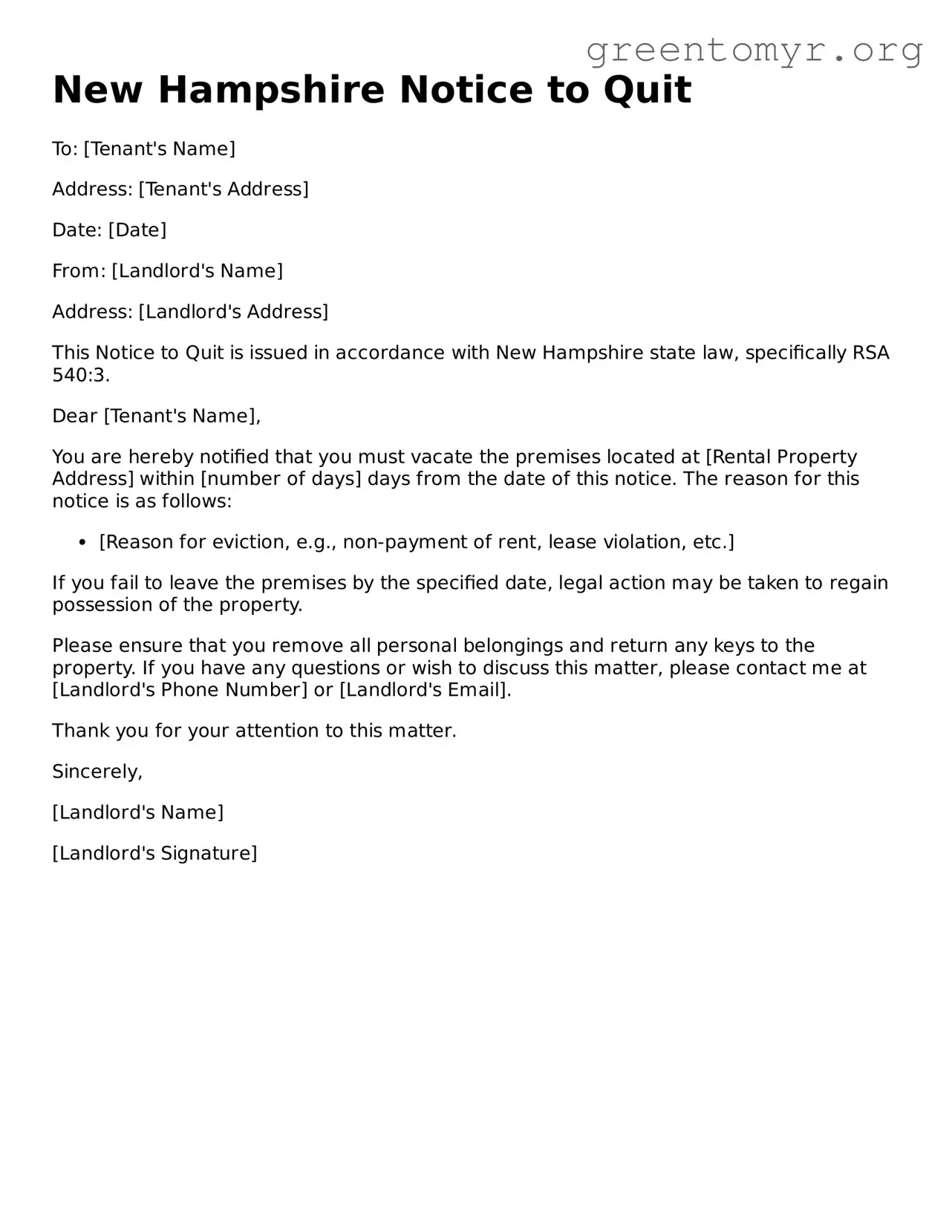
The New Hampshire Notice to Quit form is a crucial document in the landlord-tenant relationship, serving as a formal notification that a tenant must vacate a rental property. This form is typically used when a landlord seeks to terminate a tenancy, whether due to non-payment of rent, lease violations, or the expiration of a lease agreement. It outlines essential details, including the reason for termination, the date by which the tenant must leave, and any applicable state laws governing the eviction process. This notice must be delivered in accordance with New Hampshire law, ensuring that tenants receive adequate time to respond or remedy the situation. Understanding the requirements and implications of this form is vital for both landlords and tenants, as it sets the stage for potential legal proceedings and impacts the rights of both parties involved.
New Hampshire Notice to Quit
To: [Tenant's Name]
Address: [Tenant's Address]
Date: [Date]
From: [Landlord's Name]
Address: [Landlord's Address]
This Notice to Quit is issued in accordance with New Hampshire state law, specifically RSA 540:3.
Dear [Tenant's Name],
You are hereby notified that you must vacate the premises located at [Rental Property Address] within [number of days] days from the date of this notice. The reason for this notice is as follows:
If you fail to leave the premises by the specified date, legal action may be taken to regain possession of the property.
Please ensure that you remove all personal belongings and return any keys to the property. If you have any questions or wish to discuss this matter, please contact me at [Landlord's Phone Number] or [Landlord's Email].
Thank you for your attention to this matter.
Sincerely,
[Landlord's Name]
[Landlord's Signature]
| Fact Name | Details |
|---|---|
| Governing Law | The New Hampshire Notice to Quit form is governed by New Hampshire RSA 540. |
| Purpose | This form is used by landlords to terminate a tenancy and request that tenants vacate the property. |
| Notice Period | Typically, a landlord must provide at least 30 days' notice for month-to-month tenancies. |
| Delivery Methods | The notice can be delivered in person, by certified mail, or by leaving it at the tenant's residence. |
| Required Information | The form must include the landlord's name, tenant's name, property address, and the reason for termination. |
| Tenant's Rights | Tenants have the right to contest the notice in court if they believe it is unjustified. |
| Signature Requirement | The landlord must sign the Notice to Quit to validate it. |
| Legal Consequences | Failure to comply with the notice may lead to eviction proceedings. |
| Form Availability | The Notice to Quit form can be obtained from legal aid organizations or online legal resources. |
Once you have the New Hampshire Notice to Quit form in hand, it’s time to fill it out accurately. This form is an important step in the process of terminating a rental agreement. Make sure to have all necessary information handy as you complete each section.
After filling out the form, you will need to deliver it to the tenant. This can be done in person or by certified mail, ensuring you have proof of delivery. Keeping a copy for your records is essential for any future proceedings.
A Notice to Quit is a legal document that a landlord uses to inform a tenant that they must vacate the rental property. In New Hampshire, this notice is typically issued when a tenant has violated the terms of their lease or failed to pay rent. The document outlines the reasons for the eviction and provides a deadline by which the tenant must leave the property. It is an essential step in the eviction process, as it formally notifies the tenant of the landlord's intentions.
The time frame for a tenant to respond to a Notice to Quit in New Hampshire depends on the reason for the notice. Generally, tenants have the following time frames:
It is crucial for tenants to act quickly upon receiving a Notice to Quit, as failure to do so can lead to legal action and potential eviction.
A well-prepared Notice to Quit should include the following information:
Providing clear and complete information helps ensure that the notice is legally valid and minimizes confusion for the tenant.
Yes, a tenant has the right to contest a Notice to Quit. If a tenant believes the notice is unjust or the eviction is unwarranted, they can respond by communicating with the landlord or seeking legal advice. If the matter escalates, the tenant can file a response in court during the eviction proceedings. It's important for tenants to gather evidence and document their communications to support their case effectively.
If a tenant does not comply with a Notice to Quit, the landlord may proceed with legal action to initiate eviction. This typically involves filing a complaint in the local court. The court will then schedule a hearing where both the landlord and tenant can present their cases. If the court rules in favor of the landlord, the tenant may be ordered to vacate the property, and a law enforcement officer may be authorized to assist in the eviction process.
Filling out the New Hampshire Notice to Quit form can be a straightforward process, but many individuals make common mistakes that can lead to complications. One frequent error is failing to include the correct date. The Notice to Quit must specify the date when the tenant is expected to vacate the property. Without this crucial detail, the notice may be deemed invalid, causing delays in the eviction process.
Another common mistake involves incorrect tenant information. It's vital to ensure that the tenant's name is spelled correctly and that the address of the rental property is accurate. Any discrepancies can create confusion and may even lead to legal challenges. Double-checking these details can save time and prevent future issues.
Many people also overlook the importance of including the reason for the eviction. While New Hampshire law does not always require a reason, providing one can strengthen your case. A vague or missing explanation can lead to misunderstandings and complicate the eviction process.
Some individuals fail to sign the Notice to Quit. A signature is essential, as it signifies the sender's intent to proceed with the eviction. Without a signature, the notice may be considered incomplete, and the tenant may not take it seriously, delaying the process further.
Another mistake often made is not providing the tenant with proper delivery of the notice. The law requires that the Notice to Quit be delivered in specific ways, such as by certified mail or personal delivery. If the notice is not delivered correctly, it may not be legally enforceable, allowing the tenant to remain in the property longer than intended.
Lastly, individuals sometimes neglect to keep a copy of the Notice to Quit for their records. This oversight can be detrimental, especially if disputes arise later. Having a copy ensures that you have proof of the notice and can reference it if needed during any legal proceedings.
When dealing with rental agreements and tenant evictions in New Hampshire, several important documents often accompany the Notice to Quit form. These documents help clarify the rights and responsibilities of both landlords and tenants throughout the process. Understanding these forms can aid in ensuring compliance with state laws and maintaining a clear record of communications.
Utilizing these documents alongside the Notice to Quit can help streamline the eviction process and ensure that all parties are aware of their rights and obligations. Keeping thorough records is essential for both landlords and tenants to navigate any disputes that may arise effectively.
When filling out the New Hampshire Notice to Quit form, it is important to follow certain guidelines to ensure that the process goes smoothly. Here’s a list of things you should and shouldn’t do:
Understanding the New Hampshire Notice to Quit form is essential for both landlords and tenants. Unfortunately, several misconceptions can lead to confusion and missteps. Here are seven common misunderstandings about this important document:
The Notice to Quit form is specifically designed for non-payment of rent or lease violations. It cannot be used for other reasons, such as personal disputes or property damage.
Even with a Notice to Quit, landlords must follow legal procedures. They cannot simply change the locks or remove tenants without going through the proper channels.
While tenants may feel overwhelmed, it is crucial to respond to the Notice to Quit. Ignoring it can lead to further legal complications.
While personal delivery is one option, the Notice to Quit can also be sent via certified mail. This provides a record of delivery, which is important for legal purposes.
Tenants can also issue a Notice to Quit if a landlord fails to uphold their end of the lease agreement. This can be a powerful tool for tenants seeking resolution.
The Notice to Quit is just the beginning. It is part of a larger legal process that may involve court hearings and further documentation.
Notices can vary based on the specific circumstances and the type of lease agreement. It’s important to use the correct form that aligns with the situation.
By dispelling these misconceptions, both landlords and tenants can navigate the eviction process more effectively and with greater understanding. Knowledge is a powerful tool in these situations.
Filling out and using the New Hampshire Notice to Quit form is an important step in the eviction process. Here are some key takeaways to consider:
Understanding these points can help both landlords and tenants navigate the eviction process more effectively.