When forming a Limited Liability Company (LLC) in New Hampshire, one of the most crucial steps is to create an Operating Agreement. This document serves as the backbone of your LLC, outlining the management structure and operational guidelines. It defines the roles and responsibilities of members, clarifies how profits and losses will be distributed, and establishes the procedures for making important decisions. Additionally, the Operating Agreement addresses how new members can join and how existing members can exit the company. By having a well-drafted Operating Agreement, you not only protect your business interests but also ensure that all members are on the same page, reducing the risk of disputes down the line. Whether you are a sole member or part of a larger group, this agreement is essential for maintaining clarity and stability within your LLC.
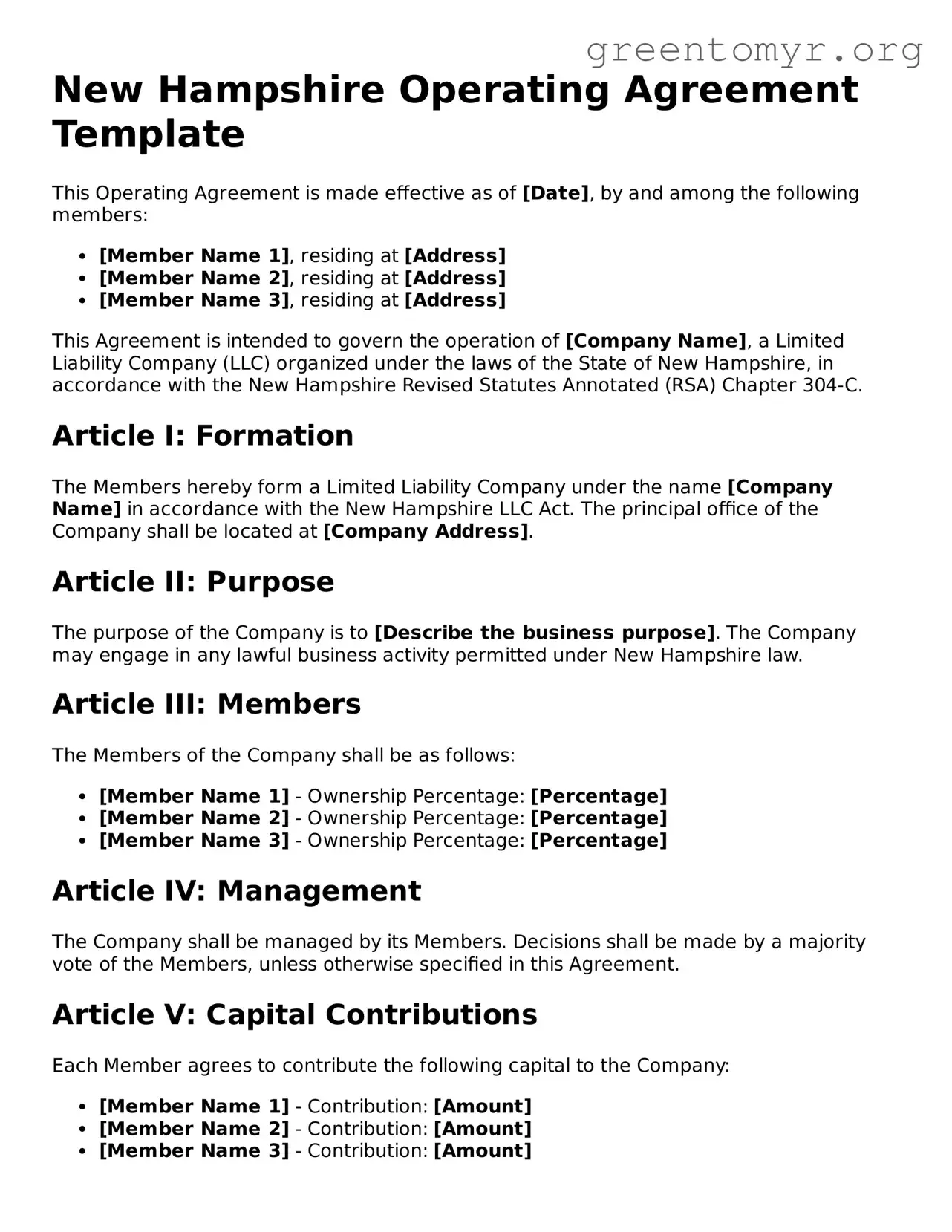
New Hampshire Operating Agreement Template
This Operating Agreement is made effective as of [Date], by and among the following members:
This Agreement is intended to govern the operation of [Company Name], a Limited Liability Company (LLC) organized under the laws of the State of New Hampshire, in accordance with the New Hampshire Revised Statutes Annotated (RSA) Chapter 304-C.
Article I: Formation
The Members hereby form a Limited Liability Company under the name [Company Name] in accordance with the New Hampshire LLC Act. The principal office of the Company shall be located at [Company Address].
Article II: Purpose
The purpose of the Company is to [Describe the business purpose]. The Company may engage in any lawful business activity permitted under New Hampshire law.
Article III: Members
The Members of the Company shall be as follows:
Article IV: Management
The Company shall be managed by its Members. Decisions shall be made by a majority vote of the Members, unless otherwise specified in this Agreement.
Article V: Capital Contributions
Each Member agrees to contribute the following capital to the Company:
Article VI: Distributions
Distributions of profits and losses shall be allocated to the Members in proportion to their respective ownership percentages, unless otherwise agreed in writing.
Article VII: Indemnification
The Company shall indemnify its Members to the fullest extent permitted by New Hampshire law against any losses, liabilities, or expenses incurred in connection with the Company.
Article VIII: Amendments
This Operating Agreement may be amended only by a written agreement signed by all Members.
Article IX: Governing Law
This Agreement shall be governed by and construed in accordance with the laws of the State of New Hampshire.
IN WITNESS WHEREOF, the Members have executed this Operating Agreement as of the date first above written.
_____________________________
[Member Name 1]
_____________________________
[Member Name 2]
_____________________________
[Member Name 3]
| Fact Name | Description |
|---|---|
| Purpose | The New Hampshire Operating Agreement outlines the management structure and operational guidelines for a limited liability company (LLC). |
| Governing Law | This agreement is governed by New Hampshire Revised Statutes Annotated, Chapter 304-C. |
| Flexibility | Members of the LLC can customize the agreement to suit their specific needs and preferences. |
| Required Information | Essential details include the LLC name, principal office address, and member information. |
| Member Roles | The agreement specifies the roles and responsibilities of each member, ensuring clarity in operations. |
| Dispute Resolution | It often includes provisions for resolving disputes among members, promoting a cooperative business environment. |
Completing the New Hampshire Operating Agreement form is essential for establishing the structure and management of your business. Follow these steps carefully to ensure that all necessary information is accurately provided.
After completing the form, it is advisable to keep a copy for your records. You may also want to consult with a legal professional to ensure compliance with all applicable laws and regulations.
An Operating Agreement is a document that outlines the management structure and operating procedures of a Limited Liability Company (LLC) in New Hampshire. It serves as a guide for how the LLC will be run, detailing the rights and responsibilities of its members. While not required by law, having an Operating Agreement is highly recommended for clarity and protection of all members involved.
Creating an Operating Agreement is beneficial for several reasons:
A comprehensive Operating Agreement typically includes:
No, New Hampshire does not legally require LLCs to have an Operating Agreement. However, having one is strongly recommended. It helps prevent misunderstandings and provides a clear framework for the operation of the business.
Creating an Operating Agreement can be straightforward. Here are the steps you can follow:
Yes, you can change your Operating Agreement. It’s common for businesses to update their agreements as they grow or as circumstances change. The process for making amendments should be outlined in the original Operating Agreement. Typically, all members must agree to any changes.
It's important to keep your Operating Agreement in a safe place. Store it with other important business documents, such as your Articles of Organization and tax records. Additionally, ensure that all members have access to a copy for reference.
Filling out the New Hampshire Operating Agreement form can be a straightforward task, but many people make common mistakes that can lead to complications down the line. One frequent error is leaving out the names of the members. Each member’s name should be clearly stated to avoid confusion about who is involved in the agreement.
Another mistake is not specifying the purpose of the business. The Operating Agreement should outline what the business does. This clarity helps in understanding the scope of operations and can be crucial for legal and tax purposes.
Some individuals forget to include the percentage of ownership for each member. This detail is vital, as it determines profit sharing and decision-making power within the company. Omitting this information can lead to disputes later.
Additionally, people often neglect to outline the management structure. Whether the business will be member-managed or manager-managed should be clearly defined. This helps establish who is responsible for daily operations and decision-making.
Another common oversight is failing to address how new members can be added. The Operating Agreement should include a process for admitting new members. Without this, the business may face difficulties when trying to expand.
Some individuals also forget to include provisions for member exit strategies. It's important to outline what happens if a member wants to leave the business. This can prevent misunderstandings and protect the interests of remaining members.
Another mistake is not specifying how profits and losses will be distributed. Clear guidelines on financial distributions help ensure fairness and transparency among members.
People sometimes overlook the need for signatures. An Operating Agreement is not valid without the signatures of all members. This step confirms that everyone agrees to the terms laid out in the document.
Finally, many individuals fail to keep the Operating Agreement updated. As the business evolves, changes may be necessary. Regularly reviewing and amending the agreement ensures it remains relevant and effective.
By avoiding these common mistakes, individuals can create a solid Operating Agreement that supports their business goals and fosters cooperation among members.
The New Hampshire Operating Agreement is an essential document for LLCs, outlining the management structure and operational guidelines. However, several other forms and documents often accompany it to ensure compliance and clarity in business operations. Below is a list of these important documents.
These documents work together to establish a solid foundation for the LLC. Properly managing and maintaining these forms can help ensure smooth operations and compliance with state regulations.
When filling out the New Hampshire Operating Agreement form, it is essential to approach the process with care. Here are some key dos and don’ts to guide you:
When it comes to the New Hampshire Operating Agreement form, many people hold misconceptions that can lead to confusion or improper usage. Here’s a list of ten common misunderstandings:
Many believe that an Operating Agreement is only needed for multi-member LLCs. However, even a single-member LLC benefits from having one, as it outlines the owner’s rights and responsibilities.
Some think that the Operating Agreement needs to be submitted to the New Hampshire Secretary of State. In reality, it is an internal document that does not require state filing.
While verbal agreements may seem convenient, an Operating Agreement should be written down. A written document provides clarity and serves as a reference in case of disputes.
This misconception leads many small business owners to overlook the importance of an Operating Agreement. Regardless of size, every LLC can benefit from having clear guidelines.
Some believe that once an Operating Agreement is signed, it cannot be modified. In fact, it can be amended as needed, provided all members agree to the changes.
Many think that a generic template will suffice. However, an Operating Agreement should be tailored to fit the specific needs and goals of the LLC and its members.
While financial arrangements are important, an Operating Agreement also addresses governance, member roles, and procedures for decision-making, among other aspects.
Some may believe that an Operating Agreement holds no legal weight. In reality, it is a binding contract among members, enforceable in court.
Though it’s ideal for all members to sign, the agreement can still be valid even if not every member has signed, provided it reflects the understanding of the members involved.
Existing LLCs can also benefit from an Operating Agreement. It can help clarify roles and responsibilities, even if the business has been operating for some time.
Understanding these misconceptions can help ensure that your LLC operates smoothly and in compliance with New Hampshire laws. Having a clear and well-structured Operating Agreement can save time and reduce conflicts down the road.
When filling out and utilizing the New Hampshire Operating Agreement form, it is essential to consider the following key takeaways:
By paying attention to these elements, members can create a comprehensive and effective Operating Agreement that serves the best interests of the business.