Content Navigation

The New Hampshire Power of Attorney form is a crucial legal document that allows individuals to appoint someone they trust to make decisions on their behalf. This form can cover a range of responsibilities, from managing financial matters to making healthcare decisions, depending on how it is structured. It grants the appointed agent, also known as an attorney-in-fact, the authority to act in the principal's best interest, ensuring that their wishes are respected even when they cannot communicate them directly. The form must be completed with specific details, including the names of the principal and agent, the scope of authority, and any limitations on that authority. Additionally, it requires the signatures of both parties and a witness or notary public to validate the document. Understanding the nuances of this form is essential for anyone looking to secure their future and ensure that their affairs are handled according to their preferences.

New Hampshire Power of Attorney Example

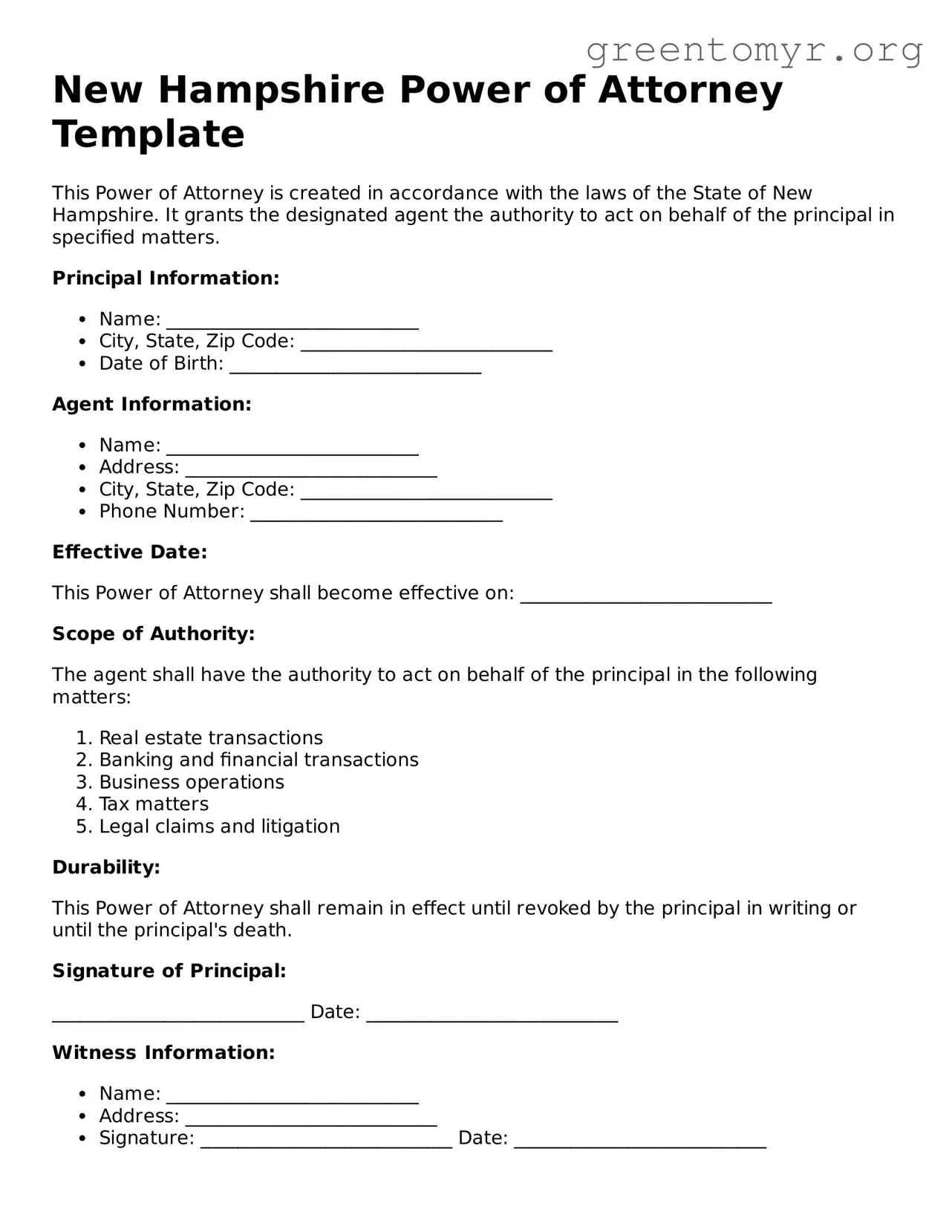
New Hampshire Power of Attorney Template

This Power of Attorney is created in accordance with the laws of the State of New Hampshire. It grants the designated agent the authority to act on behalf of the principal in specified matters.

Principal Information:

  • Name: ___________________________
  • City, State, Zip Code: ___________________________
  • Date of Birth: ___________________________

Agent Information:

  • Name: ___________________________
  • Address: ___________________________
  • City, State, Zip Code: ___________________________
  • Phone Number: ___________________________

Effective Date:

This Power of Attorney shall become effective on: ___________________________

Scope of Authority:

The agent shall have the authority to act on behalf of the principal in the following matters:

  1. Real estate transactions
  2. Banking and financial transactions
  3. Business operations
  4. Tax matters
  5. Legal claims and litigation

Durability:

This Power of Attorney shall remain in effect until revoked by the principal in writing or until the principal's death.

Signature of Principal:

___________________________ Date: ___________________________

Witness Information:

  • Name: ___________________________
  • Address: ___________________________
  • Signature: ___________________________ Date: ___________________________

Notary Public:

State of New Hampshire

County of ___________________________

Subscribed and sworn before me this _____ day of ______________, 20__.

_____________________________ Notary Public

My commission expires: ___________________________

PDF Form Features

Fact Name Description
Governing Law The New Hampshire Power of Attorney form is governed by New Hampshire Revised Statutes Annotated (RSA) 506:6-506:14.
Durability This form can be made durable, meaning it remains effective even if the principal becomes incapacitated.
Agent Authority The agent can be granted broad powers, including managing finances, real estate transactions, and making healthcare decisions.
Signature Requirements The form must be signed by the principal and acknowledged before a notary public or witnessed by two individuals.

Guide to Using New Hampshire Power of Attorney

Completing the New Hampshire Power of Attorney form is an essential step in designating someone to manage your affairs. Follow these steps carefully to ensure accuracy and compliance.

  1. Obtain the form: Download the New Hampshire Power of Attorney form from a reliable source or obtain a physical copy from a legal office.
  2. Read the instructions: Familiarize yourself with the form and its sections before filling it out.
  3. Fill in your details: Provide your full name, address, and contact information in the designated areas.
  4. Select your agent: Clearly write the name and address of the person you are appointing as your agent. Ensure they are willing to accept this responsibility.
  5. Specify powers: Indicate the specific powers you wish to grant to your agent. Be as detailed as necessary to avoid confusion.
  6. Set an expiration date: If applicable, specify when the powers will end. If no date is provided, the powers remain in effect until revoked.
  7. Sign the document: Sign and date the form in the presence of a notary public. This step is crucial for the form’s validity.
  8. Notarization: Have the notary public witness your signature and complete their section on the form.
  9. Distribute copies: Provide copies of the completed form to your agent, any relevant institutions, and keep a copy for your records.

Get Answers on New Hampshire Power of Attorney

What is a Power of Attorney in New Hampshire?

A Power of Attorney (POA) is a legal document that allows one person, known as the principal, to give another person, called the agent or attorney-in-fact, the authority to make decisions on their behalf. This can include financial decisions, medical decisions, or other specific tasks. In New Hampshire, a POA can be tailored to meet the specific needs of the principal, whether for a limited time or for ongoing authority.

Why might I need a Power of Attorney?

Having a Power of Attorney can be crucial for several reasons:

  • If you become incapacitated and cannot make decisions for yourself, your agent can step in and manage your affairs.
  • A POA can help streamline processes, such as handling financial transactions or making medical decisions, especially if you are unavailable.
  • It allows you to choose someone you trust to act in your best interest, rather than leaving those decisions to a court or the state.

What types of Power of Attorney are available in New Hampshire?

New Hampshire recognizes several types of Power of Attorney, including:

  1. General Power of Attorney: This grants broad authority to the agent to act on behalf of the principal in a variety of matters.
  2. Limited Power of Attorney: This allows the agent to act only in specific situations, such as selling a property or managing a bank account.
  3. Durable Power of Attorney: This remains effective even if the principal becomes incapacitated, ensuring that the agent can continue to make decisions.
  4. Healthcare Power of Attorney: This specifically gives the agent authority to make medical decisions for the principal if they are unable to do so.

How do I create a Power of Attorney in New Hampshire?

Creating a Power of Attorney in New Hampshire involves several steps:

  1. Choose your agent carefully. This should be someone you trust completely.
  2. Decide what powers you want to grant. Be specific about the authority you are giving.
  3. Complete the Power of Attorney form. You can find templates online or consult with a legal professional.
  4. Sign the document in the presence of a notary public. This is an important step to ensure the document is legally binding.
  5. Provide copies of the signed document to your agent and any institutions that may need it, such as banks or healthcare providers.

Can I revoke a Power of Attorney in New Hampshire?

Yes, you can revoke a Power of Attorney at any time, as long as you are mentally competent. To do this, you should create a written revocation document that states your intent to cancel the POA. It’s important to notify your agent and any institutions that have a copy of the original Power of Attorney to prevent any confusion or misuse.

What happens if I don’t have a Power of Attorney?

If you do not have a Power of Attorney and become incapacitated, your family may need to go through the court system to obtain guardianship or conservatorship. This process can be time-consuming, costly, and may not result in the outcome you desire. By establishing a POA in advance, you ensure that your wishes are respected and that someone you trust can make decisions on your behalf.

Common mistakes

Filling out the New Hampshire Power of Attorney form can be straightforward, but mistakes often occur. One common error is failing to specify the powers granted. Without clear instructions, the agent may not have the authority needed to act on behalf of the principal. It's essential to list all necessary powers explicitly to avoid confusion later.

Another mistake is not signing the document in front of a notary public. New Hampshire law requires that the Power of Attorney be notarized to be valid. Skipping this step can render the document useless, leaving the principal without the intended protections.

People often overlook the importance of including a date on the form. A missing date can lead to questions about when the powers were granted, potentially complicating matters in the future. Always ensure that the date is clearly marked to establish a timeline.

Some individuals mistakenly think that a Power of Attorney remains effective indefinitely. In reality, it can be revoked at any time by the principal, provided they are mentally competent. It's crucial to understand the conditions under which the document can be changed or canceled.

Another frequent error is failing to inform the agent about their responsibilities. The principal should have a conversation with the agent to clarify expectations and duties. Without this communication, the agent may not fully understand their role, leading to potential issues.

People sometimes neglect to consider successor agents. If the primary agent is unable or unwilling to serve, having a backup can prevent complications. It’s wise to name a successor agent in the document to ensure continuity.

Additionally, individuals may not review the form for accuracy before submitting it. Simple typos or incorrect information can cause significant problems. Taking the time to double-check the details can save a lot of trouble later on.

Another mistake is using outdated forms. Laws can change, and using an old version may not comply with current requirements. Always ensure that the most recent version of the Power of Attorney form is being used.

Lastly, many people fail to distribute copies of the signed document to relevant parties. Without copies, agents may struggle to prove their authority when needed. Distributing copies to banks, healthcare providers, and family members can help ensure that the agent can act when necessary.

Documents used along the form

When creating a Power of Attorney in New Hampshire, several other documents may be beneficial for comprehensive planning. Each of these documents serves a unique purpose, ensuring that your wishes are respected and your affairs are managed effectively.

  • Durable Power of Attorney: This document allows you to designate someone to handle your financial matters even if you become incapacitated.
  • Advance Healthcare Directive: This outlines your healthcare preferences and appoints someone to make medical decisions on your behalf if you are unable to do so.
  • Living Will: A specific type of advance directive that details your wishes regarding end-of-life care and treatments.
  • Last Will and Testament: This document specifies how your assets will be distributed after your death and can appoint guardians for minor children.
  • HIPAA Release Form: This allows designated individuals to access your medical records and health information, ensuring they can make informed decisions.
  • Trust Agreement: A legal arrangement that allows you to place your assets in a trust for management by a trustee, which can help avoid probate.
  • Property Deed: This document transfers ownership of real estate and can be important for managing property assets.
  • Financial Power of Attorney: Similar to a general Power of Attorney but specifically focuses on financial matters, allowing your agent to manage your finances directly.

Understanding these documents can help you create a robust plan for your future. Each serves a vital role in ensuring that your wishes are honored and your affairs are handled according to your preferences.

Similar forms

  • Living Will: This document outlines your wishes regarding medical treatment in case you become unable to communicate. Like a Power of Attorney, it allows someone to make decisions on your behalf, specifically about healthcare.
  • Healthcare Proxy: Similar to a Power of Attorney, a healthcare proxy designates someone to make medical decisions for you if you cannot. Both documents empower another person to act in your best interest.
  • Durable Power of Attorney: This is a type of Power of Attorney that remains effective even if you become incapacitated. It ensures that your designated agent can continue to act on your behalf when you need it most.
  • Financial Power of Attorney: This document specifically grants authority to manage your financial affairs. Like a general Power of Attorney, it allows someone to handle your financial decisions, but it focuses solely on monetary matters.
  • Trust: A trust allows a person to manage assets for the benefit of another. While a Power of Attorney grants decision-making authority, a trust involves the management of property and finances for a beneficiary.
  • Guardianship Documents: These documents appoint someone to make decisions for a minor or incapacitated adult. Both a guardianship and a Power of Attorney involve delegating authority to someone else for decision-making.
  • Advance Directive: This is a broader term that includes both living wills and healthcare proxies. It provides guidance on your medical care preferences and designates someone to make decisions, similar to a Power of Attorney.
  • Bill of Sale: While primarily used for transferring ownership of property, a Bill of Sale can authorize someone to act on your behalf in a specific transaction, akin to a Power of Attorney in limited contexts.
  • Release of Information Form: This document allows someone to access your personal information, similar to how a Power of Attorney enables another person to act in your interests. Both involve sharing authority and information.
  • Employment Authorization: This document grants someone the right to act on your behalf in employment matters. Like a Power of Attorney, it allows another person to make decisions that affect your professional life.

Dos and Don'ts

When filling out the New Hampshire Power of Attorney form, it's important to follow specific guidelines to ensure that the document is valid and meets your needs. Here’s a list of things you should and shouldn't do:

  • Do clearly identify the principal (the person granting authority) and the agent (the person receiving authority).
  • Don't leave any sections blank. Incomplete forms may lead to confusion or invalidation.
  • Do specify the powers you want to grant. Be as detailed as possible.
  • Don't use vague language. Clear terms help prevent misunderstandings.
  • Do sign the document in front of a notary public. This adds an extra layer of legitimacy.
  • Don't forget to date the form. An undated document may be questioned later.
  • Do keep copies of the signed form for your records and provide copies to your agent.
  • Don't assume that verbal agreements are enough. Always document your intentions in writing.
  • Do review the form periodically, especially if your circumstances change.
  • Don't overlook the importance of choosing a trustworthy agent. This person will have significant control over your affairs.

Misconceptions

Many people have misunderstandings about the New Hampshire Power of Attorney form. Here are six common misconceptions:

  • It only works when someone is incapacitated. Many believe a Power of Attorney is only useful when a person can no longer make decisions for themselves. In reality, it can be effective as soon as it is signed, allowing someone to manage your affairs even if you are still capable of doing so.
  • It is only for financial matters. While many use a Power of Attorney for financial decisions, it can also cover healthcare decisions. A separate healthcare Power of Attorney can specify who makes medical choices on your behalf if you cannot.
  • Once created, it cannot be changed. Some think that a Power of Attorney is permanent and cannot be modified. In fact, you can revoke or update it at any time, as long as you are mentally competent.
  • It grants unlimited power. A Power of Attorney does not give the agent unlimited authority. The document can specify what powers are granted, such as managing bank accounts or selling property, and can limit the scope of those powers.
  • It is only for the elderly. Many associate Power of Attorney documents with older adults. However, anyone can benefit from having one, especially if they anticipate being unavailable for decision-making, such as during travel or military service.
  • It is too complicated to create. Some people believe that setting up a Power of Attorney is a complex process. In reality, it can often be straightforward. Many resources and templates are available to help guide individuals through the process.

Key takeaways

When filling out and using the New Hampshire Power of Attorney form, keep the following key takeaways in mind:

  • Understand the Purpose: A Power of Attorney allows you to designate someone to make decisions on your behalf, particularly in financial or legal matters.
  • Choose Your Agent Wisely: Select someone you trust completely, as they will have significant authority over your affairs.
  • Specify Powers Clearly: Clearly outline the powers you are granting to your agent to avoid any confusion in the future.
  • Revocation is Possible: You can revoke the Power of Attorney at any time, as long as you are mentally competent to do so.

These points are crucial for ensuring that your wishes are respected and that your affairs are managed properly.