In the realm of marital planning, the New Hampshire Prenuptial Agreement form stands as a crucial tool for couples seeking to define their financial and personal rights before entering into marriage. This legally binding document outlines the distribution of assets, debts, and responsibilities, providing clarity and security for both parties. Couples can stipulate how property acquired during the marriage will be handled, as well as how to manage financial obligations should the relationship dissolve. Additionally, the form allows for the inclusion of provisions regarding spousal support, ensuring that both individuals understand their rights and obligations. By addressing potential conflicts before they arise, this agreement can help foster open communication and trust between partners, ultimately contributing to a healthier marital dynamic. Understanding the nuances of this form is essential for anyone considering marriage in New Hampshire, as it not only protects individual interests but also lays the groundwork for a more harmonious partnership.
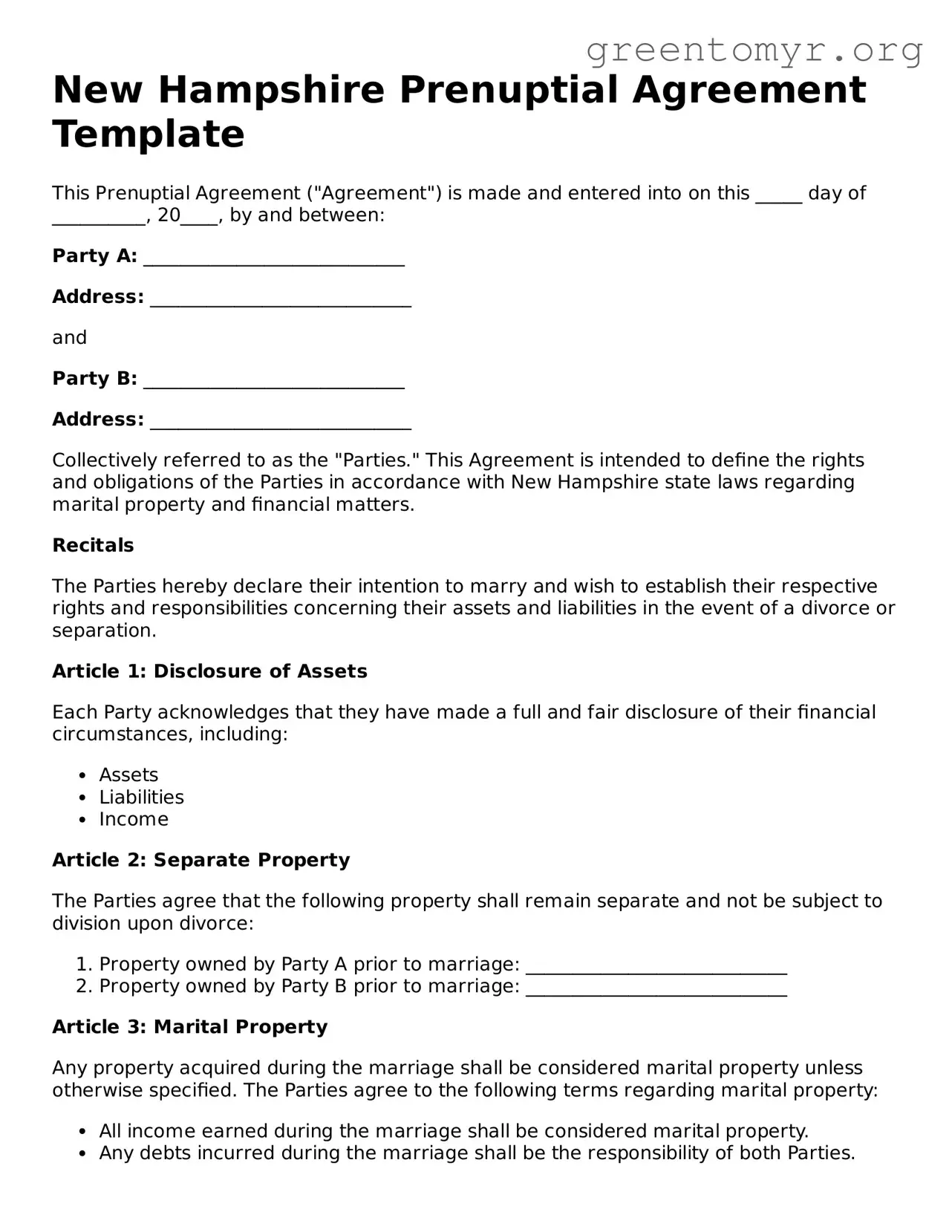
New Hampshire Prenuptial Agreement Template
This Prenuptial Agreement ("Agreement") is made and entered into on this _____ day of __________, 20____, by and between:
Party A: ____________________________
Address: ____________________________
and
Party B: ____________________________
Address: ____________________________
Collectively referred to as the "Parties." This Agreement is intended to define the rights and obligations of the Parties in accordance with New Hampshire state laws regarding marital property and financial matters.
Recitals
The Parties hereby declare their intention to marry and wish to establish their respective rights and responsibilities concerning their assets and liabilities in the event of a divorce or separation.
Article 1: Disclosure of Assets
Each Party acknowledges that they have made a full and fair disclosure of their financial circumstances, including:
Article 2: Separate Property
The Parties agree that the following property shall remain separate and not be subject to division upon divorce:
Article 3: Marital Property
Any property acquired during the marriage shall be considered marital property unless otherwise specified. The Parties agree to the following terms regarding marital property:
Article 4: Spousal Support
In the event of a divorce, the Parties agree to the following regarding spousal support:
Article 5: Amendments
This Agreement may only be amended or modified in writing and signed by both Parties.
Article 6: Governing Law
This Agreement shall be governed by and construed in accordance with the laws of the State of New Hampshire.
Signatures
IN WITNESS WHEREOF, the Parties have executed this Prenuptial Agreement as of the date first above written.
Party A Signature: ____________________________
Date: ____________________________
Party B Signature: ____________________________
Date: ____________________________
Witness Signature: ____________________________
Date: ____________________________
| Fact Name | Description |
|---|---|
| Definition | A prenuptial agreement is a contract entered into by two individuals before marriage, outlining the division of assets and responsibilities in the event of divorce or separation. |
| Governing Law | New Hampshire law governs prenuptial agreements, specifically under RSA 458:16-a. |
| Requirements | For a prenuptial agreement to be enforceable in New Hampshire, it must be in writing and signed by both parties. |
| Disclosure | Full financial disclosure by both parties is essential. This ensures that both individuals understand what they are agreeing to. |
| Fairness | The agreement should be fair and reasonable at the time of signing. Courts may not enforce agreements deemed unconscionable. |
| Modification | Prenuptial agreements can be modified after marriage, but any changes must also be in writing and signed by both parties. |
Filling out a prenuptial agreement form is an important step for couples considering marriage. This document outlines how assets and debts will be handled in the event of a divorce or separation. Properly completing the form ensures that both parties are on the same page regarding their financial expectations.
A prenuptial agreement, often referred to as a "prenup," is a legal contract between two individuals before they get married. In New Hampshire, this agreement outlines the division of assets and financial responsibilities in the event of divorce or separation. It can also address issues such as spousal support and the handling of debts.
For a prenuptial agreement to be valid in New Hampshire, it must meet several criteria:
Yes, a prenuptial agreement can be modified after marriage. Both parties must agree to the changes, and the modifications should be documented in writing and signed by both individuals. It is advisable to consult with legal counsel to ensure that the new terms are enforceable.
If a prenuptial agreement is challenged, the court will review the circumstances under which it was created. Factors such as coercion, lack of understanding, or unfairness can lead to a court invalidating the agreement. The burden of proof lies with the party challenging the agreement to demonstrate that it should not be enforced.
Yes, certain topics cannot be included in a prenuptial agreement. For example, agreements regarding child custody or child support are generally not enforceable, as courts prioritize the best interests of the child. Additionally, any illegal provisions will not be upheld in court.
To enhance the enforceability of a prenuptial agreement, individuals should:
Filling out a prenuptial agreement form can be a daunting task, and it’s easy to make mistakes along the way. One common error is not fully understanding the purpose of the agreement. A prenuptial agreement isn’t just a safety net; it’s a way to clarify expectations and protect both parties’ interests. Without a clear understanding, individuals might overlook important details.
Another mistake often made is failing to disclose all assets and liabilities. Transparency is crucial in a prenuptial agreement. If one party hides assets or doesn’t fully disclose debts, it could lead to disputes later on. It’s essential to provide a complete picture of financial circumstances to ensure fairness.
People sometimes rush through the process without seeking legal advice. While it may seem straightforward, having a legal professional review the agreement can help identify potential issues. They can offer insights that might not be obvious to someone unfamiliar with the law.
In addition, using vague language is a frequent pitfall. Clear, precise terms help avoid misunderstandings. If the language is ambiguous, it could lead to different interpretations down the line, which can complicate matters if the agreement is ever enforced.
Another common mistake is not considering future changes. Life is unpredictable, and circumstances can change dramatically over time. It’s wise to include provisions that account for potential changes in income, career paths, or family dynamics.
People often forget to address spousal support in their agreements. This can be a crucial aspect of any prenuptial agreement. By discussing and outlining expectations regarding spousal support, both parties can avoid confusion and potential conflict in the future.
Additionally, failing to have the agreement signed in front of witnesses or a notary can invalidate it. Proper execution is essential for the agreement to be legally binding. Make sure to follow the required steps to ensure that the document holds up in court.
Another mistake is not reviewing the agreement periodically. Life changes, and so should your prenuptial agreement. Regular reviews allow couples to adjust the terms as needed, ensuring that the agreement remains relevant and fair.
Lastly, some individuals underestimate the emotional aspect of a prenuptial agreement. Open communication about finances and expectations can be challenging but is vital for a healthy relationship. Ignoring this aspect can lead to resentment or misunderstandings.
By being aware of these common mistakes, individuals can approach the prenuptial agreement process with confidence. Taking the time to understand, communicate, and seek advice can make a significant difference in creating a fair and effective agreement.
A prenuptial agreement is an important document for couples considering marriage. It outlines the division of assets and responsibilities should the marriage end. Alongside this agreement, there are several other forms and documents that may be beneficial to consider. Here are four commonly used documents that often accompany a New Hampshire Prenuptial Agreement:
Considering these documents can provide clarity and protection for both individuals in a marriage. Each serves a unique purpose and can help facilitate smoother transitions during significant life changes.
When filling out the New Hampshire Prenuptial Agreement form, it is crucial to approach the process with care. Here are important dos and don'ts to consider:
Understanding prenuptial agreements in New Hampshire can be challenging due to common misconceptions. Here are six of those misconceptions explained:
This is not true. Anyone can benefit from a prenuptial agreement, regardless of their financial situation. It helps clarify financial rights and responsibilities.
In New Hampshire, prenuptial agreements are generally enforceable as long as they meet certain legal requirements. Courts typically uphold them unless they are found to be unconscionable or signed under duress.
This is a misconception. While you can outline financial responsibilities, child custody and support issues are determined based on the best interests of the child at the time of divorce.
This is incorrect. First-time marriages can also benefit from prenuptial agreements, especially if one or both parties have significant assets or debts.
In reality, prenuptial agreements can be modified or revoked at any time, as long as both parties agree to the changes in writing.
Many couples view prenuptial agreements as a practical tool for financial planning rather than a lack of trust. They can foster open communication about finances.
When considering a prenuptial agreement in New Hampshire, it is important to understand the process and implications. Here are key takeaways to keep in mind:
These points can help individuals navigate the process of creating a prenuptial agreement in New Hampshire effectively.