When a loved one passes away, managing their estate can feel overwhelming, especially when it comes to handling smaller estates. In New Hampshire, the Small Estate Affidavit form offers a streamlined process for settling these estates without the need for formal probate proceedings. This form is designed for estates valued at $25,000 or less, excluding real estate. It allows heirs or beneficiaries to claim assets directly, simplifying the transfer of property and financial accounts. To use this form, individuals must meet specific eligibility criteria and provide necessary documentation, such as a death certificate and proof of their relationship to the deceased. By utilizing the Small Estate Affidavit, families can navigate the estate settlement process more efficiently, ensuring that they can honor their loved one’s wishes while minimizing delays and costs associated with probate court. Understanding the requirements and steps involved in completing this form is essential for anyone looking to manage a small estate in New Hampshire.
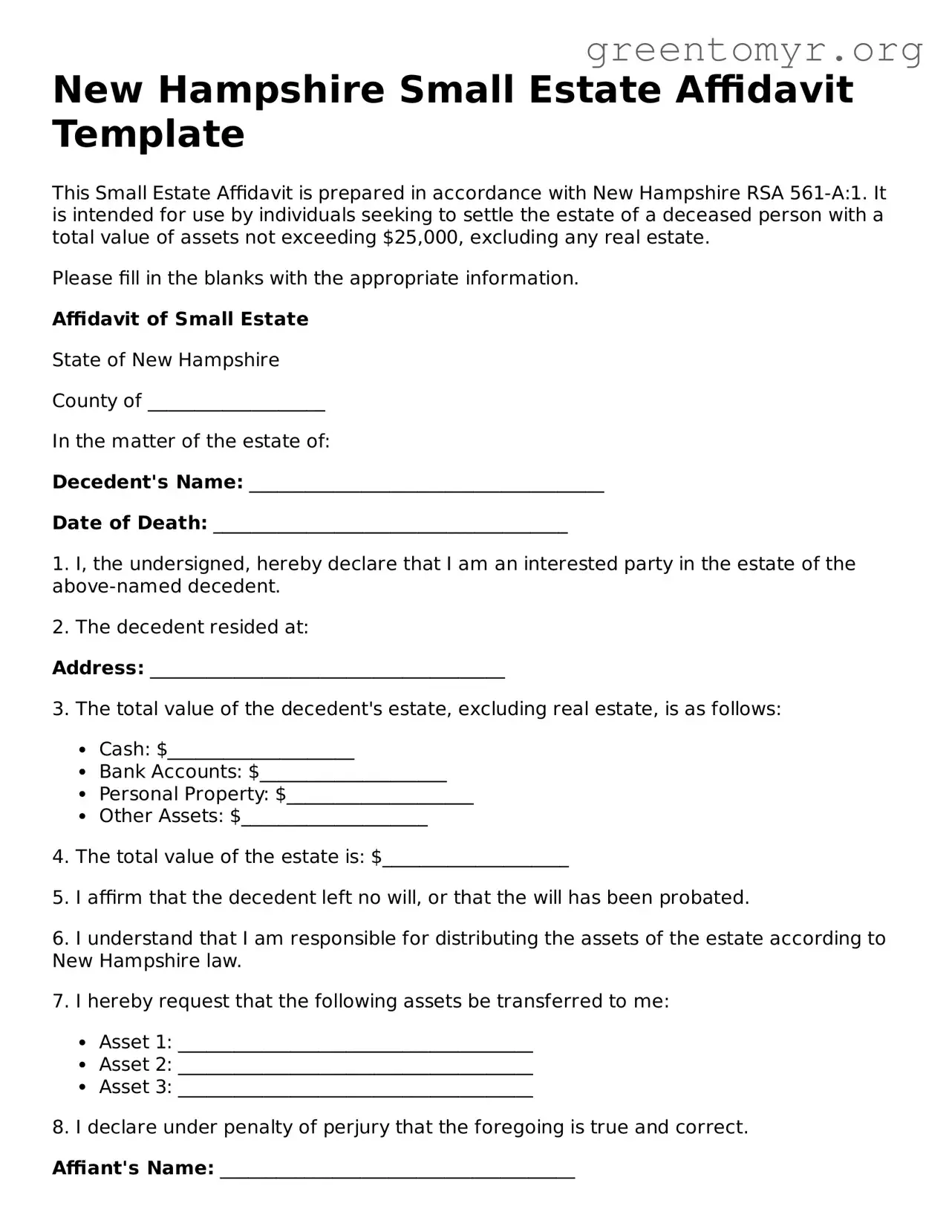
New Hampshire Small Estate Affidavit Template
This Small Estate Affidavit is prepared in accordance with New Hampshire RSA 561-A:1. It is intended for use by individuals seeking to settle the estate of a deceased person with a total value of assets not exceeding $25,000, excluding any real estate.
Please fill in the blanks with the appropriate information.
Affidavit of Small Estate
State of New Hampshire
County of ___________________
In the matter of the estate of:
Decedent's Name: ______________________________________
Date of Death: ______________________________________
1. I, the undersigned, hereby declare that I am an interested party in the estate of the above-named decedent.
2. The decedent resided at:
Address: ______________________________________
3. The total value of the decedent's estate, excluding real estate, is as follows:
4. The total value of the estate is: $____________________
5. I affirm that the decedent left no will, or that the will has been probated.
6. I understand that I am responsible for distributing the assets of the estate according to New Hampshire law.
7. I hereby request that the following assets be transferred to me:
8. I declare under penalty of perjury that the foregoing is true and correct.
Affiant's Name: ______________________________________
Affiant's Address: ______________________________________
Affiant's Signature: ________________________________
Date: ______________________________________
Notary Public/Justice of the Peace:
Name: ______________________________________
My Commission Expires: ________________________________
| Fact Name | Description |
|---|---|
| Governing Law | The New Hampshire Small Estate Affidavit is governed by RSA 294-E. |
| Eligibility | This affidavit can be used when the total value of the estate is $25,000 or less, excluding certain assets. |
| Purpose | The affidavit allows heirs to claim the deceased's assets without going through probate. |
| Required Signatures | The affidavit must be signed by all heirs or beneficiaries of the estate. |
| Filing Location | The completed affidavit is filed with the probate court in the county where the deceased lived. |
| Asset Types | It can be used for various types of assets, including bank accounts, personal property, and vehicles. |
| Exclusions | Real estate and certain jointly owned assets are excluded from this affidavit process. |
| Time Limit | There is no specific time limit to file the affidavit, but it should be done promptly after the death. |
| Notarization | The affidavit must be notarized to be considered valid. |
Once you have gathered the necessary documents and information, you can begin filling out the New Hampshire Small Estate Affidavit form. This process will help you formally declare the assets of the deceased without going through the lengthy probate process. Follow these steps carefully to ensure that the form is completed accurately.
After completing the form, you will need to file it with the appropriate court in New Hampshire. Make sure to keep copies for your records and follow any additional instructions provided by the court regarding the next steps in the estate process.
The New Hampshire Small Estate Affidavit is a legal document that allows heirs to claim the assets of a deceased person without going through the full probate process. This form is typically used when the total value of the estate is below a certain threshold, making the process simpler and faster for the heirs.
Any individual who is an heir or beneficiary of the deceased may use the Small Estate Affidavit, provided that the total value of the estate does not exceed the limit set by New Hampshire law. This includes spouses, children, and other relatives who are entitled to inherit under the state’s intestacy laws.
The value limit for using the Small Estate Affidavit in New Hampshire is currently $25,000 for personal property. If the estate includes real estate, the total value must not exceed $50,000. These limits may change, so it is advisable to check for the most current figures before proceeding.
To complete the Small Estate Affidavit, follow these steps:
Generally, you do not need to file the Small Estate Affidavit with the court unless specifically required by a financial institution or agency. However, keeping a copy for your records is advisable. If there are disputes or complications, you may need to consult with a legal professional.
If the estate exceeds the value limit, you cannot use the Small Estate Affidavit. In this case, you would need to initiate the formal probate process. This involves filing a petition with the probate court and may require more extensive documentation and legal procedures.
Filling out the New Hampshire Small Estate Affidavit form can be a straightforward process, but many individuals make common mistakes that can delay the settlement of an estate. Understanding these pitfalls is essential for ensuring a smooth and efficient filing. Here are ten mistakes to avoid.
One frequent error is failing to provide accurate information about the deceased. This includes the full name, date of birth, and date of death. Inaccuracies can lead to complications and might require additional documentation. Always double-check the details before submission.
Another common mistake is neglecting to list all assets. The affidavit requires a comprehensive inventory of the deceased's assets, including bank accounts, real estate, and personal property. Omitting any significant asset can result in legal issues and delays in the distribution process.
Many people also overlook the requirement for signatures. The affidavit must be signed by the person filing it, as well as by any other heirs or interested parties. Missing signatures can invalidate the document, causing unnecessary setbacks.
Additionally, some individuals mistakenly believe that the affidavit can be submitted without supporting documentation. Providing necessary documents, such as death certificates and proof of ownership for assets, is crucial. These documents help substantiate the claims made in the affidavit.
Another error involves miscalculating the total value of the estate. The Small Estate Affidavit is only applicable for estates valued under a certain threshold. Failing to accurately assess the estate's value can lead to the rejection of the affidavit and may require a more complex probate process.
People often forget to check for outstanding debts and obligations of the deceased. If there are debts, they must be addressed before distributing the estate. Ignoring this aspect can lead to legal complications and potential liability for the heirs.
In some cases, individuals may submit the affidavit without proper notarization. A notary public must witness the signatures to validate the document. Skipping this step can result in the affidavit being deemed invalid.
Another mistake is not keeping copies of the submitted affidavit and related documents. It’s essential to maintain a record for personal reference and for any future legal requirements. Losing these documents can complicate matters down the line.
Some people may also rush the process, leading to incomplete forms. Taking the time to review each section of the affidavit is critical. A hasty approach can result in errors that could have been easily avoided.
Lastly, individuals often fail to seek guidance when needed. Consulting with a legal professional or someone experienced in estate matters can provide valuable insights. Don’t hesitate to ask for help; it can save time and prevent costly mistakes.
By being aware of these common errors, individuals can better navigate the New Hampshire Small Estate Affidavit process. Taking the necessary precautions will ensure a smoother experience during what can be a challenging time.
When dealing with the New Hampshire Small Estate Affidavit form, several other documents may be necessary to ensure a smooth process. These forms help clarify ownership, facilitate asset distribution, and comply with state requirements. Below is a list of commonly used documents that accompany the Small Estate Affidavit.
Understanding these documents can significantly ease the process of managing a small estate in New Hampshire. Each plays a vital role in ensuring that the wishes of the deceased are honored while complying with legal requirements.
The Small Estate Affidavit form serves as a useful tool in the probate process for settling the estates of deceased individuals. It shares similarities with several other legal documents that facilitate the transfer of assets without a full probate proceeding. Here are nine documents that share characteristics with the Small Estate Affidavit:
When filling out the New Hampshire Small Estate Affidavit form, it's important to follow certain guidelines. Here are some things to keep in mind:
The New Hampshire Small Estate Affidavit form is often misunderstood. Here are nine common misconceptions about this form, along with clarifications to help clear up any confusion.
This is not true. The Small Estate Affidavit is designed for estates with a total value below a certain threshold, which is accessible to many individuals, not just the wealthy.
While it is important to address debts, the Small Estate Affidavit can still be filed even if some debts remain. However, the estate may need to account for these debts in the process.
This form is primarily for probate assets, but it can also be used to claim certain non-probate assets, depending on the circumstances.
While legal assistance can be beneficial, it is not a requirement. Many individuals successfully file the affidavit on their own.
There is a specific time frame within which the affidavit must be filed, typically shortly after the death of the estate owner.
While it is advisable to have consensus among heirs, it is not a legal requirement. The affidavit can be filed even if some heirs do not agree.
This is a misconception. While the Small Estate Affidavit can simplify the process, it does not exempt the estate from tax obligations.
In fact, it can be used for various types of assets, including bank accounts, personal property, and certain financial accounts.
This is incorrect. If there are errors or changes in circumstances, it is possible to amend the affidavit as needed.
Understanding these misconceptions can help navigate the process more effectively. If you have further questions or need assistance, consider reaching out to a knowledgeable resource.
Filling out and using the New Hampshire Small Estate Affidavit form can seem daunting, but it doesn't have to be. Here are some key takeaways to guide you through the process:
Taking these steps can simplify the process and help you navigate the legal landscape with confidence.