Content Navigation

When it comes to buying or selling a trailer in New Hampshire, having the right documentation is crucial for a smooth transaction. The Trailer Bill of Sale form serves as an essential legal document that protects both the buyer and the seller. This form typically includes important details such as the names and addresses of both parties, a description of the trailer, including its make, model, year, and Vehicle Identification Number (VIN), as well as the purchase price. Additionally, it often contains a statement of the trailer's condition, ensuring transparency in the sale. By providing a clear record of the transaction, this form helps prevent disputes and serves as proof of ownership transfer. Whether you’re a seasoned trailer owner or a first-time buyer, understanding the significance of the Trailer Bill of Sale form is key to navigating the process with confidence and peace of mind.

New Hampshire Trailer Bill of Sale Example

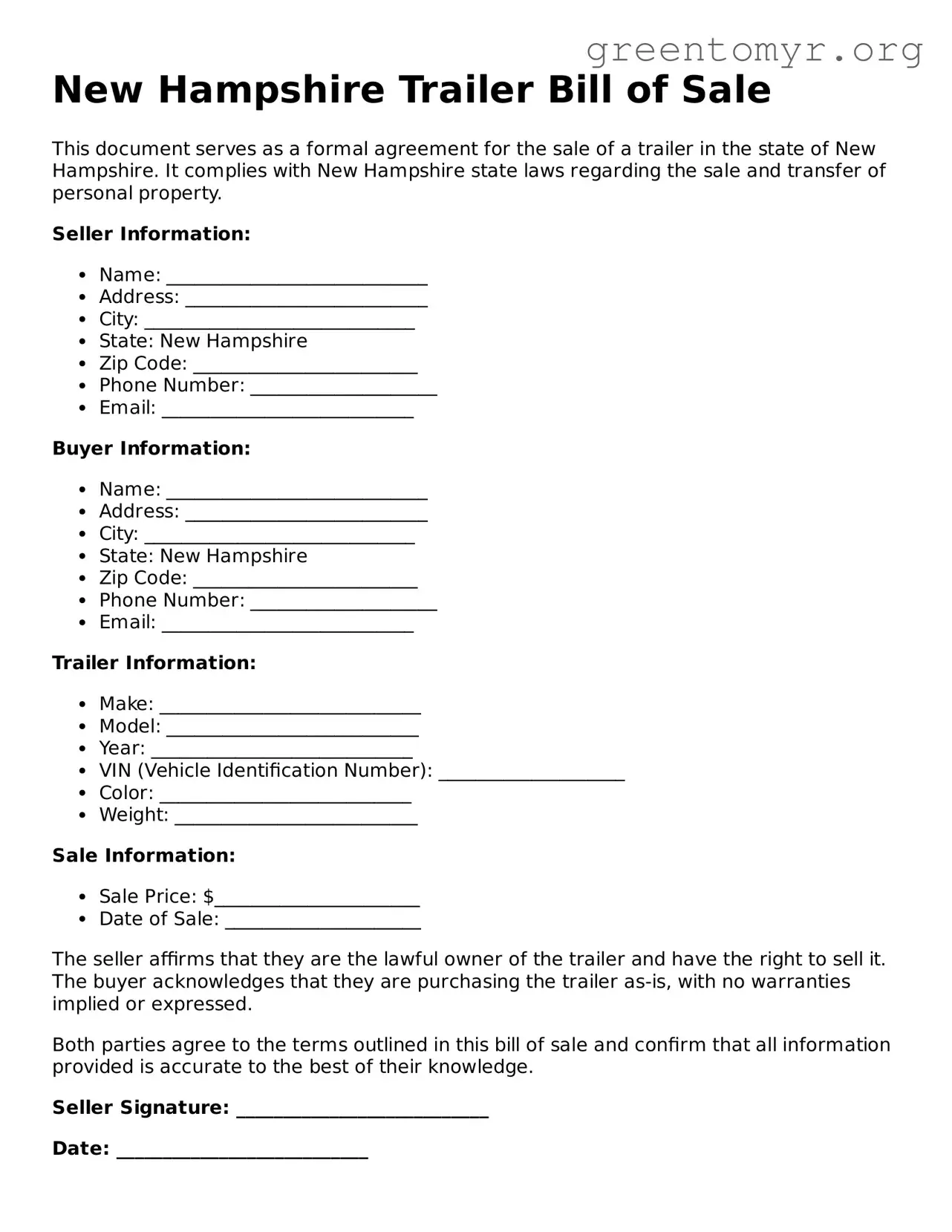
New Hampshire Trailer Bill of Sale

This document serves as a formal agreement for the sale of a trailer in the state of New Hampshire. It complies with New Hampshire state laws regarding the sale and transfer of personal property.

Seller Information:

  • Name: ____________________________
  • Address: __________________________
  • City: _____________________________
  • State: New Hampshire
  • Zip Code: ________________________
  • Phone Number: ____________________
  • Email: ___________________________

Buyer Information:

  • Name: ____________________________
  • Address: __________________________
  • City: _____________________________
  • State: New Hampshire
  • Zip Code: ________________________
  • Phone Number: ____________________
  • Email: ___________________________

Trailer Information:

  • Make: ____________________________
  • Model: ___________________________
  • Year: ____________________________
  • VIN (Vehicle Identification Number): ____________________
  • Color: ___________________________
  • Weight: __________________________

Sale Information:

  • Sale Price: $______________________
  • Date of Sale: _____________________

The seller affirms that they are the lawful owner of the trailer and have the right to sell it. The buyer acknowledges that they are purchasing the trailer as-is, with no warranties implied or expressed.

Both parties agree to the terms outlined in this bill of sale and confirm that all information provided is accurate to the best of their knowledge.

Seller Signature: ___________________________

Date: ___________________________

Buyer Signature: ___________________________

Date: ___________________________

PDF Form Features

Fact Name Description
Purpose The New Hampshire Trailer Bill of Sale form is used to document the sale of a trailer between a buyer and a seller, providing legal proof of the transaction.
Governing Law This form is governed by New Hampshire state laws, specifically the New Hampshire Revised Statutes Annotated (RSA) Chapter 261.
Required Information Essential details include the names and addresses of both the buyer and seller, trailer description, sale price, and date of sale.
Notarization While notarization is not mandatory, it is highly recommended to enhance the authenticity of the document and protect both parties.

Guide to Using New Hampshire Trailer Bill of Sale

After obtaining the New Hampshire Trailer Bill of Sale form, you’re ready to provide the necessary information to document the sale of a trailer. This form will serve as an important record for both the buyer and the seller, ensuring that the transaction is clear and legally binding.

  1. Begin by entering the date of the sale at the top of the form.
  2. Next, fill in the seller’s information, including their full name and address.
  3. Then, provide the buyer’s information, including their full name and address.
  4. In the next section, describe the trailer being sold. Include details such as the make, model, year, and Vehicle Identification Number (VIN).
  5. Indicate the purchase price of the trailer in the designated area.
  6. Both the seller and buyer should sign and date the form at the bottom, confirming the transaction.
  7. Finally, make a copy of the completed form for your records before handing it over to the buyer.

Get Answers on New Hampshire Trailer Bill of Sale

What is a Trailer Bill of Sale form in New Hampshire?

The Trailer Bill of Sale form is a legal document used to record the sale of a trailer in New Hampshire. This form provides essential information about the transaction, including the details of the buyer and seller, the trailer's identification, and the sale price. It serves as proof of ownership transfer and is crucial for registering the trailer with the state.

Why do I need a Trailer Bill of Sale?

A Trailer Bill of Sale is important for several reasons:

  • It legally documents the sale, protecting both the buyer and seller.
  • It provides evidence of ownership, which is necessary for registration.
  • It can help resolve disputes related to the sale or ownership of the trailer.

Without this document, you may face challenges in proving ownership or registering your trailer with the Department of Motor Vehicles (DMV).

What information is required on the Trailer Bill of Sale?

The Trailer Bill of Sale should include the following information:

  1. Full names and addresses of both the buyer and seller.
  2. Description of the trailer, including make, model, year, and Vehicle Identification Number (VIN).
  3. Sale price of the trailer.
  4. Date of the sale.
  5. Signatures of both parties to validate the agreement.

Completing all sections accurately helps ensure a smooth transaction and aids in future registration processes.

Do I need to have the Trailer Bill of Sale notarized?

In New Hampshire, notarization is not a requirement for the Trailer Bill of Sale. However, having the document notarized can add an extra layer of security and verification to the transaction. It may also be beneficial if you encounter any disputes in the future. Always check with local regulations or the DMV for any specific requirements.

How do I register my trailer after completing the Bill of Sale?

After completing the Trailer Bill of Sale, follow these steps to register your trailer:

  1. Gather necessary documents, including the Bill of Sale, proof of identity, and any previous title documents.
  2. Visit your local DMV office or check their website for online registration options.
  3. Complete the registration application form and pay any applicable fees.
  4. Receive your registration and license plates, which must be displayed on the trailer.

Completing this process promptly ensures that you can legally use your trailer on public roads.

Common mistakes

Completing the New Hampshire Trailer Bill of Sale form can seem straightforward, yet many individuals make common mistakes that can lead to complications later. One frequent error is failing to provide accurate vehicle identification information. This includes the trailer's Vehicle Identification Number (VIN), make, model, and year. Inaccurate or missing details can create confusion regarding ownership and may lead to issues during registration.

Another mistake is neglecting to include the correct sale price. The sale price must be clearly stated in the form. If the price is left blank or inaccurately reported, it can affect tax calculations and registration processes. Buyers and sellers should ensure that the amount reflects the agreed-upon price to avoid any discrepancies.

Many people overlook the importance of signatures on the form. Both the buyer and seller must sign the document to validate the transaction. Without these signatures, the bill of sale may not be considered legally binding. It is crucial to ensure that all parties involved have signed before submitting the form.

Additionally, individuals often forget to include the date of the transaction. The date serves as a critical reference point for both parties and is necessary for record-keeping. Omitting this detail can lead to misunderstandings about when the sale occurred, which could complicate future transactions or legal matters.

Another common oversight involves not providing contact information for both the buyer and seller. Clear contact details help facilitate communication between the parties and ensure that any future issues can be addressed promptly. Including phone numbers and addresses can prevent potential disputes.

People may also fail to keep a copy of the completed bill of sale for their records. Retaining a copy is essential for both the buyer and seller, as it serves as proof of the transaction. Should any disputes arise, having documentation can provide clarity and support one’s claims.

Finally, individuals sometimes do not check for any additional requirements specific to their local jurisdiction. While the New Hampshire Trailer Bill of Sale form is standardized, local regulations may impose further obligations. It is advisable to consult local authorities or resources to ensure full compliance with all legal requirements.

Documents used along the form

The New Hampshire Trailer Bill of Sale form serves as a crucial document for the transfer of ownership of a trailer. However, several other forms and documents are often utilized in conjunction with this bill of sale to ensure a smooth transaction and compliance with state regulations. Below is a list of these documents, each serving a specific purpose in the process.

  • Title Certificate: This document proves ownership of the trailer and is necessary for registration. It must be signed over from the seller to the buyer during the sale.
  • Registration Application: Required for registering the trailer with the state, this application provides essential details about the trailer and its owner.
  • Odometer Disclosure Statement: This form is used to disclose the trailer's mileage at the time of sale, protecting both parties from future disputes regarding mileage claims.
  • Sales Tax Form: In New Hampshire, buyers may need to complete a sales tax form to report the transaction and pay any applicable taxes on the sale.
  • Proof of Insurance: Buyers often need to provide evidence of insurance coverage for the trailer before registration can be completed.
  • Transfer of Ownership Form: This document officially records the change of ownership and may be required by the Department of Motor Vehicles (DMV).
  • VIN Verification Form: In some cases, a verification of the Vehicle Identification Number (VIN) may be necessary to confirm the trailer's identity and history.
  • Affidavit of Ownership: This form can be used by sellers who may not have a title, providing a sworn statement of ownership to facilitate the sale.
  • Power of Attorney: If the seller cannot be present for the transaction, a power of attorney may be needed to authorize another individual to sign on their behalf.

Utilizing these documents alongside the New Hampshire Trailer Bill of Sale form can streamline the ownership transfer process. Each document plays a vital role in ensuring that both the buyer and seller fulfill their legal obligations and protect their interests throughout the transaction.

Similar forms

The Trailer Bill of Sale form serves as a crucial document in the process of buying or selling a trailer. It is similar to several other documents that are used in various transactions involving vehicles or property. Here are eight documents that share similarities with the Trailer Bill of Sale:

  • Vehicle Bill of Sale: This document is used when selling or buying a car. Like the Trailer Bill of Sale, it records the transaction details, including the buyer's and seller's information, vehicle description, and sale price.
  • Boat Bill of Sale: Similar to the Trailer Bill of Sale, this document is used for the sale of a boat. It serves to confirm the transfer of ownership and includes details such as the boat's make, model, and hull identification number.
  • Motorcycle Bill of Sale: This form is used for transferring ownership of a motorcycle. It captures essential information about the motorcycle and the parties involved, much like the Trailer Bill of Sale.
  • ATV Bill of Sale: When selling or buying an all-terrain vehicle, this document is used. It includes details about the ATV and confirms the transaction, paralleling the function of the Trailer Bill of Sale.
  • Real Estate Purchase Agreement: While it pertains to property rather than vehicles, this agreement outlines the terms of a real estate transaction. It shares the same goal of documenting the transfer of ownership and the terms agreed upon by both parties.
  • Lease Agreement: This document outlines the terms under which one party agrees to rent property from another. Although it is not a sale, it still involves a transfer of rights and responsibilities, similar to the Trailer Bill of Sale.
  • Gift Bill of Sale: Used when a vehicle or trailer is given as a gift, this document serves to record the transfer of ownership without a monetary exchange, akin to the Trailer Bill of Sale's purpose.
  • Donation Receipt: When a vehicle is donated to a charity, this receipt documents the transaction. It serves a similar purpose as the Trailer Bill of Sale, confirming the transfer of ownership and providing a record for tax purposes.

Each of these documents plays a vital role in ensuring that the transfer of ownership is clear and legally recognized. Understanding their similarities can help in navigating various transactions involving vehicles and property.

Dos and Don'ts

When filling out the New Hampshire Trailer Bill of Sale form, attention to detail is crucial. A well-completed form can prevent future legal complications. Here are ten essential dos and don'ts to guide you through the process.

  • Do provide accurate information about the trailer, including the make, model, year, and Vehicle Identification Number (VIN).
  • Do include the full names and addresses of both the buyer and the seller.
  • Do specify the sale price clearly to avoid any confusion later on.
  • Do sign and date the form to validate the transaction.
  • Do keep a copy of the completed bill of sale for your records.
  • Don't leave any fields blank; incomplete forms can lead to issues with registration.
  • Don't use abbreviations or shorthand that could cause misunderstandings.
  • Don't forget to check for spelling errors, especially in names and addresses.
  • Don't sign the document without reviewing all the information thoroughly.
  • Don't attempt to alter the form after it has been signed; this could invalidate the sale.

By following these guidelines, you can ensure a smooth transaction and protect both parties involved in the sale of the trailer.

Misconceptions

Many people have misunderstandings about the New Hampshire Trailer Bill of Sale form. Here are nine common misconceptions:

  1. It's only for new trailers. Some believe the form is only necessary for new trailers. In reality, it is required for both new and used trailers to document the sale.
  2. It's not legally binding. Some think that the form is just a formality and holds no legal weight. However, it serves as a legal document that can protect both the buyer and seller.
  3. Only the seller needs to sign it. A common misconception is that only the seller's signature is required. Both parties should sign the form to validate the transaction.
  4. It's not needed if there’s a verbal agreement. Many believe that a verbal agreement suffices. However, having a written bill of sale is crucial for clarity and legal protection.
  5. It can be filled out after the sale. Some think they can complete the form after the transaction. It's best to fill it out at the time of sale to ensure accuracy and completeness.
  6. It doesn't need to be notarized. Some people assume notarization is unnecessary. While it's not always required, having it notarized can add an extra layer of security.
  7. Only certain types of trailers require it. There's a belief that only specific trailers need this form. In fact, any trailer sold in New Hampshire should have a bill of sale.
  8. It’s a complicated process. Many think the process of creating a bill of sale is complex. In truth, it is a straightforward document that can be easily completed.
  9. It's only for private sales. Some believe that the bill of sale is only necessary for private transactions. However, it is also important for sales through dealerships or other businesses.

Understanding these misconceptions can help ensure that both buyers and sellers navigate the sale of a trailer more effectively.

Key takeaways

When filling out and using the New Hampshire Trailer Bill of Sale form, several important considerations should be kept in mind. Below are key takeaways to ensure a smooth transaction.

  • The form serves as a legal document to record the sale of a trailer.
  • Both the seller and buyer must complete the form to validate the transaction.
  • Accurate information about the trailer, including its VIN (Vehicle Identification Number), is essential.
  • Include the purchase price to document the financial aspect of the sale.
  • Both parties should sign and date the form to confirm their agreement.
  • Keep a copy of the completed form for personal records.
  • The form may be required for registering the trailer with the New Hampshire DMV.
  • Consult local regulations to ensure compliance with any additional requirements.

By adhering to these guidelines, individuals can facilitate a clear and effective sale of a trailer in New Hampshire.