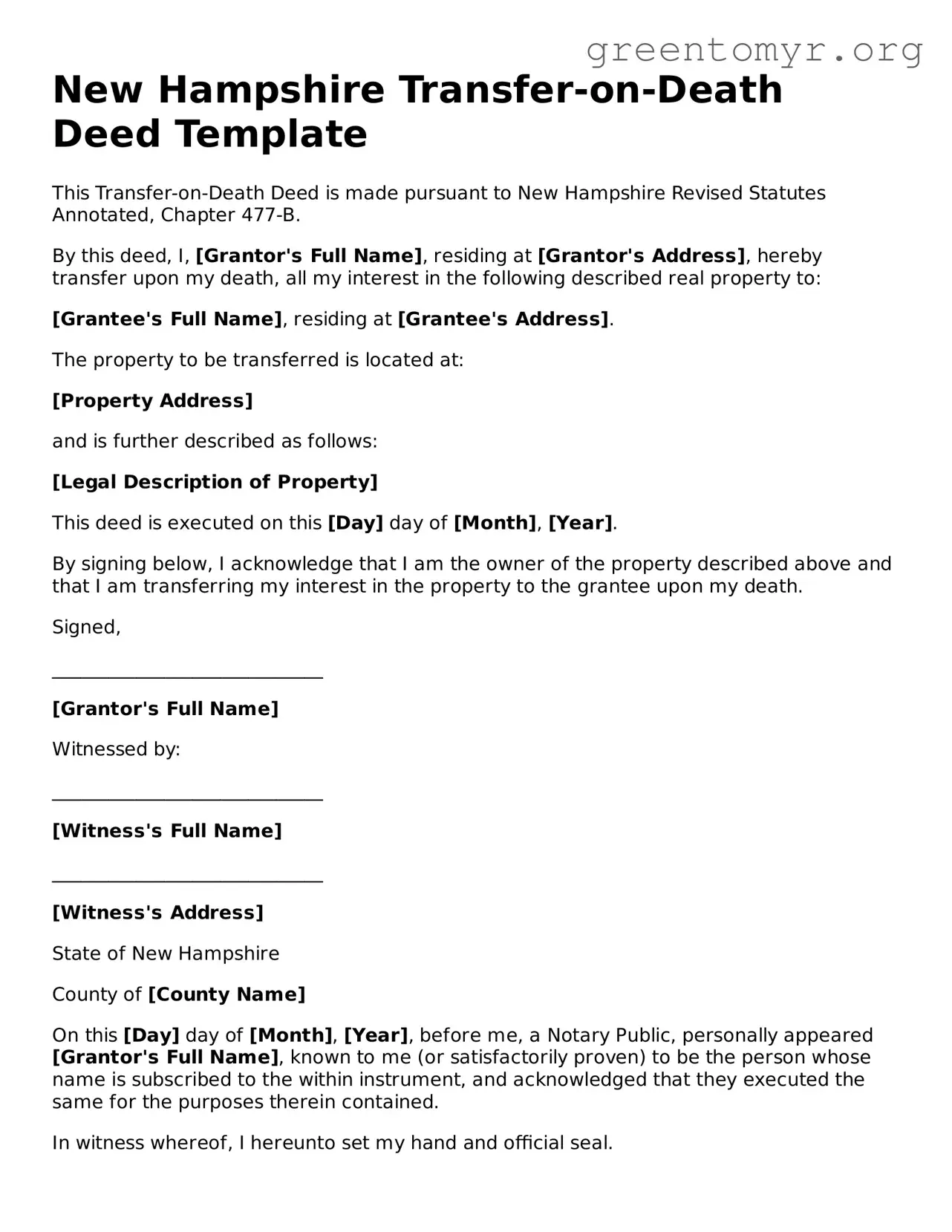
In New Hampshire, the Transfer-on-Death Deed (TODD) form serves as a valuable estate planning tool, allowing property owners to designate beneficiaries who will receive their real estate upon their passing. This form simplifies the transfer process, avoiding the complexities of probate, and offers peace of mind to both the property owner and their loved ones. By filling out the TODD, individuals can specify who will inherit their property, ensuring that their wishes are clearly communicated. Additionally, the form allows for flexibility, as property owners can change or revoke their designations at any time during their lifetime. Understanding the requirements and implications of the TODD is essential for anyone looking to manage their estate effectively and protect their family’s future. With this straightforward approach, New Hampshire residents can navigate the often daunting aspects of property transfer with confidence.
New Hampshire Transfer-on-Death Deed Template
This Transfer-on-Death Deed is made pursuant to New Hampshire Revised Statutes Annotated, Chapter 477-B.
By this deed, I, [Grantor's Full Name], residing at [Grantor's Address], hereby transfer upon my death, all my interest in the following described real property to:
[Grantee's Full Name], residing at [Grantee's Address].
The property to be transferred is located at:
[Property Address]
and is further described as follows:
[Legal Description of Property]
This deed is executed on this [Day] day of [Month], [Year].
By signing below, I acknowledge that I am the owner of the property described above and that I am transferring my interest in the property to the grantee upon my death.
Signed,
_____________________________
[Grantor's Full Name]
Witnessed by:
_____________________________
[Witness's Full Name]
_____________________________
[Witness's Address]
State of New Hampshire
County of [County Name]
On this [Day] day of [Month], [Year], before me, a Notary Public, personally appeared [Grantor's Full Name], known to me (or satisfactorily proven) to be the person whose name is subscribed to the within instrument, and acknowledged that they executed the same for the purposes therein contained.
In witness whereof, I hereunto set my hand and official seal.
_____________________________
[Notary Public's Name]
Notary Public
My commission expires: [Expiration Date]
| Fact Name | Description |
|---|---|
| Definition | A Transfer-on-Death Deed allows an individual to transfer real estate to a beneficiary upon their death without the property going through probate. |
| Governing Law | The Transfer-on-Death Deed in New Hampshire is governed by New Hampshire Revised Statutes Annotated (RSA) 477:11-A. |
| Eligibility | Any individual who owns real estate in New Hampshire can create a Transfer-on-Death Deed for their property. |
| Revocation | A Transfer-on-Death Deed can be revoked at any time by the grantor, provided that the revocation is executed in writing and recorded. |
| Beneficiary Rights | The beneficiary named in a Transfer-on-Death Deed has no rights to the property until the death of the grantor. |
Once you have the New Hampshire Transfer-on-Death Deed form, you are ready to begin filling it out. This deed allows you to designate a beneficiary who will receive your property upon your passing, without the need for probate. Follow these steps to ensure that the form is completed correctly.
A Transfer-on-Death Deed (TOD) allows property owners in New Hampshire to designate a beneficiary who will receive the property upon the owner's death. This deed does not transfer ownership during the owner's lifetime, allowing them to retain full control of the property until their passing.
When the property owner dies, the property automatically transfers to the designated beneficiary without going through probate. The beneficiary must record the death certificate and the TOD deed in the appropriate registry of deeds to complete the transfer.
Any individual or entity can be named as a beneficiary. This includes family members, friends, or organizations. However, it is essential to ensure that the beneficiary is legally capable of receiving the property.
Yes, the property owner can change or revoke the TOD deed at any time before their death. This can be done by executing a new TOD deed or a formal revocation document. It is crucial to record any changes with the registry of deeds to ensure they are legally recognized.
While creating a TOD deed typically does not incur significant costs, there may be fees for recording the deed with the local registry of deeds. Additionally, consulting with a legal professional may involve fees, but it can provide valuable guidance in the process.
If no beneficiary is named, the property will be treated as part of the deceased's estate and will go through the probate process. This can lead to delays and additional costs for the heirs or beneficiaries.
No, a Transfer-on-Death Deed is not the same as a will. A will distributes assets after death and goes through probate. In contrast, a TOD deed allows for a direct transfer of property outside of probate, simplifying the process for beneficiaries.
While it is not legally required to have an attorney, consulting one is highly recommended. An attorney can help ensure that the deed is completed correctly and meets all legal requirements, reducing the risk of future disputes.
In New Hampshire, you can use a TOD deed for real estate, such as residential or commercial properties. However, personal property, bank accounts, and other assets typically cannot be transferred using this deed.
Many states recognize Transfer-on-Death Deeds, but the rules and procedures may vary. It is essential to check the specific laws in the state where the property is located if you are considering a TOD deed outside of New Hampshire.
Filling out a Transfer-on-Death (TOD) Deed form in New Hampshire can seem straightforward, but many people make common mistakes that can lead to complications down the road. Understanding these pitfalls is essential for ensuring that your property is transferred smoothly upon your passing. Here are eight mistakes to avoid.
One of the most frequent errors is failing to provide complete and accurate property descriptions. The deed must include a precise legal description of the property, not just the address. Omitting details can create confusion and may even invalidate the deed. Always double-check the property description against official records to ensure accuracy.
Another common mistake is neglecting to sign the deed correctly. The law requires that the grantor—typically the property owner—signs the deed. If the deed is not signed in the presence of a notary public, it may not hold up in court. It’s crucial to follow the signing and notarization requirements to avoid future disputes.
People often overlook the importance of naming beneficiaries clearly. Using vague terms or nicknames can lead to misunderstandings about who is intended to receive the property. It is wise to use full legal names and consider including their relationship to you to eliminate any ambiguity.
Additionally, some individuals forget to record the deed with the appropriate county registry of deeds. A TOD deed is not effective until it is recorded. Failing to do this step can result in the property being treated as part of the estate, which defeats the purpose of the TOD deed.
Another mistake involves not considering the implications of the deed on other estate planning documents. For instance, if you have a will that contradicts the TOD deed, it can create legal conflicts. It’s essential to ensure that all estate planning documents are aligned to reflect your wishes clearly.
Many people also fail to communicate their intentions to the beneficiaries. Not informing them about the existence of the TOD deed can lead to confusion and disputes among family members after your passing. Open conversations about your estate planning can help prevent misunderstandings.
Some individuals may think that once the deed is executed, it cannot be changed. This is not true. You can revoke or alter the TOD deed at any time before your death. However, many people forget to keep their documents updated, which can lead to unintended consequences.
Lastly, there is often a misunderstanding about the tax implications of a TOD deed. While the property typically does not go through probate, it is important to consult with a tax professional to understand any potential tax liabilities for the beneficiaries. Being informed can help ensure that your loved ones are not caught off guard.
By avoiding these common mistakes, you can help ensure that your Transfer-on-Death Deed serves its intended purpose, providing peace of mind for you and your beneficiaries.
When considering the New Hampshire Transfer-on-Death Deed form, it is essential to understand that several other documents often accompany it. These forms help ensure a smooth transition of property ownership and clarify the intentions of the property owner. Below is a list of commonly used documents that may be relevant in conjunction with the Transfer-on-Death Deed.
Understanding these documents can greatly assist individuals in navigating the complexities of property transfer and estate planning. Each form serves a unique purpose, and together they create a comprehensive approach to managing one's assets and ensuring that wishes are honored after death.
When filling out the New Hampshire Transfer-on-Death Deed form, it is important to ensure that you do it correctly to avoid any potential issues in the future. Below is a list of things you should and shouldn't do during this process.
By following these guidelines, you can help ensure that your Transfer-on-Death Deed is completed properly and is legally valid.
Understanding the Transfer-on-Death Deed (TODD) in New Hampshire is essential for effective estate planning. Unfortunately, several misconceptions can lead to confusion. Here are seven common misconceptions about the New Hampshire Transfer-on-Death Deed form:
Clarifying these misconceptions can empower individuals to make informed decisions about their estate planning needs. Understanding the nuances of the Transfer-on-Death Deed is vital for ensuring that property is transferred according to one's wishes.
Filling out and using the New Hampshire Transfer-on-Death Deed form can be straightforward if you keep these key takeaways in mind: