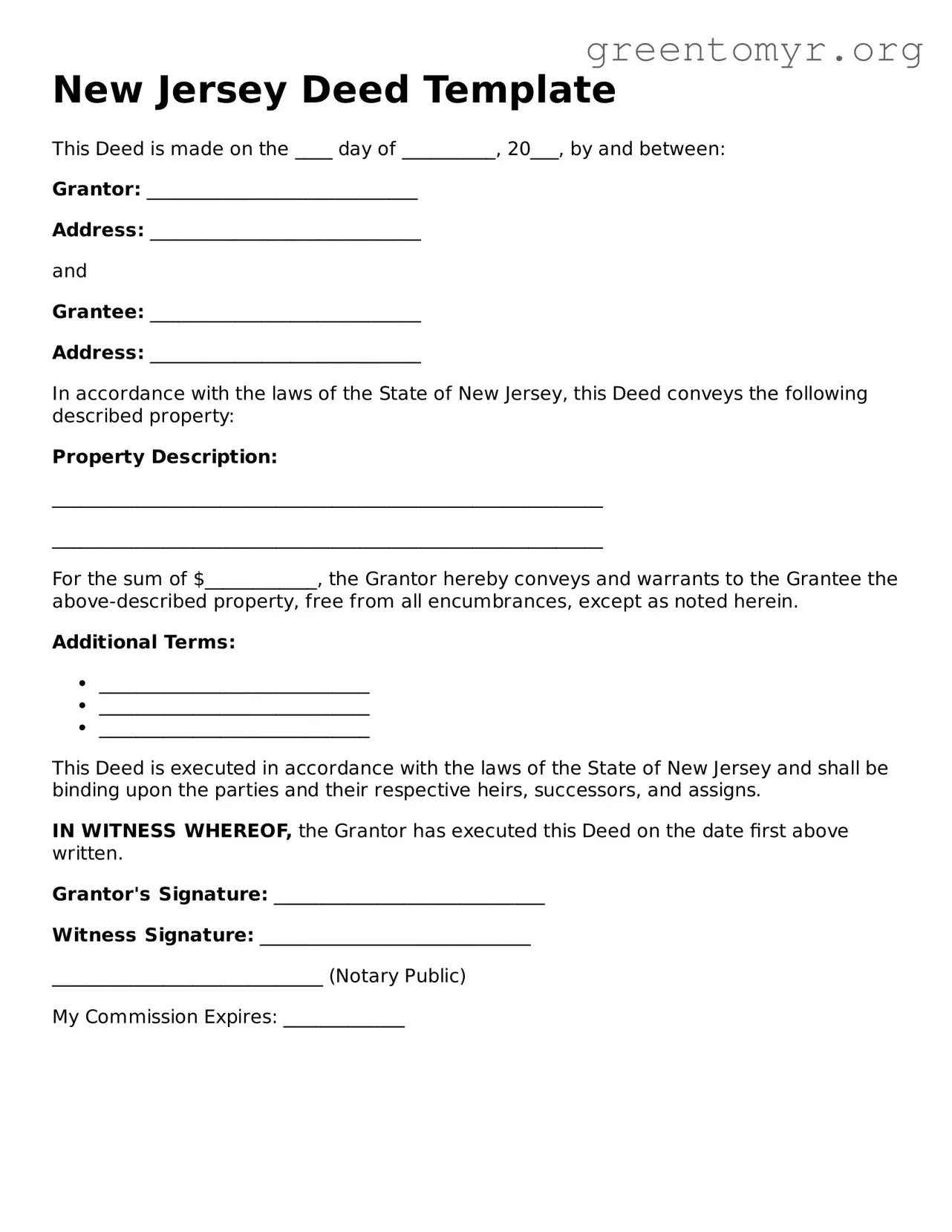
When it comes to transferring property ownership in New Jersey, understanding the nuances of the New Jersey Deed form is essential. This legal document serves as a crucial tool in real estate transactions, detailing the specifics of the property being transferred, including its legal description and the names of the parties involved. The form must be properly executed and typically requires signatures from both the grantor and grantee, as well as notarization to ensure its validity. Additionally, various types of deeds, such as warranty deeds and quitclaim deeds, offer different levels of protection and assurance regarding the title. It's important to note that the New Jersey Deed form must also comply with state regulations, including any necessary disclosures and tax implications associated with the transfer. Understanding these components can help streamline the process and safeguard the interests of all parties involved.
New Jersey Deed Template
This Deed is made on the ____ day of __________, 20___, by and between:
Grantor: _____________________________
Address: _____________________________
and
Grantee: _____________________________
Address: _____________________________
In accordance with the laws of the State of New Jersey, this Deed conveys the following described property:
Property Description:
___________________________________________________________
___________________________________________________________
For the sum of $____________, the Grantor hereby conveys and warrants to the Grantee the above-described property, free from all encumbrances, except as noted herein.
Additional Terms:
This Deed is executed in accordance with the laws of the State of New Jersey and shall be binding upon the parties and their respective heirs, successors, and assigns.
IN WITNESS WHEREOF, the Grantor has executed this Deed on the date first above written.
Grantor's Signature: _____________________________
Witness Signature: _____________________________
_____________________________ (Notary Public)
My Commission Expires: _____________
| Fact Name | Description |
|---|---|
| Governing Law | The New Jersey Deed form is governed by New Jersey Statutes Annotated (N.J.S.A.) Title 46, which covers property and conveyances. |
| Types of Deeds | New Jersey recognizes several types of deeds, including warranty deeds, quitclaim deeds, and bargain and sale deeds. |
| Signature Requirements | The deed must be signed by the grantor (seller) and, in some cases, the grantee (buyer) to be valid. |
| Recording | To provide public notice, the deed must be recorded in the county where the property is located. |
| Transfer Tax | A transfer tax is imposed on the sale of real estate in New Jersey, and the amount varies based on the sale price. |
Once you have the New Jersey Deed form, you will need to complete it accurately to ensure a smooth transfer of property ownership. After filling out the form, it will need to be signed and notarized before being filed with the appropriate county office.
A New Jersey Deed form is a legal document used to transfer ownership of real estate from one party to another. This form outlines the specifics of the property being transferred and the parties involved in the transaction. It serves as a public record of the change in ownership.
New Jersey recognizes several types of deeds, including:
To complete a New Jersey Deed form, follow these steps:
Yes, a New Jersey Deed form must be notarized to be legally valid. The notary public will verify the identities of the signers and ensure that they are signing voluntarily. This step is crucial for the deed to be recorded in the county clerk's office.
The completed and notarized New Jersey Deed form must be filed with the county clerk's office in the county where the property is located. Filing fees may apply, and it is essential to keep a copy for your records after filing.
Once the deed is filed, it becomes a public record. The county clerk will assign a recording number and return a stamped copy to you. This serves as proof of the transfer of ownership. It is advisable to keep this document in a safe place, as it may be needed for future transactions or legal matters.
Filling out a New Jersey Deed form can seem straightforward, but there are common mistakes that people often make. One of the most frequent errors is not providing complete information about the property. It’s essential to include the correct address and legal description. Omitting even a small detail can lead to delays or complications in the transfer process.
Another mistake is failing to sign the deed correctly. The deed must be signed by the grantor, and if the signature is missing or not properly notarized, the document may be rejected. It's crucial to ensure that all signatures are clear and that the notary's seal is visible. This step is vital for the deed to be legally binding.
People sometimes overlook the importance of including the correct names of the parties involved. If there are spelling errors or if the names do not match official identification, it can cause issues. Always double-check that names are spelled correctly and match the identification documents.
Not paying attention to the tax implications is another common mistake. New Jersey has specific requirements regarding transfer taxes. If these taxes are not calculated and paid correctly, it can result in penalties or additional fees. It’s wise to consult with a professional if you are unsure about the tax obligations.
Lastly, many people forget to keep a copy of the completed deed. Once the deed is filed, it’s important to have a record for personal files. This document serves as proof of ownership and can be necessary for future transactions. Always make sure to retain a copy for your records.
When dealing with property transactions in New Jersey, the Deed form is just one piece of the puzzle. Several other documents accompany the Deed, each serving a specific purpose to ensure the transaction is smooth and legally sound. Below is a list of common forms and documents that are often used alongside the New Jersey Deed form.
Each of these documents plays a vital role in the property transaction process. Understanding their purposes can help both buyers and sellers navigate the complexities of real estate dealings in New Jersey. Being well-informed contributes to a smoother and more successful transaction.
When filling out the New Jersey Deed form, attention to detail is crucial. Here are four essential guidelines to follow:
Understanding the New Jersey Deed form is essential for anyone involved in real estate transactions. However, several misconceptions can lead to confusion. Here are five common misunderstandings:
All Deeds are the Same: Many believe that all deeds serve the same purpose. In reality, different types of deeds, such as warranty deeds and quitclaim deeds, have distinct implications for ownership and liability.
A Deed Must Be Notarized: Some think that a deed cannot be valid without notarization. While notarization is recommended for legal clarity, it is not a strict requirement for the deed to be legally binding in New Jersey.
Deeds are Only for Selling Property: It is a common misconception that deeds are only used in sales transactions. Deeds can also be used for transferring property as gifts, inheritance, or in divorce settlements.
Once a Deed is Signed, It Cannot Be Changed: Many assume that a signed deed is permanent. However, deeds can be modified or revoked under certain conditions, such as mutual agreement between the parties involved.
All Information on a Deed is Public: Some individuals believe that all details contained in a deed are accessible to the public. While the deed itself is public record, certain personal information may be protected from public view.
Clarifying these misconceptions can help ensure a smoother process in real estate transactions in New Jersey.
Filling out and using the New Jersey Deed form is a straightforward process, but attention to detail is essential. Here are some key takeaways to keep in mind:
By following these guidelines, you can ensure that your New Jersey Deed form is filled out correctly and effectively. Proper execution of this document is vital for a smooth property transfer process.