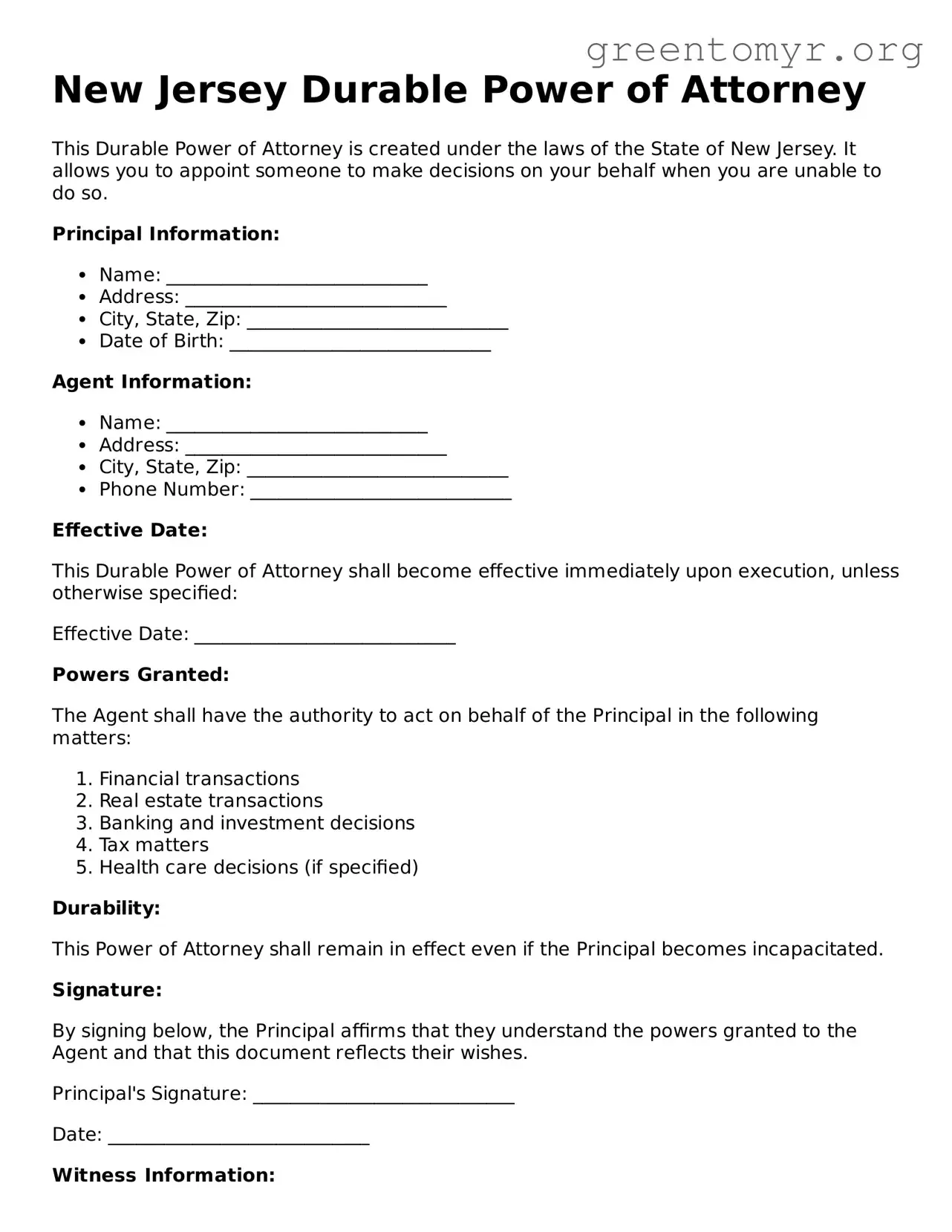
In New Jersey, the Durable Power of Attorney form serves as a crucial tool for individuals seeking to manage their financial and legal affairs when they are unable to do so themselves. This legal document allows you to appoint a trusted person, known as an agent or attorney-in-fact, to act on your behalf. With this form, you can specify the powers granted to your agent, which may include handling banking transactions, managing real estate, or making healthcare decisions. Importantly, the Durable Power of Attorney remains effective even if you become incapacitated, ensuring that your affairs are in capable hands when you need it most. Understanding the nuances of this form is essential for anyone looking to secure their future and maintain control over their personal and financial matters. By taking the time to complete this document thoughtfully, you empower yourself and your chosen agent to navigate any challenges that may arise, all while adhering to New Jersey's legal requirements.
New Jersey Durable Power of Attorney
This Durable Power of Attorney is created under the laws of the State of New Jersey. It allows you to appoint someone to make decisions on your behalf when you are unable to do so.
Principal Information:
Agent Information:
Effective Date:
This Durable Power of Attorney shall become effective immediately upon execution, unless otherwise specified:
Effective Date: ____________________________
Powers Granted:
The Agent shall have the authority to act on behalf of the Principal in the following matters:
Durability:
This Power of Attorney shall remain in effect even if the Principal becomes incapacitated.
Signature:
By signing below, the Principal affirms that they understand the powers granted to the Agent and that this document reflects their wishes.
Principal's Signature: ____________________________
Date: ____________________________
Witness Information:
It is recommended that this document be notarized for additional validity.
| Fact Name | Details |
|---|---|
| Definition | A New Jersey Durable Power of Attorney form allows an individual to designate someone else to make financial and legal decisions on their behalf, even if they become incapacitated. |
| Governing Law | The New Jersey Durable Power of Attorney is governed by the New Jersey Statutes, specifically Title 46, Chapter 2B. |
| Durability | This form remains effective even if the principal becomes mentally incapacitated, distinguishing it from a regular power of attorney. |
| Revocation | The principal can revoke the Durable Power of Attorney at any time, as long as they are mentally competent to do so. |
Filling out the New Jersey Durable Power of Attorney form is an important step in designating someone to handle your financial and legal matters. Once completed, the form should be signed and witnessed to ensure its validity.
Once you have completed these steps, keep a copy of the signed form for your records. Provide a copy to your agent and any relevant financial institutions or healthcare providers as needed.
A Durable Power of Attorney (DPOA) in New Jersey is a legal document that allows you to appoint someone to manage your financial and legal affairs if you become incapacitated. Unlike a regular power of attorney, a durable power of attorney remains effective even if you are unable to make decisions for yourself.
In New Jersey, you can choose any competent adult as your agent. This could be a family member, friend, or trusted advisor. It’s essential to select someone you trust to act in your best interests, as they will have significant authority over your financial matters.
You can grant a wide range of powers to your agent, including:
However, you can also limit the powers you grant. Clearly outline any restrictions in the document to ensure your wishes are followed.
To create a Durable Power of Attorney in New Jersey, follow these steps:
Consider consulting with a legal professional to ensure that your document meets all legal requirements.
Yes, you can revoke a Durable Power of Attorney at any time, as long as you are mentally competent. To revoke it, you must create a written notice of revocation and notify your agent and any institutions that have a copy of the original DPOA.
A Durable Power of Attorney created in New Jersey is generally valid in other states, but it’s advisable to check the laws of the new state. Some states have specific requirements for powers of attorney, and updating your document may be necessary.
If you become incapacitated without a Durable Power of Attorney, your loved ones may need to go through a legal process called guardianship to manage your affairs. This can be time-consuming, costly, and may not reflect your wishes.
While it is not legally required to have a lawyer to create a Durable Power of Attorney in New Jersey, consulting with one is highly recommended. A legal professional can ensure that your document is properly drafted and that your wishes are accurately reflected.
Filling out a Durable Power of Attorney (DPOA) form in New Jersey can be straightforward, but many people make common mistakes that can lead to complications. Understanding these pitfalls can help ensure that the document serves its intended purpose effectively.
One frequent mistake is failing to specify the powers granted to the agent. A DPOA should clearly outline what decisions the agent can make on behalf of the principal. Without this clarity, the agent may lack the authority to act when needed. It's essential to be specific about financial, medical, and legal powers.
Another error involves not signing the document in the presence of a notary or witnesses. New Jersey law requires that the DPOA be signed and acknowledged by a notary public. Skipping this step can render the document invalid, leaving the principal without the intended protections.
Some individuals overlook the importance of naming alternate agents. If the primary agent is unavailable or unwilling to act, having a backup ensures that someone can step in. Failing to name an alternate can create confusion and delays during critical times.
Many people also neglect to review the form thoroughly before signing. Errors in names, dates, or other critical information can invalidate the document. Taking the time to double-check all details can prevent future complications.
Another common mistake is not discussing the DPOA with the chosen agent. It’s crucial that the agent understands their responsibilities and is willing to accept the role. A lack of communication can lead to misunderstandings and potential conflicts later on.
Finally, some individuals forget to update their DPOA as life circumstances change. Major life events, such as marriage, divorce, or the death of an agent, can affect the validity of the document. Regularly reviewing and updating the DPOA ensures it reflects current wishes and circumstances.
When considering a Durable Power of Attorney (DPOA) in New Jersey, it's essential to understand that it often goes hand-in-hand with several other important documents. These documents can help ensure that your wishes are honored and that your affairs are managed smoothly if you become unable to do so yourself. Here’s a list of commonly used forms and documents that complement a DPOA.
Understanding these documents and how they work together can provide peace of mind. They ensure that your wishes regarding health care, finances, and the distribution of your assets are clearly communicated and respected. Taking the time to prepare these documents can help you and your loved ones navigate difficult situations more easily.
The Durable Power of Attorney (DPOA) is an important legal document that allows one person to make decisions on behalf of another. It shares similarities with several other documents that also grant authority or manage responsibilities. Here are ten documents that are similar to the DPOA:
When filling out the New Jersey Durable Power of Attorney form, it is essential to approach the task with care and attention. Here is a list of things you should and shouldn't do:
By following these guidelines, you can create a Durable Power of Attorney that accurately reflects your wishes and provides clarity for your agent.
Understanding the New Jersey Durable Power of Attorney form is crucial for effective estate planning. However, several misconceptions can lead to confusion. Here are five common misunderstandings:
Many believe that a Durable Power of Attorney (DPOA) is limited to financial matters. In reality, it can also grant authority over healthcare decisions, depending on how it is drafted.
Some think that a DPOA ceases to be effective if they lose the ability to make decisions. However, the "durable" aspect means it remains valid even if you become incapacitated.
People often assume they can appoint anyone as their agent. While you can choose a trusted individual, they must be at least 18 years old and capable of making decisions.
Many think that a DPOA is permanent and unchangeable. You can revoke or modify it at any time, as long as you are mentally competent.
Some confuse a DPOA with a living will. A DPOA allows someone to make decisions on your behalf, while a living will outlines your wishes regarding medical treatment.
Clearing up these misconceptions can help ensure that your wishes are honored and your affairs are managed according to your preferences.
Filling out and using a Durable Power of Attorney (DPOA) form in New Jersey can be a straightforward process, but understanding its key aspects is essential. Here are some important takeaways:
Understanding these key points can help ensure that your Durable Power of Attorney works effectively when you need it most.