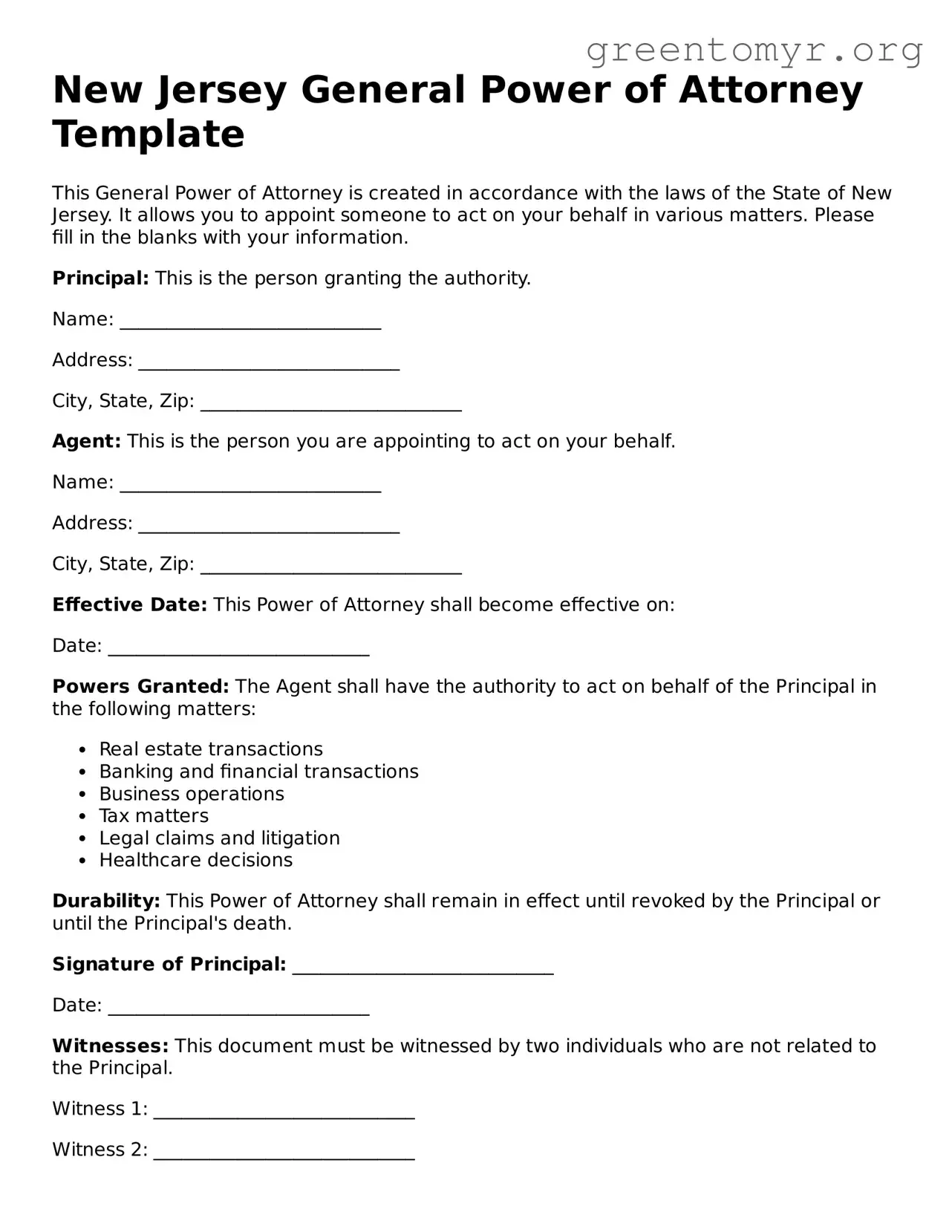
The New Jersey General Power of Attorney form is a crucial legal document that allows an individual, known as the principal, to grant another person, called the agent or attorney-in-fact, the authority to act on their behalf in various matters. This form is particularly useful in situations where the principal may be unable to manage their affairs due to illness, absence, or other reasons. By completing this form, the principal can specify the powers granted to the agent, which may include handling financial transactions, managing real estate, and making healthcare decisions. Importantly, the General Power of Attorney can be tailored to meet specific needs, allowing the principal to limit or expand the scope of authority as desired. The document also includes provisions for revocation, ensuring that the principal can withdraw the authority granted at any time, as long as they are mentally competent. Understanding the implications of this form is essential for anyone considering its use, as it establishes a significant level of trust between the principal and the agent, and carries legal weight in various situations.
New Jersey General Power of Attorney Template
This General Power of Attorney is created in accordance with the laws of the State of New Jersey. It allows you to appoint someone to act on your behalf in various matters. Please fill in the blanks with your information.
Principal: This is the person granting the authority.
Name: ____________________________
Address: ____________________________
City, State, Zip: ____________________________
Agent: This is the person you are appointing to act on your behalf.
Name: ____________________________
Address: ____________________________
City, State, Zip: ____________________________
Effective Date: This Power of Attorney shall become effective on:
Date: ____________________________
Powers Granted: The Agent shall have the authority to act on behalf of the Principal in the following matters:
Durability: This Power of Attorney shall remain in effect until revoked by the Principal or until the Principal's death.
Signature of Principal: ____________________________
Date: ____________________________
Witnesses: This document must be witnessed by two individuals who are not related to the Principal.
Witness 1: ____________________________
Witness 2: ____________________________
Notary Public: This document should be notarized for additional validity.
State of New Jersey
County of ____________________________
Subscribed and sworn to before me this ____ day of __________, 20__.
Notary Public Signature: ____________________________
My Commission Expires: ____________________________
| Fact Name | Description |
|---|---|
| Definition | A General Power of Attorney allows an individual to appoint someone else to handle their financial and legal matters. |
| Governing Law | This form is governed by the New Jersey Statutes, specifically NJ Rev Stat § 46:2B-8 (2023). |
| Durability | The General Power of Attorney can be made durable, meaning it remains effective even if the principal becomes incapacitated. |
| Agent's Authority | The agent can perform various tasks, including managing bank accounts, selling property, and making investment decisions. |
| Revocation | The principal can revoke the General Power of Attorney at any time, as long as they are mentally competent. |
| Witness Requirement | In New Jersey, the form must be signed in the presence of a notary public or two witnesses to be valid. |
Filling out the New Jersey General Power of Attorney form is a straightforward process. Once completed, the document will allow you to appoint someone to make decisions on your behalf. This can be helpful in various situations, such as managing finances or making medical decisions if you're unable to do so yourself.
A General Power of Attorney (GPOA) is a legal document that allows one person, known as the principal, to grant another person, called the agent or attorney-in-fact, the authority to make decisions on their behalf. This can include financial matters, property management, and other legal affairs. The powers granted can be broad or limited, depending on what the principal specifies in the document.
Creating a GPOA can be crucial for several reasons. It allows you to designate someone you trust to handle your affairs if you become incapacitated or unable to make decisions. This can help ensure that your financial and personal matters are managed according to your wishes. Additionally, it can save time and reduce stress for your loved ones during difficult times.
In New Jersey, your agent can be anyone you trust, such as a family member, friend, or professional advisor. However, it is important to choose someone who is responsible and capable of handling your affairs. The agent must be at least 18 years old and of sound mind.
To create a GPOA, you must complete a specific form that outlines the powers you wish to grant to your agent. You can find the form online or consult with a lawyer to ensure it meets your needs. After completing the form, you must sign it in the presence of a notary public and, in some cases, witnesses. This helps validate the document and ensures it is legally binding.
Yes, you can revoke a GPOA at any time, as long as you are of sound mind. To revoke the document, you should create a written notice stating your intention to revoke it. This notice should be signed and dated. It is also advisable to inform your agent and any institutions or individuals that had relied on the original GPOA to avoid confusion.
If you do not have a GPOA and become incapacitated, a court may appoint a guardian to manage your affairs. This process can be time-consuming and may not reflect your wishes. Having a GPOA in place allows you to choose someone you trust to make decisions on your behalf, which can provide peace of mind and ensure your preferences are honored.
A General Power of Attorney created in New Jersey is generally valid in other states, but it is important to check the specific laws of the state where it will be used. Some states may have different requirements or may require additional documentation. It is advisable to consult with a local attorney if you plan to use your GPOA outside of New Jersey.
Filling out a General Power of Attorney (POA) form in New Jersey is a crucial task that allows individuals to designate someone to make decisions on their behalf. However, many people stumble along the way, leading to mistakes that can complicate matters later on. Here are six common pitfalls to avoid.
One frequent mistake is not specifying the powers granted to the agent. A POA can be broad or limited, depending on the individual's needs. When the form lacks clarity, it can lead to confusion or disputes about what the agent is allowed to do. Always take the time to outline the specific powers you wish to grant, ensuring that your intentions are clear.
Another common error is failing to date the document. A POA is only valid if it is properly executed, and this includes including a date. Without a date, it can be challenging to determine when the authority begins or if it remains valid. Always remember to include the date when signing the document.
Some individuals overlook the importance of having the document notarized. In New Jersey, a POA must be signed in the presence of a notary public to be legally binding. Skipping this step can render the document invalid, leaving your agent without the authority to act on your behalf. Make sure to schedule a visit to a notary to ensure your document is properly executed.
Additionally, many people forget to inform their chosen agent about their role. It’s essential that the person you select as your agent understands their responsibilities and is willing to accept them. Failing to communicate this can lead to confusion and may even result in your wishes not being carried out as intended. Have an open conversation with your agent before finalizing the document.
Another mistake is neglecting to review the form for errors. Simple typos or incorrect information can create significant issues down the line. Before submitting or signing the document, take the time to read through it carefully. Ensure that all names, addresses, and other details are accurate to avoid complications.
Finally, many individuals forget to update their POA as circumstances change. Life is dynamic, and situations may arise that require you to alter your choices. Whether it’s a change in your agent or a shift in the powers granted, regularly reviewing and updating your POA is essential. Don’t let outdated information jeopardize your intentions.
When setting up a General Power of Attorney in New Jersey, several other forms and documents may be necessary to ensure that all aspects of financial and legal matters are adequately addressed. Below is a list of commonly used documents that often accompany the General Power of Attorney form.
These documents can work together to provide a comprehensive plan for managing personal and financial affairs. It is advisable to consult with a legal professional to ensure that all necessary forms are completed correctly and reflect the individual's wishes accurately.
Filling out a General Power of Attorney form in New Jersey is an important task that requires careful attention. Here are some essential do's and don'ts to consider:
Understanding the New Jersey General Power of Attorney (GPOA) form is essential for anyone considering its use. However, several misconceptions can lead to confusion. Here are ten common misunderstandings:
By addressing these misconceptions, individuals can make more informed decisions regarding the New Jersey General Power of Attorney form and its implications.
When considering the New Jersey General Power of Attorney form, there are several important aspects to keep in mind. Understanding these key takeaways can help ensure that the process is smooth and effective.
By keeping these key points in mind, you can navigate the process of filling out and utilizing the New Jersey General Power of Attorney form with greater confidence and clarity.